
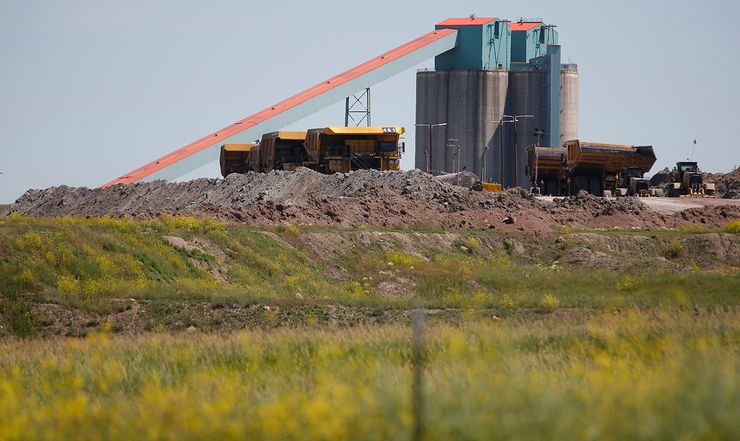
Coronavirus accelerates decline of slumping coal industry
Apr 19, 2020
The coal industry was already hurting before the coronavirus, and the pandemic has made things much worse
CHEYENNE, Wyo. (AP) — Travis Deti has been working the phones to try to get government support for the U.S. coal industry during the coronavirus pandemic. Between recent calls, the head of the Wyoming Mining Association tried to unclog a sink at home.
But unlike Deti’s sink, which eventually started flowing again with help from a plumber, aid remains stubbornly clogged for an industry whose already rapid decline is accelerating because of the economic effects of the virus.
“We’d take anything right now,” said Deti, whose group represents companies that produce about 40% of the nation’s coal.
Coal demand has tanked over the past decade amid competition from cheap natural gas and expanded renewable energy sources. Coal companies have faced a reckoning as the world looks to combat climate change and move away from fossil fuels despite President Donald Trump's effort to revive the industry.
Now, the pandemic has made things worse. Lockdowns have shut off lights and computers in offices and schools, sapping demand for electricity provided by coal-fired power plants. Americans stuck at home binge-watching Netflix aren’t coming close to making up for that drop in demand, expected to be 3% for 2020.
The safety of workers is another issue. In the most productive coal region in the U.S. — Wyoming and Montana’s Powder River Basin — companies are staggering shifts and running more buses to and from mining towns to create more space between workers.
Companies have temporarily suspended operations at mines in Pennsylvania, Illinois and Virginia to stop the spread of the virus. Some miners are only working two or three days a week.
“There is no consistency from mine to mine, even within the same company,” said Phil Smith, spokesman for the United Mine Workers of America, a union representing thousands of coal miners primarily in the eastern U.S.
Even before the virus, companies were forced into bankruptcy and workers faced furloughs and layoffs. Six of the top seven U.S. coal companies have filed for Chapter 11 bankruptcy since 2015 and analysts expect more as the economy dives.
There are bright spots, however. The worldwide decline in electricity consumption, along with less fuel being burned for transportation, has meant clearer skies. Particulate pollution is down almost 19% in India and 6% in China since before the outbreak, according to Fiona Burlig with the University of Chicago’s Energy Policy Institute. The decrease in the U.S. is a modest 0.5%.
The U.S. is expected to see a 7.5% drop in climate-warming greenhouse gas emissions tied to reduced production — that is until carbon dioxide emissions surge next year as the economy rebounds, according to projections by the Energy Information Administration.
But there is little doubt of the crushing effect of the virus's economic fallout on coal. In January, before the pandemic took hold in the U.S., coal production was forecast to drop 14% this year. With the coronavirus and a mild winter that meant less electricity needed to heat homes and businesses, that drop is now expected to be as much as 25% — falling to levels not seen in 55 years.
“It will simply be that renewables and gas will keep their market, and coal, being the more expensive fuel, is going to get pushed out even more than it would,” said Seth Feaster of the Institute for Energy Economics and Financial Analysis.
St. Louis-based coal company Foresight Energy, which employs 800 people, may be the industry's first coronavirus-related casualty. It filed for federal bankruptcy protection in March, citing in part “a slowdown in the global economy due to concerns over the coronavirus.”
The National Mining Association last month asked Congress and the White House for $822 million in federal assistance by reducing or eliminating royalties, taxes and fees.
“If we can stay operating, that’s the big thing for us," said Deti of the Wyoming group.
Congress has shown little willingness so far to help, and none of the industry’s requests were included in the $2 trillion coronavirus relief bill. Analysts doubt any significant aid will come.
“Typically, when you think about industries that the government has protected, it’s large, strategically vital industries,” said Benjamin Nelson, a senior credit officer with Moody’s Investors Service. “So, in an industry that’s in a steep, secular decline, I think there’s less incentive to get involved.”
One U.S. lawmaker from a coal state, Democratic Sen. Jon Tester of Montana, said mining companies could apply for relief but that there are bigger challenges for the economy than propping up coal corporations. The priority should be small businesses, he said.
“They are the ones that, quite frankly, we need to make sure are able to survive through this,” Tester said.
Even if the industry gets what it wants, the boost would be only temporary and leave the same fundamental problem: a lack of demand, said Feaster of the energy economics institute.
“Both royalty relief and tax relief depend on your ability to produce or make a profit,” Feaster said. “If there’s no demand and nobody wants to buy, that doesn’t really help you.”
___
Brown reported from Billings, Montana. Associated Press reporter Dylan Lovan contributed from Louisville, Kentucky.

India, Guatemala highlight coffee for global consumers at Seoul cafe show
Coffee brands, roasters, experts and authorities from around the world are gathering in Seoul for the 25th Seoul International Cafe Show, a four-day event that kicked off Wednesday. This year, India and Guatemala took part in one of the event’s flagship programs, Origin Discovery, showcasing their coffee traditions and explaining how their distinctive beans have won loyal followings among coffee lovers worldwide. Organized by the Coffee Board under the Government of India, a session titled Coffees of India introduced the country’s history of coffee cultivation, which dates back to the 1600s and reached its commercial zenith in the 18th century. Indian coffees, including Arabica, Robusta and Excelsa varieties, have been cultivated across Western Ghats — a biodiversity hotspot recognized by the UNESCO — as well as Eastern Ghats and Northeastern states. Amulya K.G., director of the Coffee Board and the host of the session, said there are 441,000 coffee farms in India, 99 percent of which are small holdings of less than 10 hectares. India is the world’s fifth largest coffee export

Luxury van market heats up in Korea as Mercedes-Benz joins rivalry with V-Class
Mercedes-Benz Korea has entered the nation's fast-growing luxury van market with the V-Class, intensifying competition in a segment previously dominated by Toyota’s Alphard and Lexus LM. The German luxury carmaker launched Wednesday the seven-seat V-Class as a single-trim model priced at 124 million won ($92,700), targeting customers looking for a premium vehicle that combines passenger capacity with a high level of comfort. The launch comes as demand for high-end vans grows in Korea, particularly among business executives, celebrities and families seeking more spacious and comfortable transportation. Toyota and Lexus have established a strong presence in the segment with their Alphard and LM models, respectively. The two brands have benefited from growing demand for premium multipurpose vehicles that offer more space and comfort than conventional luxury sedans and SUVs. The arrival of Mercedes-Benz is expected to intensify competition by giving consumers another premium option. The V-Class luxury van is only available for a diesel powertrain here. The V-Class is positioned as a more sp

Deutsche Bank urges Korean financial markets to match its companies' global reach
Deutsche Bank said Korea needs to improve financial market accessibility and regulatory predictability to attract more global capital, as its world-class companies continue to underpin the country's investment appeal. In a recent exclusive interview with The Korea Times, Alexander von zur Muehlen, Deutsche Bank's CEO of Asia Pacific, Europe, Middle East & Africa and Germany, said "few economies have produced such a concentration of globally competitive companies across strategically important industries" as Korea has. "The next step is to make its financial markets as international as its companies," said von zur Muehlen, who is also a member of the bank's management board. "Greater openness, simplicity and predictability can help broaden international participation." Korea has been opening its financial markets to global investors, introducing 24-hour foreign exchange trading in July. The country also allows foreign institutions to participate directly in its onshore foreign exchange market through the Registered Foreign Institution program, with Deutsche Bank among the first participa

Gov't to curb incumbents' influence over CEO selection process in sweeping corporate governance overhaul
The government is set to prevent incumbent CEOs at financial companies from having an undue influence on appointing their successors, while imposing tougher voting requirements for bank holding company chiefs who seek to extend their tenure, according to financial authorities, Thursday. The measures are part of a long-delayed corporate governance reform package unveiled by the Lee Jae Myung administration and the ruling Democratic Party of Korea (DPK), aimed at making leadership succession more transparent and strengthening board independence across the financial sector. The Financial Services Commission (FSC) plans to draw up amendments to the Act on Corporate Governance of Financial Companies within the year. The changes are expected to take effect six months after the legislation is passed. A central focus is to give independent directors greater control over leadership succession and strengthen their ability to hold management accountable. Under the proposed changes, committees responsible for nominating CEO candidates would consist entirely of independent directors. Sitting CEOs wou

Ramyeon exports set to rise 30% in 2027 on expanded production: sources
Korea's ramyeon exports are expected to increase 30 percent in 2027 from a year earlier, driven by expanded production capacity, industry sources said Thursday. Ramyeon shipments rose 26 percent to $1.59 billion in the January-October period, already surpassing last year's full-year growth rate of 22 percent and total exports of $1.52 billion, according to data from the trade ministry and other sources. "Major ramyeon makers' investments in production facilities are expected to continue driving export growth next year," an industry official said over the phone. Nongshim, Korea's leading instant noodle maker, began operations last month at its first plant dedicated to exports in the southern port city of Busan. The company currently generates about 40 percent of its total ramyeon sales from overseas markets, including the United States, China and Japan. It operates seven plants in Korea and six overseas facilities — two in the US and four in China — and sells flagship products such as Shin Ramyun, Chapagetti and Neoguri worldwide. Samyang Foods, known for its globally popular Buldak spi

Samsung, SK hynix monitor Nvidia leadership uncertainty: officials
Korean chipmakers Samsung Electronics and SK hynix are monitoring leadership uncertainty at Nvidia, one of their biggest clients, company insiders said Thursday. As the major suppliers of chips used in artificial intelligence (AI) accelerators, the two are assessing potential succession scenarios following reports that Nvidia's board is considering possible replacements for CEO Jensen Huang amid allegations of multiple extramarital affairs. Huang's close ties with Samsung Electronics Chairman Lee Jae-yong and SK Group Chairman Chey Tae-won have raised concerns that his possible departure could affect business relations. "If Huang is removed, it could inevitably affect networking among top industry executives," a company official said, requesting anonymity. "We cannot rule out the possibility that business discussions could slow or existing plans could change." Others, however, said existing supply agreements were unlikely to be affected, noting that the two companies have traditionally worked with Nvidia executives, including Senior Vice President Jeff Fisher, on detailed business plans.

Chip upcycle, easing oil-related pressures to boost consumption in 2027: KDI
The global semiconductor upcycle, coupled with easing pressure from higher oil prices, is expected to lead to stronger consumption next year, a state-run think tank projected Thursday. The outlook came amid assessments that this year's global chip upcycle, driven by the artificial intelligence (AI) boom, has had a limited impact on domestic consumption due to the gradual spillover of its benefits, while higher oil prices have weighed more immediately on the room for spending. "Next year, the negative impact of oil price hikes is expected to gradually weaken, while the positive impact of the chip upcycle spreads, leading to stronger consumption compared with this year," the Korea Development Institute (KDI) said in a report. The KDI said bonuses and dividends paid by major chipmakers could also provide additional momentum for domestic consumption, although geopolitical uncertainties in the Middle East may pose some downside risks. Amid the potential challenges, the KDI advised the government to refrain from measures aimed at stimulating short-term spending and instead focus on improving e

FTC approves combination of Jin Air, Air Seoul, Air Busan
The proposed merger of Jin Air, Air Busan and Air Seoul has cleared its final regulatory hurdle, paving the way for the three low-cost carriers (LCCs) to officially operate as a single carrier under the Jin Air brand beginning March 17, the nation’s antitrust authority said Thursday. Under the approvals by the Ministry of Land, Infrastructure and Transport and the Fair Trade Commission (FTC), the three carriers will be integrated through Jin Air's absorption of Air Busan and Air Seoul following Korean Air’s acquisition of Asiana Airlines. The approvals remove the major regulatory obstacles to the restructuring of Hanjin Group's airline business, following the planned launch of the integrated Korean Air as a full-service carrier on Dec. 17. Jin Air will assume the assets, liabilities, employees and legal status of the two other carriers. The combined airline will become Korea's largest LCC by fleet size, with about 58 aircraft in operation by the three carriers combined as of the end of 2025. It will combine the three carriers' routes, aircraft and operating infrastructure, with the a

Grand Korea Leisure earns top ESG rating for 3rd straight year
Grand Korea Leisure, the state-run operator of Seven Luck foreigner-only casinos, has earned an A rating for the third consecutive year in an annual evaluation of corporate environmental, social and governance (ESG) practices. The state-run casino operator, which runs the Seven Luck brand for foreign visitors, said Thursday it received an overall A grade in the 2026 ESG assessment announced Wednesday by the Korea Institute of Corporate Governance and Sustainability. The company also received A grades in all three individual categories: environmental protection, social responsibility and corporate governance. The annual assessment, conducted by the Korea Institute of Corporate Governance and Sustainability since 2011, evaluates listed companies on their sustainability management practices, with 1,022 companies included in this year's review. In the environmental category, Grand Korea Leisure was recognized for strengthening climate-risk management based on recommendations from the Task Force on Climate-related Financial Disclosures, improving its environmental management framework and red

Samsung Electronics breaks ground on new HBM packaging facility in Asan
Samsung Electronics broke ground on a new semiconductor packaging facility at its Onyang campus in Asan, South Chungcheong Province, Thursday as part of a 144 trillion-won ($108.4 billion) investment plan by the company and three affiliates to expand advanced manufacturing capacity in the region. The company held a groundbreaking ceremony at the campus, joined by President Lee Jae Myung, Executive Chairman Lee Jae-yong, Deputy Prime Minister Lee Hyeong-il, South Chungcheong Province Gov. Park Soo-hyun and about 100 executives and employees from Samsung and its partner companies. The new production line, aimed at beginning operations in June 2028, a year ahead of the original schedule, will expand the campus' role beyond conventional semiconductor assembly and testing to include advanced high bandwidth memory (HBM) packaging. "Through today's groundbreaking ceremony, we pledge to take another leap forward," Lee Jae-yong said. "This site, which has traditionally focused on simply assembling and testing conventional semiconductors, will become a leading hub for advanced HBM, the heart of A

CHA Bio Group head outlines vision for stem cells to fight diseases, extend life
Dr. Cha Kwang-yul, head of the CHA Global Research Institutes at CHA Medical Center and CHA Bio Group, outlined an ambitious vision to use stem cells to treat intractable diseases and potentially extend human lifespan, drawing global interest at an international conference in Busan. Cha delivered his keynote address, titled "Longevity and Reproductive Aging Using K-Cells," at the 16th World Congress of the International Society for Immunology of Reproduction, held Nov. 5-8, with about 400 participants attending. The presentation focused on K-Cell, a proposed cell resource intended to support the development of treatments for intractable diseases before expanding into research on aging and longevity. Cha outlined a donor-screening strategy that combines medical and infectious disease histories with age, clinical characteristics, three generations of family medical history and whole-genome sequencing to identify cells suited to specific therapeutic purposes. He also discussed genetic modification and somatic cell nuclear transfer, a technique that involves transferring the nucleus of a sel

KOGAS Q3 net profit soars 213.8% to $204.6 mil.
Korea Gas Corp. (KOGAS), Korea's natural gas monopoly, on Thursday reported its third-quarter net profit of 272.4 billion won ($204.6 million), a surge of 213.8 percent from a year earlier. Operating income for the July-September period was 587.8 billion won, up a sharp 51.1 percent from a year ago, the public utility company said in a regulatory filing. Revenue also rose 17.8 percent to 7.5 trillion won. The operating profit was 18.9 percent higher than the average estimate, according to a survey by Yonhap Infomax, the financial data firm of Yonhap News Agency. The estimate of net profit was not available.