
10 years after BP spill: Oil drilled deeper; rules relaxed
Apr 18, 2020
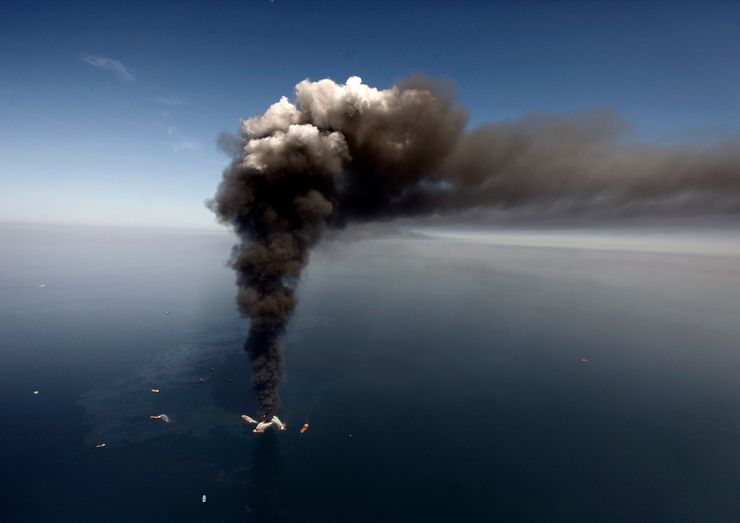
Ten years ago, an oil rig explosion killed 11 workers and unleashed an environmental nightmare in the Gulf of Mexico
NEW ORLEANS (AP) — Ten years after an oil rig explosion killed 11 workers and unleashed an environmental nightmare in the Gulf of Mexico, companies are drilling in deeper and deeper waters, where payoffs can be huge but risks are greater than ever.
Industry leaders and government officials say they’re determined to prevent a repeat of BP’s Deepwater Horizon disaster, which spilled 134 million gallons of oil that fouled beaches from Louisiana to Florida, killed hundreds of thousands of marine animals, and devastated the tourist economy.
Yet safety rules adopted in the spill’s aftermath have been eased as part of President Donald Trump’s drive to boost U.S. oil production. And government data reviewed by the Associated Press shows the number of safety inspection visits has declined in recent years, although officials say checks of electronic records, safety systems and individual oil rig components have increased.
Today, companies are increasingly reliant on production from deeper and inherently more dangerous oil reserves, where drill crews can grapple with ultra-high pressures and oil temperatures that can top 350 degrees (177 degrees Celsius).
Despite almost $2 billion spent by the industry on equipment to respond to an oil well blowout like BP’s, some scientists, former government officials and environmentalists say safety practices appear to be eroding.
“I’m concerned that in the industry the lessons aren’t fully learned — that we’re tending to backslide,” said Donald Boesch, a University of Maryland professor who was on a federal commission that found the BP blowout was preventable.
After the spill, oil giants created the Marine Well Containment Co., which has equipment and vessels ready to respond if another major spill occurs.
“All of industry wanted to make sure that nothing like it could ever happen again,” said company CEO David Nickerson at the company’s complex, near Corpus Christi on the Texas coast.
Industry leaders say the administration’s rule changes allow companies to deviate from “one-size-fits-all” standards not always suited to water pressure and other conditions at individual wells.
Companies also have a financial interest in avoiding a repeat of an accident that has cost BP more than $69 billion in cleanup expenses, fines, fees and legal settlements.
The rule changes under Trump, including less frequent safety tests, are projected to save energy companies $1.67 billion over a decade.
An AP review found inspection visits by the U.S. Bureau of Safety and Environmental Enforcement — created in the 2010 disaster’s aftermath — went down more than 20% over the past six years in the Gulf.
Bureau spokesman Sandy Day said government inspection data AP gathered reflects visits by inspectors to rigs, platforms and other facilities. But Day said the data doesn’t show electronic records reviewed remotely or the increased time spent at each facility and all the inspection tasks performed. Those, he said, have increased from 9,287 in 2017 to 12,489 last year.
“While on the facility we did numerous inspections of different items,” Day said, including equipment meant to prevent major accidents. He added that electronic records allow more work to be done from shore, rather than on site.
Industry advocates say the drop reflects greater emphasis on complex systems that influence safety and note that there are fewer, if much bigger, active oil platforms.
As wells close to shore run dry, the average drilling depth in deeper waters steadily increased, from about 3,500 feet (1,070 meters) beneath the surface in 1999 to more than 4,600 feet (1,400 meters) in 2019, according to AP analysis of data from the U.S. Interior Department’s Bureau of Ocean Energy Management.
Drilling deeper makes well sites harder to reach in a blowout or other accident.
In the past year, the industry began producing crude from ultra-high pressure reserves in the Gulf, where well pressures can top 20,000 pounds per square inch, much more than Deepwater Horizon.
“Higher risk, higher pressure, higher temperatures, more reliance on technology — it’s just a tougher environment to operate in,” said Lois Epstein, a Wilderness Society civil engineer who served on a government advisory committee formed to improve drilling safety after the spill.
The safety debate has recently centered on rules for keeping wells under control, such as requirements for blowout preventers that failed in the Gulf spill.
Under Obama, companies were required to test devices every 14 days. The Trump administration allowed companies upon approval to test every 21 days, saying more frequent testing would risk equipment failure under extreme conditions.
Inspection visits by the government’s safety bureau fell from 4,712 in 2013 to 3,717 in 2019, according to data reviewed by AP. The decline coincided with increased focus on higher risk facilities, including those with historical problems.
Warnings and citations to companies for safety or environmental violations peaked in 2012 and have since fallen faster than inspection visits. The decline accelerated under the current administration.
Fewer inspections and citations suggests safety improvements after the spill are unraveling, said Matt Lee-Ashley, formerly of the Interior Department.
Industry representatives contend fewer inspections do not automatically mean less effective oversight. Inspectors are less interested now about technical violations and are trying to make sure comprehensive safety systems are in place to handle major accidents, said Erik Milito, president of the National Ocean Industries Association, an oil trade group.
“There’s got to be an emphasis on your more significant potential incidents, potential blowouts,” Milito said.
Even if companies are prepared for another Deepwater Horizon, they could be overwhelmed by other types of incidents, such as of one of the Gulf’s frequent underwater mudslides wiping out a cluster of wellheads on the seafloor, said Florida State University oceanographer Ian MacDonald.
That could leave the blowout source buried under hundreds of feet of muddy debris, said MacDonald.
“Absent really extraordinary intervention and brand new engineering technology being built as you fly along, you’re not going to stop it,” he said.
___
Brown reported from Billings, Montana. Janet McConnaughey contributed to this story from New Orleans.
___
Follow Kevin McGill on Twitter: @mcgill56 and Matthew Brown on Twitter: @matthewbrownap

Hoban's rise gives Delta more leverage in Hanjin KAL power battle
Hoban Group’s rise as Hanjin KAL’s largest shareholder is giving Delta Air Lines greater leverage in the power struggle over Korean Air’s holding company as Chairman Cho Won-tae seeks to retain control. Hoban and its affiliates held a 20.69 percent stake in Hanjin KAL as of Wednesday, narrowly surpassing Cho and related parties at 20.58 percent. Cho has agreed to purchase another 325,000 shares for 37.05 billion won ($27 million), which could lift his side’s stake to 21.06 percent and restore its position as the largest shareholder. The increasingly close shareholding structure, however, has heightened the importance of major shareholders outside the two rival camps. Delta owns 14.9 percent of Hanjin KAL, while the state-run Korea Development Bank (KDB) holds 10.58 percent. Together with Cho’s stake, the three parties account for about 46 percent of Hanjin KAL. Excluding KDB from consideration for any future Korean Air deal due to its unique status as a public financial institution, Delta is emerging as an unexpected beneficiary of the renewed power struggle between Cho and Ho

Battery materials firms ramp up LFP capacity amid rising demand
Battery materials makers are accelerating their expansion into lithium iron phosphate (LFP) materials, as growing demand for energy storage systems (ESS) and non-Chinese supply chains in North America fuels competition to secure production capacity. LFP cathode supply commitments between domestic battery cell makers and materials suppliers are estimated to exceed 210,000 metric tons, according to industry estimates, prompting manufacturers — POSCO Future M, L&F and EcoPro BM — to step up investments. POSCO Future M is expanding its LFP capacity by converting part of its existing high-nickel cathode production lines at its Pohang plant. The company plans to increase annual capacity from about 20,000 tons to as much as 105,000 tons by the end of next year. It also plans to utilize up to 50,000 tons of capacity from CNP New Material Technology, a joint venture with CNGR and Fino. Following a 1.07 trillion won ($784.5 million) LFP cathode material supply deal with SK On in September, POSCO Future M signed another long-term supply contract worth about 6 trillion won with Samsung SDI last

Innospace to launch upgraded suborbital rocket in Brazil on Nov. 29
Korean space startup Innospace said Monday it plans to launch its upgraded multipurpose suborbital rocket, Sebit, in Brazil on Nov. 29, following an unsuccessful maiden test flight in August. The company has secured a 26-day launch window from Nov. 16 to Dec. 11 at the Alcantara Launch Center in Brazil, in coordination with state-owned aerospace company ALADA, the Brazilian Air Force and the Brazilian Space Agency. The final launch date and time will be determined based on weather conditions, launch readiness and other operational factors. Sebit is a multipurpose suborbital rocket designed to provide commercial testing and validation services. The single-stage rocket is powered by a 4-ton-class hybrid engine and measures 8.7 meters in length and 0.7 meters in diameter. The upcoming flight will mark Sebit's second test launch following a series of technical upgrades aimed at improving its propulsion and flight stability. The improvements include increasing engine thrust from the 3-ton class to the 4-ton class and redesigning the flight control algorithm. The upgrades follow an unsuccessful

Samsung Bioepis' Keytruda biosimilar demonstrates equivalence in global Phase 3 trial
Samsung Bioepis said Monday that its proposed biosimilar SB27 demonstrated comparable efficacy and safety to Keytruda, a blockbuster cancer immunotherapy drug that was the world's best-selling pharmaceutical product last year, in a global Phase 3 clinical trial. According to the company, it announced the Phase 3 clinical study results at the Society for Immunotherapy of Cancer Annual Meeting 2026 held in Phoenix, Arizona, from Nov. 4 to 8. Keytruda, developed by U.S. pharmaceutical company MSD, is a cancer immunotherapy drug that binds to programmed cell death protein 1 (PD-1), an immune checkpoint receptor, helping the immune system attack cancer cells. It was the world's best-selling drug last year, generating approximately 46 trillion won ($31.7 billion) in global sales. The Phase 3 study, which began in 2024, involved 555 patients with metastatic nonsquamous non-small cell lung cancer across 14 countries, comparing SB27 with the original drug in combination with standard chemotherapy. In the study, SB27 met its primary endpoint by demonstrating an equivalent objective response rate t

Samyang's employee-led YouTube channel tops 2 mil. views in 3 months
Samyang Roundsquare, the parent company behind the Buldak spicy instant noodle maker Samyang Foods, said Monday its YouTube channel samyangman has surpassed 2 million cumulative views about three months after its launch in August. The channel airs “Fire or Fired,” an original series from BURNT, the company’s spicy food content brand. The show follows Tony, a Samyang employee who struggles with spicy food, as he tries fiery local dishes in New York, Texas, Los Angeles and other parts of the United States. Tony is what Koreans jokingly call a “maepjjiri,” slang for someone with a low tolerance for spicy food. Instead of hiring celebrities or influencers, the company cast its own employee, who interacts with locals on camera. The seven episodes released so far have drawn more than 2.18 million views as of Sunday. The most-watched episode, featuring a visit to Samyang America, the company’s U.S. subsidiary, logged 770,000 views, followed by episodes filmed in Nashville, Tennessee, and New Mexico. Viewers in the United States accounted for about 45 percent of total views, while th

CJ Olive Young to open 5 more US stores by mid-2027, expanding to San Diego
CJ Olive Young, Korea’s largest health and beauty store chain, will open five more stores in California by the first half of 2027, bringing its U.S. total to seven, the company said Monday. The retailer opened its first U.S. store in Pasadena in May and a second at Westfield Century City in Los Angeles in June. Four of the new stores will be in the greater Los Angeles area: Spectrum Center, a lifestyle shopping center in Irvine; Del Amo Fashion Center in the South Bay area; Bloom on 3rd, a shopping complex near the Farmers Market in central Los Angeles; and Brea Mall in Orange County. The fifth will open at Fashion Valley in San Diego, its first outside the Los Angeles area. Opening dates for each store have not been set. Three of the sites — Del Amo Fashion Center, Brea Mall and Fashion Valley — are operated by Simon Property Group, a major U.S. mall owner. The company said the expansion will help small and independent Korean cosmetics brands, collectively known as K-beauty, reach American consumers without their own distribution networks. Olive Young said its stores also introduce

Hanwha Aerospace to conduct ship-based Chunmoo missile tests in US
Hanwha Aerospace said Monday its U.S. subsidiary plans to conduct two test-firings of missiles from its Chunmoo multiple rocket launcher system in the United States as part of its effort to adapt the land-based system for naval use. The missiles will be launched from a vessel off the southern U.S. coast later this month to assess the system's suitability for shipboard deployment. The tests follow an April agreement between Hanwha Defense USA (HDUSA) and Florida-based Magnet Defense to develop a containerized Chunmoo launcher for the H38 medium unmanned surface vessel (MUSV). HDUSA has been expanding its presence in the U.S. maritime defense market. It is in talks to acquire Austal USA, the U.S. subsidiary of Australian shipbuilder Austal, with negotiations under way over key terms of the deal. Last month, HDUSA secured a $269 million contract from shipbuilding management company TOTE Services to build a medium landing ship for the U.S. Navy and Marine Corps. The deal came two years after Hanwha acquired Philly Shipyard in 2024, marking another step in its U.S. shipbuilding expansion.

Hyundai Motor's HTWO teams up with Air Liquide to expand hydrogen mobility in China
Hyundai Motor Group said Monday its hydrogen business brand HTWO will partner with French industrial gas company Air Liquide to expand hydrogen-powered mobility in China. HTWO Guangzhou, the Korean automotive group's first overseas hydrogen fuel-cell system manufacturing base, signed a cooperation agreement with Air Liquide China on the sidelines of the China International Import Expo 2026, which opened in Shanghai last week. Under the agreement, the two companies will combine HTWO Guangzhou's hydrogen fuel-cell system technology with Air Liquide's expertise in hydrogen production, storage, transportation and infrastructure development. The partnership is aimed at accelerating the adoption of hydrogen-powered vehicles in China by integrating fuel cell technology with the hydrogen supply and refueling infrastructure.

Troubled broadcaster JTBC to select preferred bidder in January
Debt-ridden Korean broadcaster JTBC plans to select a preferred bidder in January, the company said Monday, putting up its official notice for the envisioned sale. The sale will be conducted through an open competitive bidding process through the injection of external capital, EY Hanyoung, the accounting firm advising the sale, said in the notice. Potential bidders can submit their letter of intent over the next four weeks. JTBC said it will conduct the sale in a "transparent and fair" manner in accordance with relevant laws and rehabilitation court procedures. "Through the merger and acquisition, we hope to establish a sustainable base for growth and strengthen content and channel competitiveness," the broadcaster said. The sale notice came some two months after the Seoul Bankruptcy Court approved JTBC's request to begin rehabilitation proceedings in late August, allowing the company to restructure its debts under court supervision.

Woowa Brothers, Coupang face $465 mil. in fines for abusing delivery market dominance
Woowa Brothers and Coupang have been slapped with a combined 631.9 billion won ($465 million) in fines for abusing their dominant positions in Korea’s food delivery market by forcing affiliated restaurants to offer consumers prices and promotional terms at least as favorable as those available through competing channels. The Fair Trade Commission (FTC) said Monday it has decided to order the companies to rectify the unfair practices and impose provisional fines of 331.1 billion won on Woowa Brothers, the operator of Baemin, and 300.8 billion won on Coupang, which operates Coupang Eats. The two platforms account for more than 90 percent of the nation’s food delivery market share. According to the regulator's investigation, both companies abused their market power to impose so-called most-favored-nation (MFN) requirements on restaurants, restricting their ability to offer different prices, discounts and other terms through competing delivery platforms. The FTC said the practices made it difficult for restaurants to establish more favorable conditions on rival platforms and weakened co

KT opens coveted gold-number lottery to customers across carriers
KT is opening its latest gold-number lottery to mobile phone users across Korea, giving customers of rival carriers and budget phone services a chance to secure sought-after numbers such as 1111, 1234 and 1004. KT said Monday it would hold a drawing for mobile phone numbers considered particularly desirable because they are easy to remember or carry special meanings. The company is offering 155 categories of preferred numbers, including AAAA patterns, in which all four digits are identical, such as 1111 and 2222, and ABCD patterns featuring consecutive digits, such as 1234 and 5678. Numbers with particular meanings, including 1004 and 2580, are also included in the selection. Each applicant can enter the drawing for up to three numbers, KT said. Applications can be submitted at KT stores nationwide, through KT's website or via its My KT mobile application. Participation is not limited to KT subscribers, with customers using other mobile carriers and mobile virtual network operators, commonly known as MVNOs, also eligible to enter. The expanded eligibility gives mobile phone users across dif

KT&G targets Central Asia with launch of FLEX in Kazakhstan
KT&G, Korea’s leading tobacco maker, is expanding its next-generation product footprint in Central Asia by launching its FLEX heated tobacco device and FAIIM sticks in Kazakhstan. The Korean tobacco company said it introduced the products in October, marking its direct entry into Kazakhstan's heated tobacco market. FLEX and FAIIM are locally branded versions of KT&G's lil AIBLE device and AIIM tobacco sticks, which are already sold in Korea, adapted for the local market. The products are initially available only in Almaty, Kazakhstan's largest city, with KT&G planning to expand distribution channels gradually. The company is also operating a FLEX flagship store at Forum Mall, a major shopping center in Almaty, to strengthen its connection with local consumers. The store will offer brand information, customer consultations and other services designed to help consumers better understand the products and experience the brand. The launch forms part of KT&G's broader strategy to expand its next-generation products (NGP) business internationally after establishing an independent commercializat