
What Is a Realistic MOQ for Custom Commercial Gym Equipment?
Sep 16, 2026
Nantong, Jiangsu Sep 15, 2026 (Issuewire.com) - When a boutique gym owner in Southeast Asia needed 15 branded leg press machines last year, the first three suppliers quoted minimum orders of 50 units each. The fourth offered a tiered approach starting at just 5 pieces for standard models. That range -- from 5 to 50 or more -- highlights why understanding the MOQ for custom commercial gym equipment matters before signing any purchase agreement.
Minimum order quantity is not just a number on a quote sheet. It reflects tooling costs, production line setup, raw material procurement, and container loading efficiency. For buyers entering the commercial fitness market or expanding an existing facility chain, knowing what counts as a realistic threshold can prevent overstocking, reduce capital risk, and ensure product quality remains consistent across every unit delivered.
Why a Lower MOQ Is Not Always the Better Deal
A common misconception among first-time importers is that the lowest possible MOQ automatically represents the best value. In practice, extremely low minimums sometimes signal compromises elsewhere -- thinner steel tubing, simplified welding, or generic powder coating that chips within months of heavy use.
Commercial gym equipment endures thousands of repetitions daily. Structural integrity depends on proper material selection, precision welding, and durable surface treatment. When a factory accepts an order of just one or two units at a suspiciously low price, buyers should ask how fixed costs like mold amortization, jig setup, and quality inspection are being absorbed. Often, those costs get hidden in inflated per-unit pricing or reduced finishing standards.
A realistic MOQ balances production economics with buyer flexibility. It should be low enough to test a supplier relationship without forcing a warehouse full of untested inventory, yet high enough that the manufacturer can maintain consistent craft standards across the batch.
How MOQ Varies Across Equipment Categories
Not all commercial gym equipment carries the same production complexity, and minimum order thresholds reflect those differences.
- Strength Training Machines
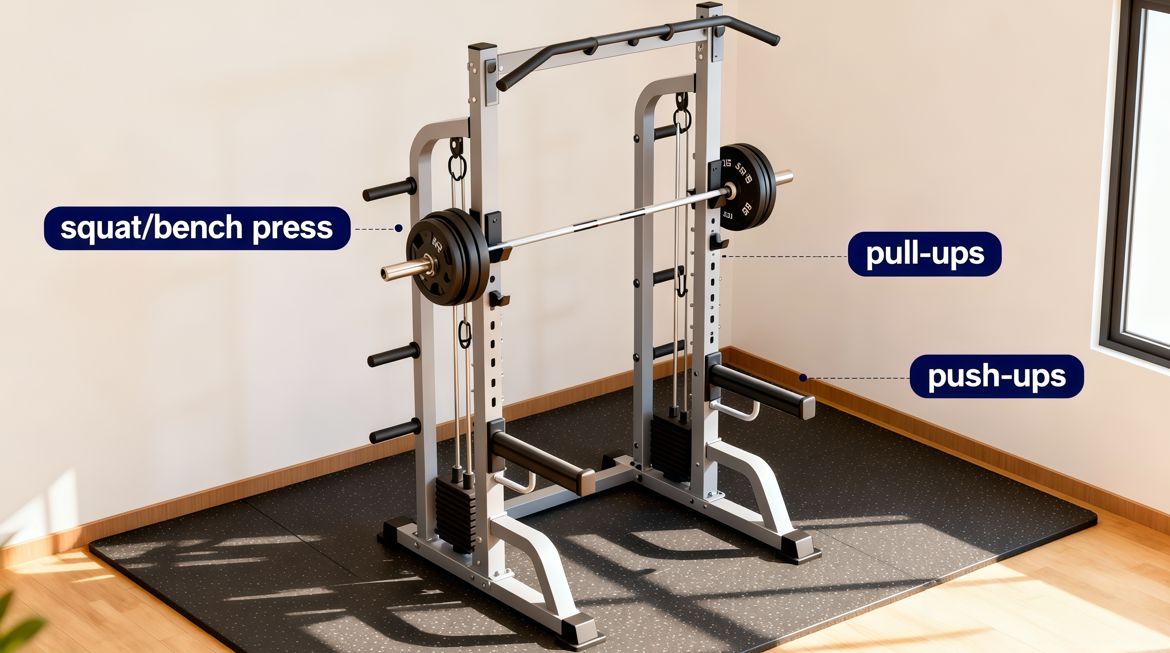
Pin-loaded and plate-loaded strength stations involve heavy steel frames, multi-point welding, cable routing, pulley systems, and upholstery. Setup for these machines requires dedicated jigs and fixtures. A typical MOQ fitness equipment benchmark for strength stations ranges between 5 and 20 units per model, depending on whether the design is catalog-standard or fully custom.
- Cardio Equipment
Treadmills, ellipticals, and stationary bikes incorporate electronic components, motors, and console assemblies alongside mechanical parts. The electronics sourcing alone often dictates higher minimums -- usually 20 to 50 units -- because component suppliers themselves impose batch requirements.
- Free Weights and Benches
Dumbbells, barbells, weight plates, and adjustable benches have simpler structures but rely heavily on casting, machining, or rubber molding processes. Customization here typically involves logo engraving, color variations, or dimensional adjustments. MOQ for these items can start as low as 50 to 100 pieces for standard shapes, or 10 to 30 units for specialized bench configurations.
- Packaging and Shipping Considerations
Container loading also influences realistic minimums. A 40-foot container holds roughly 8 to 12 multi-station machines or 25 to 40 benches. Suppliers often align MOQ suggestions with efficient container fill rates to minimize per-unit freight costs for the buyer.
A Tiered Approach in Practice: How Senfeng Structures Its Minimums
Nantong Senfeng Sports Products Co., Ltd. with over eight years of OEM and ODM production experience, applies a graduated MOQ system that reflects actual production realities rather than arbitrary thresholds.
For standard catalog models of custom commercial gym equipment, Senfeng sets a baseline of 5 units per model. This covers basic production setup costs while giving buyers enough volume to evaluate build quality, finish consistency, and packaging durability across multiple pieces.
When customization enters the picture -- such as specific RAL color matching, laser-engraved logos, or dimensional modifications to seat heights and arm lengths -- the minimum rises to 10 units per customized specification. This increase accounts for additional setup time in the powder coating line, programming adjustments on CNC equipment, and separate quality control checkpoints for non-standard dimensions.
For buyers placing combined orders across multiple equipment categories, Senfeng offers negotiated terms that can bring effective per-model quantities below standard thresholds. A gym outfitter ordering 8 different machine types might negotiate 5 to 8 units each, reaching a combined container volume that justifies the production run economically.
Sample lead time runs 7 to 10 days, allowing buyers to physically inspect weld quality, coating adhesion, and mechanical function before committing to bulk production. Full production orders typically ship within 25 to 35 days from confirmation, a timeline that accounts for steel cutting, welding, surface treatment, assembly, and pre-shipment inspection.
What Enables Competitive Minimums Without Quality Compromise
Low MOQ fitness equipment offers only matter when backed by production infrastructure capable of maintaining standards at smaller batch sizes. Several structural factors determine whether a manufacturer can deliver on that promise.
Senfeng operates a self-owned factory rather than subcontracting production to third parties. This vertical integration means scheduling flexibility -- small orders slot into production gaps between larger runs without requiring separate facility coordination or markup layers.
Eight years of continuous OEM and ODM output have generated standardized workflows for common customization requests. Color changes, logo placement, and dimensional adjustments follow documented procedures rather than requiring engineering improvisation each time. This repeatability keeps setup costs manageable even at lower volumes.
Certification infrastructure also plays a role. Senfeng maintains CE and ISO certification, which means quality management systems operate continuously regardless of order size. Every batch -- whether 5 units or 500 -- passes through the same inspection protocols before shipment. Weld penetration checks, coating thickness measurements, load-bearing tests, and dimensional verification apply uniformly.
A dedicated after-sales team handles issues that arise post-delivery, which reduces buyer risk on trial orders. Knowing that warranty support and technical assistance remain available regardless of order volume encourages smaller initial commitments.
Three Steps to Start a Trial Order
For buyers ready to evaluate a supplier of commercial gym equipment through a manageable first purchase, a straightforward process reduces friction.
- Select target models from the supplier catalog or submit reference designs. Senfeng accepts both standard product selections and custom drawings for quotation.
- Submit specific customization requirements including preferred colors, logo files, dimensional changes, and target quantities. The 24-hour response commitment with replies typically within 2 hours keeps the quotation cycle short.
- Request a sample order to physically assess construction quality before scaling up. The 7-to-10-day sample timeline means evaluation can happen within a few weeks rather than months.
This phased approach lets buyers verify weld consistency, paint durability, packaging protection, and shipping logistics on a small scale. Once a trial order confirms that the supplier meets expectations, subsequent orders can expand in both volume and customization complexity with confidence built on actual evidence rather than promises alone.
Understanding the realistic MOQ for custom commercial gym equipment removes guesswork from supplier selection. The right minimum protects both parties -- giving the manufacturer enough volume to maintain craft standards while giving the buyer enough flexibility to manage inventory risk and validate quality firsthand.
For detailed product specifications, factory photos, and direct consultation on custom orders, please visit: https://senfengfitness.com/
Media Contact
Nantong Senfeng Sports Products Co., Ltd
+86 19514497849
Source :Nantong Senfeng Sports Products Co., Ltd
This article was originally published by IssueWire. Read the original article here.

Fathers take on more, but mothers still bear heavier domestic workload
For a 33-year-old bank employee surnamed Jung raising a 3-year-old son in Seoul’s Yeongdeungpo District, coming home from work feels like starting a second shift. She uses a reduced working hours program for parents to leave work an hour or two early. Once her mother-in-law, who looks after the child while the couple are at work, heads home, Jung handles child care alone until her husband returns. “As soon as I get home, I feed my son dinner, bathe him and play with him. By then, my husband is home,” she said. “While he plays with our son, I finally get to shower, wash the dishes and tidy up. Then it’s time to put our son to bed.” Jung gets her first chance to sit down on the sofa after her son falls asleep, past 10 p.m. “Even though I leave work early, it feels like I work overtime every day,” she said. “My husband does quite a lot of child care, but our son tends to seek me out more, and I feel that a larger share of the housework naturally falls to me.” Government figures released Monday show that an uneven division of domestic duties persists among young working pa

Gov't, businesses team up to help retired detection dogs find new homes
The Ministry of Agriculture, Food and Rural Affairs last week joined Trinity Airways and Sono Pet Clubs & Resorts for a two-day pet adoption program, combining government support for retired detection dogs with private-sector assistance in event planning, accommodation and training. The Animal and Plant Quarantine Agency under the ministry provided guidance on adoption procedures and answered prospective owners’ questions. Trinity Airways, formerly T’way Air, organized the program, held Saturday and Sunday, while Sono Pet provided spaces for families and dogs to interact and rest, along with professional training support. Held at Sono Pet’s Vivaldi Park in Hongcheon, Gangwon Province, the program brought together three retired quarantine detection dogs and three prospective adoptive families selected through a screening process, according to the agency. The dogs were two English springer spaniels, aged 7 and 9, and a 9-year-old beagle. Activities included running together, treasure hunts and walks, giving participants opportunities to interact with the dogs. A trainer specializing

Finda to become 1st fintech firm to acquire savings bank
Finda, a loan comparison platform, is set to acquire a savings bank, in what would be a first for a Korean fintech company, as it looks to build an artificial intelligence (AI)-native bank, industry officials said Monday. The Financial Services Commission's subcommittee approved Finda's application to acquire Daewon Savings Bank on Friday. The regulator is set to make a final decision at its regular meeting Wednesday. Finda signed a deal in June to acquire all of Daewon Savings Bank's shares for about 12 billion won ($9 million). The acquisition would allow the company to move beyond matching borrowers with lenders and offer financial services directly, including loans and deposits. Once the deal receives final approval, Finda plans to appoint a new CEO through board and shareholder meetings. The fintech firm aims to turn the lender into an AI-native bank, relying on digital services rather than a traditional network of branches. It plans to draw on AI technology and loan-comparison data it has collected since 2019 to expand its online lending business nationwide, the firm said. The compa

Hyundai Rotem to acquire Hyundai Wia's defense unit for $252 mil.
Hyundai Rotem, a defense affiliate of Hyundai Motor Group, said Monday it will acquire Hyundai Wia's defense business for 358.4 billion won ($252 million) to strengthen its weapons production capabilities. Hyundai Rotem said in a regulatory filing that it plans to acquire Hyundai Wia's defense business, which manufactures key components for Korea's K9 self-propelled howitzers and K2 main battle tanks. The acquisition is expected to boost Hyundai Rotem's competitiveness in the global market by bringing more of its weapons production capabilities in-house, particularly for its flagship K2 tanks. In August 2025, the company signed a $6.5 billion follow-up contract to supply K2 tanks to Poland. Five months later, it reached a comprehensive agreement with Peru to supply 195 ground weapons systems, including 54 K2 tanks. For Hyundai Wia, the sale is part of broader restructuring efforts to shift its focus toward future mobility technologies, including vehicle electrification and software-defined vehicles (SDVs). The company plans to use the proceeds from the sale to invest in new growth areas,

Global AI & Digital Summit kicks off 3-day run in Seoul
A global event aimed at exploring how artificial intelligence (AI) and digital transformation can deliver practical development gains kicked off its three-day run in Seoul on Monday, the science ministry said. The Global AI & Digital Summit, co-hosted by the ministry and the World Bank Group — a family of five institutions that makes leveraged loans to developing countries —brought together government officials from some 60 nations, as well as development partners, private sector leaders and researchers. This year marks the first time the summit was held outside of the United States, the ministry added. The event will begin with an AI and Digital Ministerial meeting, co-chaired by Science Minister Bae Kyung-hoon and Kim Sang-bu, the vice president for digital and AI at the World Bank Group, followed by policy forums and exhibitions from participating companies. Korea has been hosting the AI and digital ministerial meeting since 2005, with the most recent gathering held last year on the sidelines of the Asia Pacific Economic Co-operation (APEC) forum. Second Vice Science Minister Ryu J

Points beat percentages: Why three in four Singaporeans think their spare cash is underperforming
A Singaporean who will argue over a 50-cent difference in cashback at a hawker centre may have no idea what their savings account pays. New research suggests that person is the norm. Some 89 per cent of Singapore residents hold spare cash, according to a survey of 1,000 people conducted by research firm Milieu. Among […] The post Points beat percentages: Why three in four Singaporeans think their spare cash is underperforming appeared first on e27.

Singapore employers say they offer burnout support. Half their staff say they’ve never seen it
Many Singapore companies offer a peculiar kind of workplace benefit: one that exists mostly in the HR handbook. Managers will tell you it is there. Employees, asked the same question, will tell you they have never come across it. That gap sits at the centre of the Jobstreet by SEEK Singapore Workplace Culture Study 2026. […] The post Singapore employers say they offer burnout support. Half their staff say they’ve never seen it appeared first on e27.

Will the upcoming Federal Reserve meeting crush the bullish push toward the US$84,000 target?
Global financial ecosystems present a fascinating landscape today, as virtual currencies are in a modest recovery phase. Bitcoin leads this upward trajectory, up 0.94 per cent over the past 24 hours. The premier cryptocurrency trades at exactly US$82,204.31. This price action slightly outperforms a broadly flat digital asset sector. The total cryptocurrency capitalisation registers a […] The post Will the upcoming Federal Reserve meeting crush the bullish push toward the US$84,000 target? appeared first on e27.

Beyond play-to-earn: 14 Southeast Asian gaming and sports-tech startups still in the game
Southeast Asia has spent the last decade trying to turn its obsession with play into businesses. Some bets worked spectacularly, some blew up just as spectacularly, and a surprising number of the best ones never raised much venture money at all. The Web3 gaming boom of 2021 is the cautionary tale everyone remembers: blockchain games, […] The post Beyond play-to-earn: 14 Southeast Asian gaming and sports-tech startups still in the game appeared first on e27.

Gen Z is bringing its own AI to work. Singapore’s SMEs need rules, not bans
Young workers in Singapore are not waiting for their employers to roll out AI. They are already using it, often on personal devices and often without anyone watching. According to “What Gen Z Workers Want 2026”, a study commissioned by Deel and conducted with YouGov and ThinkerTank, 49 per cent of Singapore workers aged 18 […] The post Gen Z is bringing its own AI to work. Singapore’s SMEs need rules, not bans appeared first on e27.

When AI takes your side in a workplace conflict
Workplace conflict rarely arrives as a clean set of facts. By the time we decide that a manager is undermining us, a colleague is being deliberately difficult, or someone on the team cannot be trusted, we have usually spent some time interpreting what happened. We have noticed particular behaviours, connected them with earlier experiences, filled […] The post When AI takes your side in a workplace conflict appeared first on e27.

Faster, smarter, but more fragile? Rethinking communications resilience in Southeast Asia
Southeast Asia has spent the past decade moving rapidly towards a more connected future. Fibre networks have replaced much of the region’s older copper infrastructure, smartphones have become the primary gateway to services, and communications, payments, government functions and commerce have increasingly shifted online. That transition has brought enormous benefits, but it has also created […] The post Faster, smarter, but more fragile? Rethinking communications resilience in Southeast Asia appeared first on e27.


Hyundai Rotem Q3 net down 10.3% to $133.9 mil
YOUR NEWS, OUR NETWORK.
Do you have Great News you want to tell the world?
Be it updates about your business or your community, you can make sure that it’s heard by submitting your story to our network reaching hundreds of news sites across 6 verticals.