
What Defines a Reliable Heavy-Gauge Stainless Steel Soup Pot Manufacturer in the Current Market?
Sep 9, 2026
Chaozhou, Guangdong Sep 8, 2026 (Issuewire.com) - Commercial kitchens -- from hotel banquet operations to hospital catering facilities -- place exacting demands on cookware performance. Soup pots must hold temperature across extended service windows, survive repeated thermal cycling, and endure daily industrial washing without surface degradation. Against this operational backdrop, identifying a Reliable Heavy-Gauge Stainless Steel Soup Pot Manufacturer stands as one of the more consequential decisions a procurement team makes. The market offers no shortage of suppliers. Most present near-identical product catalogs and pricing structures, making differentiation difficult without structured evaluation criteria. This FAQ addresses the questions procurement professionals raise most frequently -- and offers a practical framework for assessing supplier answers critically, rather than accepting marketing claims at face value.
Q1: What Makes a Heavy-Gauge Stainless Steel Soup Pot, and Why Does Wall Thickness Matter for Commercial Use?
A high-performance soup pot achieves superior thermal retention through a precision-engineered, extra-thick single-wall construction. The increased wall thickness functions as a thermal buffer, slowing the rate of heat transfer from the inner cooking surface to the exterior environment. The outcome is significantly extended heat retention compared with standard thin-gauge designs. For hotel kitchens managing buffet lines or extended banquet operations, that thermal retention cuts reheating frequency, reduces energy costs, and preserves broth consistency across service periods. The 3.0 Series Stock Pot from Chuangfa (Chaozhou Chao'an District Hongfa Hardware Industrial Co., Ltd.) illustrates this category clearly -- a commercial-grade stainless steel soup pot engineered for daily high-volume kitchen environments. Critically, not all thick-wall construction performs equally. The determining factor is wall thickness uniformity. Uneven gauge distribution creates localized weak points that reduce overall thermal performance and accelerate mechanical wear during repeated heating cycles. Procurement teams should treat consistent wall thickness as a primary evaluation criterion, not a footnote in product descriptions.
Q2: How Can Buyers Verify Insulation Performance Before Placing a Full Production Order?
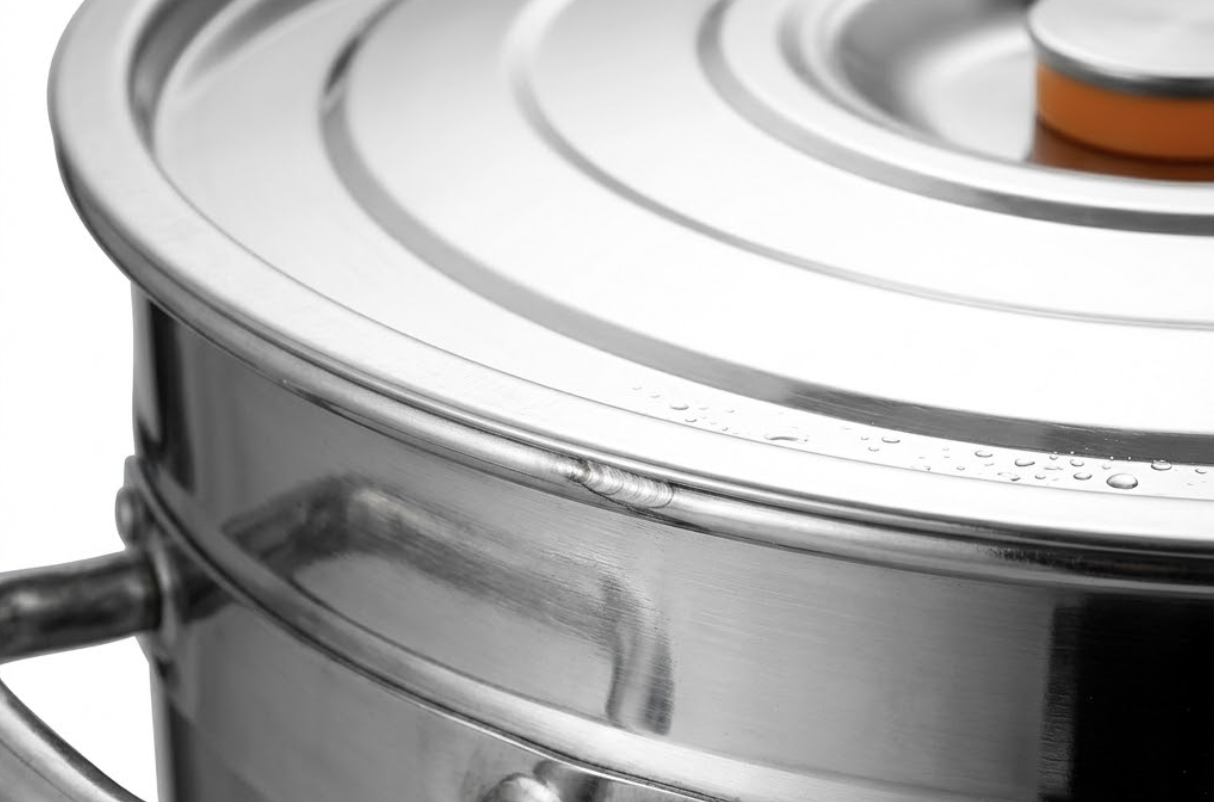
Verifying thermal retention performance does not require a laboratory setup. A practical test involves filling the pot with water at 90 degrees Celsius, sealing it with a fitted lid, and measuring temperature at 30-minute and 60-minute intervals under ambient conditions of around 20 to 22 degrees Celsius. A well-constructed heavy-gauge pot retains above 70 degrees Celsius at the 60-minute mark. Beyond this field test, sourcing teams should request die cross-section drawings to confirm wall thickness uniformity across the full pot body. Weld integrity at rim and handle attachment points also merits close inspection. These joints absorb the highest thermal stress and represent the most frequent structural failure zone in extremely thick cookware under extended use.
Chuangfa manages cold-rolled coil processing as part of its own production infrastructure. Wall thickness consistency therefore develops at the raw material stage -- not as a corrective step during finishing. This upstream discipline gives procurement teams a more dependable foundation for batch-to-batch dimensional stability, which is particularly important for hospitality accounts placing repeat orders across multiple seasons.
Q3: What Steel Grade Should Commercial Soup Pots Use, and How Do Buyers Distinguish Between Grades?
Grade 304 stainless steel carries approximately 18% chromium and 8% nickel by composition. This alloy structure delivers reliable resistance to corrosion from acidic food contents, saline broths, and commercial-grade detergents used in industrial dishwashing systems. Grade 201 substitutes manganese for nickel, reducing material cost but also reducing corrosion resistance measurably. For soup pots holding salt-based broths through extended service periods, this performance gap becomes visible within months of regular use. A simplified field screening method helps buyers conduct a first-pass check: a drop of diluted hydrochloric acid on 201 steel produces visible surface discoloration within minutes, while grade 304 resists the reaction. This check supplements -- rather than replaces -- formal XRF spectrometry during supplier qualification. Chuangfa's soup pot range includes both 201 and 304 grade options, allowing buyers to align material selection with end-use context and the compliance standards of their target export market.
Q4: What Does Genuine OEM Capability Look Like, and How Does It Differ From Catalog Reselling?
The gap between authentic OEM manufacturing and catalog reselling carries real procurement consequences. Genuine OEM capability means adjusting tooling at the die level -- modifying pot depth, wall thickness, handle geometry, or lid profile to satisfy a specific operational requirement. Catalog resellers apply branding to existing standard stock without modifying the underlying tooling. The clearest signal of real OEM capability is a structured, milestone-based production process with documented handoffs at each stage. Chaozhou Chao'an District Hongfa Hardware Industrial Co., Ltd. follows a seven-step OEM workflow: requirement submission, sample mapping, requirement confirmation, contract signing, proofing production, quality inspection, and shipment. For procurement managers overseeing venue-specific configurations -- such as hospital nutrition services requiring sealed lids with precise handle clearances, or hotel banquet operations needing stackable format compatibility -- this tooling flexibility directly determines whether a manufacturer can genuinely serve the account or only approximate its requirements. The company's product portfolio spans over 200 series and nearly 2,000 individual items, reflecting ongoing die investment rather than a static third-party catalog.
Q5: How Does Vertical Integration Affect Consistency Across Repeat Orders?
Batch-to-batch consistency is a frequently overlooked procurement risk in cross-border sourcing. Factories relying on spot market coil suppliers introduce material variability between production runs. Wall thickness, surface texture, and alloy composition can all shift between orders -- sometimes remaining undetected until post-delivery quality checks reveal the discrepancy. A vertically integrated manufacturer processes its own raw coil, maintaining material traceability through every production batch. Buyers can then request coil batch records linked to specific shipment references, building an auditable material history across the supply relationship. Chuangfa operates six dedicated production lines within a 100,000-square-metre facility in Caitang Town, Chaozhou. Production scope covers cold-rolled steel coil, wire drawing, mould heat treatment, industrial furnace components, and finished kitchenware. This structure places raw material input and finished export product under a single accountability framework -- eliminating the quality variables that accumulate across multi-supplier networks.
Q6: What Should Procurement Managers Confirm Before Approving a Soup Pot Manufacturer?
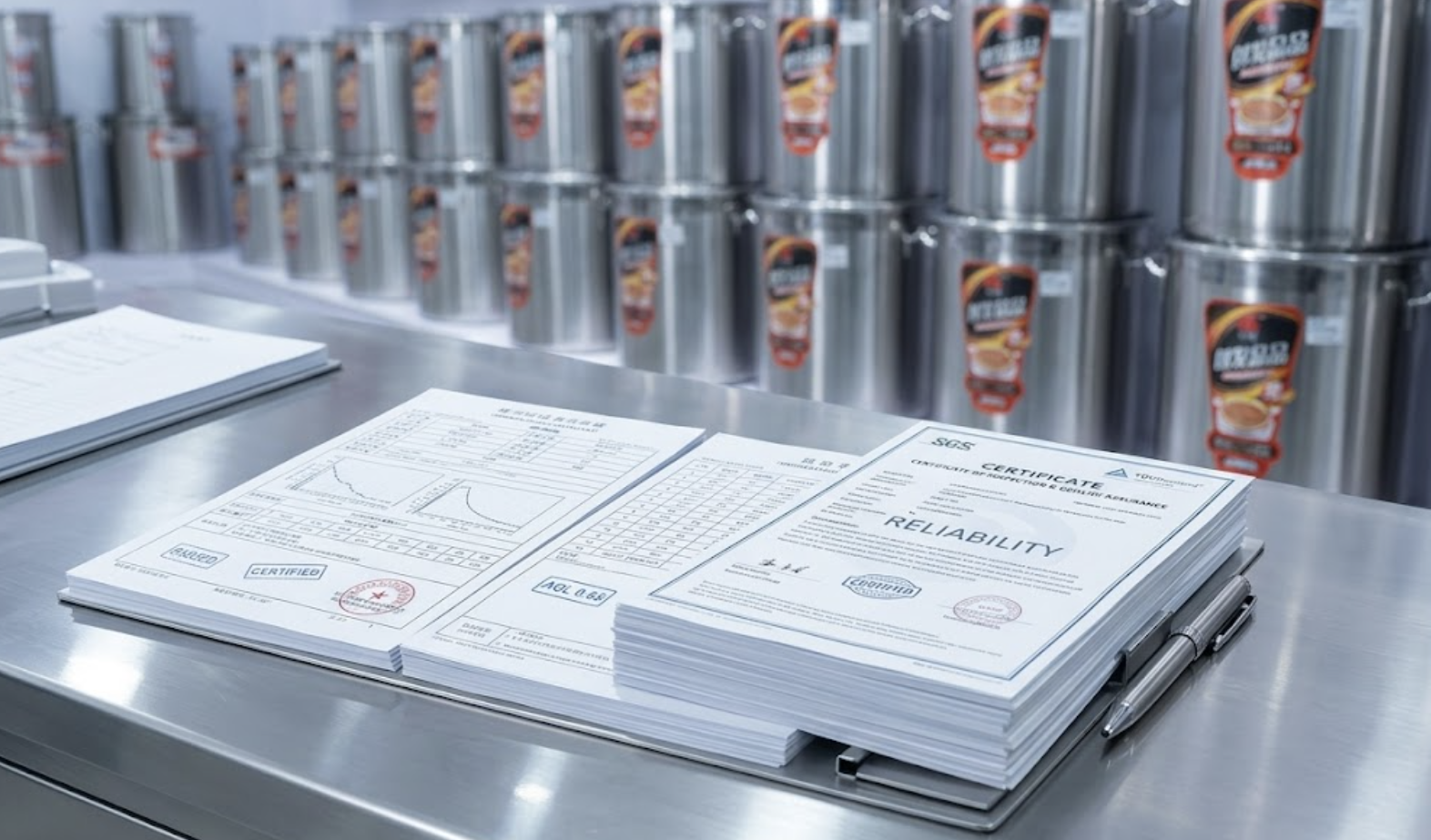
A structured pre-approval checklist creates a consistent comparison basis across supplier candidates. Verification priorities include: mill certificate traceability linked to specific coil batches for the ordered steel grade; equipment audit confirming press tonnage and in-house die-making capacity; third-party thermal retention testing on production-run samples rather than pre-selected showroom units; written production timeline with defined milestone dates; interior surface finish specifications aligned with food-contact compliance in the target export market; and export documentation accuracy, including HS code classification history for stainless steel cookware. These questions are not exhaustive, but they address the structural variables that determine supplier reliability at scale -- a sound starting point before entering formal qualification discussions. Chuangfa's OEM documentation and one-stop service framework -- spanning production management, packaging, logistics coordination, and shipment -- positions this checklist as an internally manageable process rather than a multi-vendor coordination effort.
A manufacturer earns the designation of reliable extremely thick soup pot supplier through production transparency, material traceability, and process consistency -- not through catalog depth or unit pricing alone. The framework above gives procurement teams a structured, repeatable method for distinguishing vertically integrated manufacturers from intermediaries presenting identical-looking products. Sourcing teams looking to review specifications, OEM capability documentation, or factory details for Chuangfa (Chaozhou Chao'an District Hongfa Hardware Industrial Co., Ltd.) can access further information at https://en.hongfasteel.com/.
Media Contact
Chaozhou Chao'an District Hongfa Hardware Industrial Co., Ltd.
Hongqi Industrial Zone, Caitang Town, Chao'an District, Chaozhou City, Guangdong Province, China
Source :Chaozhou Chao'an District Hongfa Hardware Industrial Co., Ltd.
This article was originally published by IssueWire. Read the original article here.

Samsung, SK hynix shareholder return policies in focus ahead of Q3 earnings
Shareholder return policies of Samsung Electronics and SK hynix are gaining market attention ahead of their announcements for third-quarter earnings, as investors see them as a key way to address the mismatch between the chipmakers' record-breaking profits and their sluggish share prices. Samsung Electronics is set to announce its three-month financial results during its earnings call on Thursday, while SK hynix said it will announce its results on its earnings call on Wednesday. Earnings are expected to be exceptionally strong, as surging demand for memory chips and continued supply bottlenecks have driven up average selling prices across the memory chip market. In its earnings guidance released Oct. 8, Samsung Electronics estimated third-quarter revenue of 195 trillion won ($146.96 billion) and operating profit of 107.4 trillion won. If realized, the company will become the first Korean company to surpass 100 trillion won in quarterly operating profit. SK hynix is expected to post 98.23 trillion won in revenue and 76.96 trillion won in operating profit during the same period, according

Early user reports of iPhone Duo mishaps see cracked screens and faulty pixels
Users report that inner displays become damaged after a few folds, with

Two part-timers and one AI orchestrator: Inside a Dubai conference on “The Breaking Point” — Part 1
Most conferences are built the same way. A committee brainstorms a theme, a team chases speakers, a designer lays out a program, and everyone hopes the real value happens in the corridors. Three days in Dubai this October worked differently. The operating model was deliberately lean: two people shaping the ideas and running the room, […] The post Two part-timers and one AI orchestrator: Inside a Dubai conference on “The Breaking Point” — Part 1 appeared first on e27.

Ailytics bags US$7.4M Series A to make old CCTV cameras earn their keep
Most industrial CCTV cameras lead a thankless life. They record everything, are watched by almost no one, and only become important after something has gone wrong, when their footage turns into evidence rather than prevention. Singapore-based Ailytics has built a business on reversing that order. The vision AI startup has raised US$7.4 million in an […] The post Ailytics bags US$7.4M Series A to make old CCTV cameras earn their keep appeared first on e27.

Youth brain drain: A hidden threat in Indonesia’s agriculture sector
Indonesia is losing its farmers. According to Statistics Indonesia (BPS), the number of farmers dropped from 31.7 million in 2013 to 29.3 million in 2023. That is a drop of about 7.5 per cent in ten years. Many of them moved to other jobs, such as construction work, factory work, or selling in the market, […] The post Youth brain drain: A hidden threat in Indonesia’s agriculture sector appeared first on e27.

Alibaba Cloud founder on how AI can unlock human potential
Long before artificial intelligence became the next big thing in the tech industry, Wang Jian was crafting the foundational infrastructure that would eventually power it. In 2008, he joined Alibaba Group Holding – owner of the South China Morning Post – as chief architect and founded Alibaba Cloud in 2009, convincing the company’s leadership to invest heavily in building a cloud computing infrastructure from scratch. Today, Wang’s purview has expanded considerably. As an academician at the...

Japan’s innovation problem is execution, and Southeast Asian startups are built for it
Japan has industrial expertise and established corporate networks. Southeast Asia has startups building digital products for fast-changing markets. The opportunity lies in connecting these strengths, not simply exporting Japanese technology or selling into Southeast Asia. Japan’s next innovation challenge is about execution Japan has long been associated with advanced manufacturing, engineering excellence, and globally competitive […] The post Japan’s innovation problem is execution, and Southeast Asian startups are built for it appeared first on e27.

Founders are buying gold, not Lamborghinis, after the exit
A running joke in Singapore’s startup circles holds that a founder’s net worth exists only in two places: the cap table and the LinkedIn bio. For most of Southeast Asia’s entrepreneurs, the joke still lands. IPO windows open and slam shut, trade sales are thin on the ground, and secondary sales have become the region’s […] The post Founders are buying gold, not Lamborghinis, after the exit appeared first on e27.

China shoots ahead on AI video models
While few dispute that China is narrowing the gap with the United States in developing artificial intelligence (AI) models, there is one area where Chinese firms are already the undisputed leaders: video. China has seen a proliferation of advanced generative AI video models – systems trained on visual data to generate or edit video content based on user inputs such as text prompts, images and audio. The country’s vast short-video ecosystems and looser copyright rules have helped give Chinese...

Thirty climate tech startups in Southeast Asia that would rather build than pledge
Southeast Asia has a talent for making climate pledges sound like wedding vows: grand, emotional and frequently broken. Net-zero deadlines stretch to 2050 and beyond, yet coal still dominates several national grids, petrol motorbikes still choke the cities and mangroves still vanish faster than ministers can name them. Into that gap has stepped a scrappy […] The post Thirty climate tech startups in Southeast Asia that would rather build than pledge appeared first on e27.

How a 39-store retail chain in Laos moved from Excel to AI agents
Until this summer, the morning numbers at LDC Import-Export Co., Ltd. were built by hand. LDC is a Lao distribution and retail group. It started in Vientiane in 2011, distributing local and imported goods, and its retail arm now runs 39 convenience stores across seven provinces, including Jiffy shops on PTT fuel forecourts and its […] The post How a 39-store retail chain in Laos moved from Excel to AI agents appeared first on e27.

Strong iPhone Duo demand reportedly prompts Apple to increase orders by 44%
The iPhone Duo reportedly saw stronger-than-expected pre-orders in several major markets, prompting a significant increase in production orders.


YOUR NEWS, OUR NETWORK.
Do you have Great News you want to tell the world?
Be it updates about your business or your community, you can make sure that it’s heard by submitting your story to our network reaching hundreds of news sites across 6 verticals.