
Viscosity Measurement in Chemical Processing: Polymers, Paints and Reaction Control
Sep 20, 2026
Shenzhen, Guangdong Sep 20, 2026 (Issuewire.com) - In a chemical plant, viscosity is rarely a simple number. Unlike density, which is a bulk property of whatever sits at the sensor, viscosity describes how a fluid responds to shear -- and in chemical production the response is almost always nonlinear. Paints, polymer solutions, emulsions, and coating formulations are shear-thinning: their viscosity drops as shear rate rises. Some fluids additionally behave as solids until a threshold stress is exceeded. Measure such a fluid at the wrong shear rate and you get the wrong viscosity -- not by instrument error, but by definition.
The chemical plant therefore needs a different question answered before any viscometer is selected: what is the shear rate of the process step we are trying to control? Pumping, mixing, coating, and pipeline flow each impose different shear conditions. A viscosity measurement is only meaningful when its shear rate is matched to the process step it represents.
This article works through the three chemical applications where inline viscosity measurement delivers the clearest return -- polymer reaction control, paint and coating production, and emulsion stability -- and the measurement principle that fits each.
Application 1: polymer reaction control -- viscosity as a conversion proxy
In polymerization, molecular weight and conversion both drive viscosity. As monomer converts to polymer, chain length grows and the solution thickens -- viscosity can climb by orders of magnitude over the course of a batch. That makes viscosity the plant's most convenient real-time window into a reaction that lab sampling sees only minutes or hours late.
The catch is the magnitude of the change. A polymerization batch can move from 10 mPa·s to 10,000 mPa·s -- three orders of magnitude. No single viscometer covers that span with good resolution at both ends. The practical approach is to instrument the batch for the range that matters at the decision point: the end-of-batch viscosity that determines when to stop the reaction or add the terminator. If the full range must be watched, a sensor with wide dynamic range is needed, accepting reduced resolution at the extremes.
Polymerization viscosity points (typical ranges, batch process)
Monomer feed (low conversion): 1 - 100 mPa·s
Mid-reaction (growing chains): 100 - 2,000 mPa·s
End-of-batch (target MW): 2,000 - 50,000 mPa·s
Reaction mass near gel point: >50,000 mPa·s (may not flow)
Instrument the decision point: the end-of-batch target range. Do not buy a
sensor for the whole span and accept poor resolution where the decision is made.
Vibrational viscometers suit the lower and middle of this range -- roughly up to 5,000-10,000 mPa·s -- and are the standard choice for solution polymerization where the reaction mass stays pumpable. For bulk polymerization approaching the gel point, the fluid becomes too viscous and too elastic for vibrational measurement; rotational instruments with larger gaps, or offline lab control at that stage, are the alternatives. The decision is about where in the batch the control action happens, not which instrument is "better".
Application 2: paints and coatings -- matching the shear rate of application
Paint is the classic shear-thinning fluid, and its viscosity is specified at multiple shear rates because different process steps see different conditions:
Storage and can stability: low shear rate (1-10 s¹). Viscosity here controls pigment settling and sag resistance.
Mixing and transfer: moderate shear (10-100 s¹). Governs pumpability and tank blending.
Spray or roller application: high shear (1,000-10,000 s¹ and above). Controls atomization, film build, and leveling.
A single inline viscosity number cannot serve all three. The plant must decide which process step the inline meter represents. For a paint production line, the usual choice is the let-down and can-fill stage, where final viscosity is adjusted to the product spec -- because that is where batch quality is locked in before filling. The shear rate of the let-down recirculation loop then defines the measurement condition.
Rotational viscometers with controllable shear rate are the standard lab tool for paint, which is why paint specs quote viscosity at specific spindle speeds (Brookfield RVT, often 20 rpm) and temperatures (25°C). An inline meter used for paint control must correlate with that lab method -- which usually means a rotational design whose shear rate can be matched, or a vibrational meter with a documented correlation established against the plant's own lab data. Without the correlation, the inline number and the lab number will disagree, and operators will rightly distrust the inline meter.
Application 3: emulsions and dispersions -- viscosity as a stability alarm
Emulsions -- polymer dispersions, agrochemical formulations, personal care bases -- are thermodynamically unstable by nature. They separate, cream, or flocculate over time. Viscosity is the earliest measurable symptom of that instability: a slow upward drift often signals flocculation starting; a sudden drop can signal phase inversion or creaming. An inline viscometer on the recirculation loop of an emulsion storage tank turns a batch-quality problem into an early-warning signal.
For emulsions the requirement is less about absolute accuracy and more about stable repeatability over weeks -- the meter must reliably detect a 5% drift that signals trouble. Vibrational viscometers are well suited here: no rotating parts to disturb the emulsion, wetted parts easy to clean, and sensitivity to small changes at low-to-moderate viscosity. The measurement must be taken in a well-mixed location -- a recirculation line, not a static tank bottom -- because a separated emulsion at rest does not present a representative sample to any sensor.
Temperature: the hidden variable in every chemical viscosity reading
Viscosity is exponentially temperature-sensitive -- far more than density. A 10°C change can halve the viscosity of a polymer solution or paint. This cuts both ways: the process needs the viscosity at its actual temperature, and the plant needs to compare batches that may have run at slightly different temperatures.
The practical rule in chemical plants is to control temperature tightly at the measurement point rather than rely on compensation over wide swings. A viscometer on a reactor loop should be installed where temperature is stable and representative. If the process temperature itself is the controlled variable, viscosity compensation against a measured temperature with an Arrhenius-type coefficient is acceptable over modest ranges -- but the coefficient must be derived from the plant's own fluid data. A generic coefficient will drift the reading precisely when the process needs accurate control.
LONNMETER viscosity options for chemical service
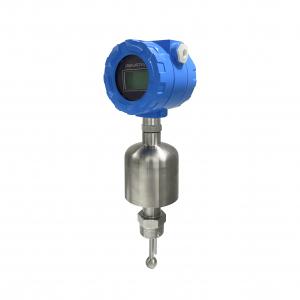
LONNMETER offers two inline families for chemical viscosity. The LONN-V100 vibrational viscometer serves the low-to-mid range (to ~5,000 mPa·s) with 316L or Hastelloy wetted options, ATEX/IECEx certification, and clean-in-place capability -- suited to polymerization loops, emulsions, and solvent lines. The LONN-V200 rotational series extends to higher viscosities and provides the controlled-shear measurement needed where the process spec is defined against a rotational lab method, as in paints and coatings.
Our specification questions for chemical viscosity are always the same three: what process step does this measurement represent, what hear rate does that step impose, and what is the viscosity at the relevant temperature? Answer those and the correct instrument selects itself.
Common questions on viscosity measurement in chemical processing
Why does my paint viscosity read differently inline than in the lab?
Because paint is shear-thinning and the two instruments almost certainly operate at different shear rates. Your lab spec is quoted at a specific spindle speed (for example Brookfield RVT 20 rpm), while the inline meter measures at whatever shear its design imposes. The reading is not wrong -- it is correct at a different shear rate. The solution is either a rotational inline meter whose shear rate you can match to the lab method, or a documented correlation between the inline reading and the lab method built from plant samples. Never compare the two numbers directly without the correlation.
Can a vibrational viscometer measure a polymer batch near the gel point?
Not reliably. Near the gel point a polymer mass becomes highly viscous and elastic -- typically above 50,000-100,000 mPa·s -- and the damping on a vibrating element becomes so strong that the measurement loses accuracy. Vibrational sensors are practical to roughly 5,000-10,000 mPa·s. For the gel-point region, use a rotational instrument with adequate torque, or remove the sample for lab control. Instrument the batch for the range where your control decision is made, and let lab samples cover the extremes.
How much does a 10°C temperature change affect polymer solution viscosity?
Typically 30-50% for polymer solutions and many paints -- viscosity follows an Arrhenius-type exponential relationship with temperature. Some resins change even more. This is why viscosity specifications always quote a temperature (25°C for paint, 40°C for many lubricants, specific temperatures for resin melts). Control the temperature at the measurement point tightly; do not rely on compensation to correct a 15°C error, because the compensation coefficient itself changes with temperature and composition.
Is inline viscosity useful for emulsion stability monitoring?
Yes -- viscosity drift is usually the earliest measurable sign of emulsion instability. A slow upward drift commonly indicates flocculation or thickening beginning; a sudden drop can signal creaming or phase inversion. For this duty, repeatability matters more than absolute accuracy: the meter must reliably detect a few percent of drift over days or weeks. Install the sensor on a recirculation loop so it always sees a mixed, representative sample, and log the trend rather than reacting to single readings.
What viscosity range can inline chemical viscometers cover?
The practical inline range across technologies spans roughly 0.3 mPa·s (light solvents) to over 1,000,000 mPa·s for specialized rotational designs -- but no single instrument covers that full span. Vibrational sensors are strong from about 1 to 10,000 mPa·s. Rotational sensors extend upward depending on torque and geometry. Select for the range at your control decision point, and confirm the sensor's low-end signal-to-noise for light fluids -- measuring a 0.5 mPa·s solvent needs a sensor designed for low viscosity, not the general-purpose model.
Source :SHENZHEN LONNMETER GROUP
This article was originally published by IssueWire. Read the original article here.

Trump claims neither he nor Musk caused Ukraine Starlink outage
President Trump claimed on Friday that neither he nor SpaceX founder Elon Musk caused Ukraine’s Starlink outage earlier this week as the president clashed with Ukrainian President Volodymyr Zelensky over resumed strikes on Russian oil refineries. “I didn’t do that. No, we didn’t do that at all. In fact, I don’t even think it was...

18 reasons to get the new iPhone Duo with Smart Postpaid
A foldable design, a larger display when you need it, and the flexibility of the iPhone experience – all in one device. Apple’s much-anticipated iPhone Duo introduces a new way to experience iPhone, and Smart makes it easier for you to own it with Smart Postpaid Plans+ 1999 starting at P6,304 per month, with zero-interest

Musk settles election lottery lawsuits over $1 million voter giveaways
Tech mogul Elon Musk agreed to settle two lawsuits over his $1 million check handouts to battleground voters in the 2024 election, according to court filings published Thursday. The suits, filed in the Western District of Texas, accused the Tesla and SpaceX CEO of defrauding voters when his America PAC offered a $1 million giveaway...

AI safety group pushes for tighter export controls, limits on 'vastly superhuman AI'
A conservative AI safety group is calling for the U.S. to implement tighter restrictions on advanced chip sales to China and limit the development of “vastly superhuman AI” as part of a new framework for AI policy. Humans First, chaired by former Tea Party leader Amy Kremer, laid out what it described as an “America...

Warsh offers no fresh signals on interest rates
Federal Reserve Chair Kevin Warsh declined Friday to predict central bank officials’ future course on interest rates, less than two weeks before they meet to discuss monetary policy. “I don’t prejudge meetings. I don’t believe in saying now what I might do at the meetings that we have in the balance of this year,” Warsh...

'AI artists' perform improvised music at Jarasum Jazz Festival
Artificial intelligence (AI) models developed by a research team led by Korea Advanced Institute of Science and Technology (KAIST) professor Nam Ju-han made their debut at one of Korea’s leading jazz festivals, performing improvised jazz alongside human artists. According to the university Friday, the team showcased human-AI music collaboration technology that analyzes the flow of human performances in real time, allowing AI to take over performances or generate improvised accompaniment during the 23rd Jarasum Jazz Festival, held in Gapyeong County, Gyeonggi Province, from Oct. 9 to 11. A total of 12 human jazz artists participated in the event, collaborating with AI in 26 pieces across 12 performances. The technology is different from existing music AI services as it enables collaboration with human musicians in jazz, a genre characterized by improvisation. Jazz musicians often change the tempo or create new melodies based on how they feel in the moment. Because the same piece can be performed differently each time, musicians must listen to one another and adjust their playing accordi

Why do some Samsung employees cheer company's stock plunge?
Some Samsung Electronics employees have drawn criticism from online users after appearing to welcome a nearly 9 percent plunge in their company's share price on an anonymous workplace community. Posts written by Samsung Electronics employees on the company's board on Blind, an anonymous community for office workers, spread across online communities and social media Thursday. Blind requires users to verify their employment through their company email addresses, and displays the name of their employer alongside their usernames. According to the Korea Exchange, Samsung Electronics closed Thursday's regular trading at 210,000 won ($147), down 9.48 percent, or 22,000 won, from the previous session. One person believed to be a Samsung Electronics employee posted on Blind under the title, "Please let the stock plunge to 100,000 won." Another employee wrote a post titled, "Isn't a falling stock price actually better for Samsung Electronics employees?" The employee said, "From the Device Solutions (DS) division's perspective, a higher stock price only increases the risk associated with OPI2," ref

Michael Jordan's Steak House named Korea's best hotel restaurant
Michael Jordan’s Steak House, the only location of the U.S. restaurant brand outside the United States, has been named “Korea’s Best Hotel Restaurant 2026” at the World Culinary Awards. INSPIRE Entertainment Resort in Incheon, which houses the restaurant, said Friday that the steakhouse received the award at a ceremony held Wednesday in Jamaica. The awards recognize outstanding restaurants and culinary destinations through votes cast by industry professionals, experts and consumers. The event is a sister event of the World Travel Awards, described as the “Oscars of the travel industry.” The restaurant opened in Incheon in 2023 as the brand’s first and only location outside the U.S., bringing a selection of steaks that had proved popular in its home market. Cornerstone Restaurant Group oversees the brand in partnership with basketball legend Michael Jordan, with two U.S. locations in Chicago and Connecticut. The Incheon restaurant also received a Best of Award of Excellence in June from Wine Spectator, a U.S. wine publication, as part of its annual Restaurant Awards. “This

Chaevi wins all 4 government EV charging subsidy categories
Electric vehicle (EV) charging operator Chaevi has achieved a rare clean sweep in this year's government EV charging facility subsidy program, securing qualifications across all four categories in both network operation and hardware manufacturing. The company was selected as an operator and manufacturer of fast, medium-speed and slow charging facilities under a program overseen by the Ministry of Climate, Energy and Environment. The selection marks Chaevi’s ninth consecutive year as a designated charging facility operator and its first selection in newly introduced manufacturer categories, according to the company. The four categories cover operators of fast and medium-speed chargers, operators of slow chargers, manufacturers of fast and medium-speed chargers, and manufacturers of slow chargers, allowing Chaevi to participate in the government’s subsidy program through 2027. The government revised its evaluation system this year to assess operators and manufacturers separately, with manufacturers facing additional scrutiny of technological development, product quality and charging pe

Hyosung Heavy Industries doubles export capacity with Changwon factory
Power transmission equipment manufacturer Hyosung Heavy Industries opened a new factory in Changwon, South Gyeongsang Province, Friday, doubling its production capacity for extra-high-voltage circuit breakers rated at 420 kilovolts (kV) and above as it prepares for surging global demand for power infrastructure. The facility, covering about 18,996 square meters, will exclusively manufacture circuit breakers rated at 420 kV, 550 kV and 800 kV for export markets, strengthening the company's ability to fulfill large overseas orders. Hyosung Heavy Industries reorganized its existing circuit breaker operations to focus primarily on domestic models, while the new facility handles export products rated at 420 kV and above. The factory integrates component manufacturing, assembly, testing and shipping under one roof, creating a streamlined production system designed to improve efficiency and delivery times. Production capacity for insulation components, which are critical to circuit breaker performance, has also doubled, according to the company, which said it is the only domestic power equipmen

Samsung's Galaxy S26 Ultra, 2 other products named to TIME's Best Inventions of 2026
Samsung Electronics said Friday that three of its products have been named to TIME magazine’s list of The Best Inventions of 2026. The U.S. weekly news magazine announced the list Thursday (local time). It picked the Galaxy S26 Ultra smartphone in the Consumer Electronics category, the Bespoke AI Family Hub refrigerator in Household and the Odyssey G8 gaming monitor in Entertainment & Gaming. TIME compiles the list each year from nominations by its editors and correspondents around the world. It rates new products and ideas on originality, efficacy, ambition and impact. The magazine called the Galaxy S26 Ultra “a privacy-focused smartphone,” citing its Privacy Display. The feature effectively blocks people from viewing the screen from the side. Users can choose when it turns on or apply it only to certain content, such as pop-up notifications. TIME said this makes it more flexible than conventional privacy screen protectors. The phone is the top model in the Galaxy S26 series, which was released in March. It has a 200-megapixel wide-angle camera and artificial intelligence (AI) fea

AMCHAM chief receives honorary doctorate from Korea Aerospace University
American Chamber of Commerce in Korea (AMCHAM) Chairman James Kim received an honorary doctorate in business administration from Korea Aerospace University (KAU) on Thursday in recognition of his contributions to Korea-U.S. economic cooperation. The university recognized Kim for bringing businesses and policymakers from the two countries together to promote trade, investment and cooperation in advanced industries. It also cited his efforts to attract foreign investment to Korea and improve the business environment in the country, drawing on his experience leading global companies. A degree ceremony was held at Vision Hall in the university’s Aerospace Center following a commemorative tree-planting event. KAU President Hurr Hee-young delivered welcoming remarks, while Korean Air Executive Vice President Kenneth Chang offered congratulatory remarks. “It is a great honor to receive an honorary doctorate from a university that has been at the forefront of developing Korea’s aerospace and defense talent,” Kim said. Kim also praised KAU’s efforts to develop talent and strengthen ties








Where to preorder the iPhone Duo?

YOUR NEWS, OUR NETWORK.
Do you have Great News you want to tell the world?
Be it updates about your business or your community, you can make sure that it’s heard by submitting your story to our network reaching hundreds of news sites across 6 verticals.