
Setting Industry Benchmarks: Why Gluten-Free, Non-GMO, and Vegan Certified Sea Buckthorn Oil Leads in Skin Health
Sep 14, 2026
Xian, Shaanxi Sep 13, 2026 (Issuewire.com) - Quick Summary
Gluten-free, Non-GMO, and vegan labels appear frequently across the modern wellness landscape. However, consumers do not always understand what each designation verifies in a botanical formula. While dietary certifications confirm raw ingredient origin and agricultural purity, manufacturing protocols guarantee safety and batch consistency. Integrating these distinct verification layers establishes a comprehensive benchmark for dietary supplements. Consequently, choosing a verified Certified Sea Buckthorn Oil allows health-conscious individuals to address skin health without compromising dietary principles. This report breaks down how dietary certifications function, explains their relation to facility standards, and provides a clear framework for evaluating premium botanical products.
This article reflects general research and traditional herbal use. It does not constitute medical advice. Persistent or severe symptoms warrant consultation with a qualified healthcare professional.
What Dietary Certifications Actually Confirm -- and What They Leave Out
Dietary labels like gluten-free, Non-GMO, and vegan provide immediate clarity regarding product composition. However, buyers must recognize the explicit boundaries of these credentials. These certifications verify ingredient sourcing, agricultural practices, and the absence of specific animal or allergenic inputs. Specifically, a vegan certification confirms that a formula contains no animal derivatives, while gluten-free testing verifies that gluten protein levels remain below regulatory thresholds.
Nevertheless, dietary credentials do not evaluate biological potency, active compound concentrations, or facility sanitation. A product can maintain strict vegan and Non-GMO status while still lacking standardized active ingredients like palmitoleic acid. Therefore, consumers should view dietary certifications as vital safety and ethical baselines rather than direct measures of therapeutic strength. Understanding this distinction prevents misunderstanding and helps buyers evaluate products with objective clarity.
The Non-GMO Verification Case for a Botanical Supplement
Sea buckthorn berries grow naturally in wild and cultivated environments, making them inherently plant-based. However, Non-GMO verification remains critical in modern supply chain management. This credential confirms that agricultural workers cultivated the botanical crops without genetic engineering. Furthermore, it verifies that processing aids and carrier lipids used during extraction remain completely free from genetically modified organisms.
Although Non-GMO status shares common ground with USDA Organic certification, the two credentials serve distinct functions. USDA Organic certification covers broader ecological standards, prohibiting synthetic pesticides, chemical fertilizers, and sewage sludge. In contrast, Non-GMO verification focuses strictly on genetic integrity throughout the agricultural and processing lifecycle. For skin health supplements, Non-GMO status guarantees that the essential fatty acids and lipophilic compounds maintain their natural molecular structure without synthetic genetic alterations.
Gluten-Free and Vegan Certifications -- Which Consumer They Protect and Why
Gluten-free and vegan certifications address specific physiological vulnerabilities and ethical requirements. For individuals with celiac disease or severe gluten sensitivity, even trace cross-contamination can trigger intestinal inflammation. Because systemic inflammation directly impairs the skin barrier, consuming certified gluten-free supplements protects both gut integrity and dermal appearance.
Simultaneously, vegan certification plays a decisive role in softgel formulation. Traditional nutritional softgels utilize bovine or porcine gelatin, which renders them unsuitable for plant-based consumers. In contrast, certified vegan softgels utilize tapioca starch or carrageenan shells to encapsulate the lipid matrix. This distinction matters greatly in skin health categories, where consumers frequently seek clean, plant-derived alternatives to marine collagen or fish oil. Providing verified vegan and gluten-free options ensures that individuals with complex dietary restrictions can support their skin barrier safely.
How Dietary Certifications Stack With NSF cGMP and BRCGS to Complete the Quality Picture
A truly reliable supplement relies on a multi-tiered verification framework rather than a single label claim. Evaluating product quality requires stacking dietary attributes, manufacturing compliance, and empirical batch testing. Dietary certifications represent the first layer, validating raw ingredient attributes, crop cultivation, and formula suitability.
The second layer consists of facility-level manufacturing certifications, such as NSF cGMP and BRCGS. These industrial protocols monitor facility hygiene, equipment calibration, and environmental controls to prevent physical, chemical, and biological contamination during processing. Finally, the third layer involves batch-specific Certificate of Analysis documentation from independent testing laboratories. This laboratory documentation confirms exact fatty acid percentages and proves the total absence of heavy metals or microbial blooms. Stacking these three layers provides consumers with verifiable assurance regarding product safety and consistency.
About Himalayan Sea Buckthorn Oil by Laicuherb
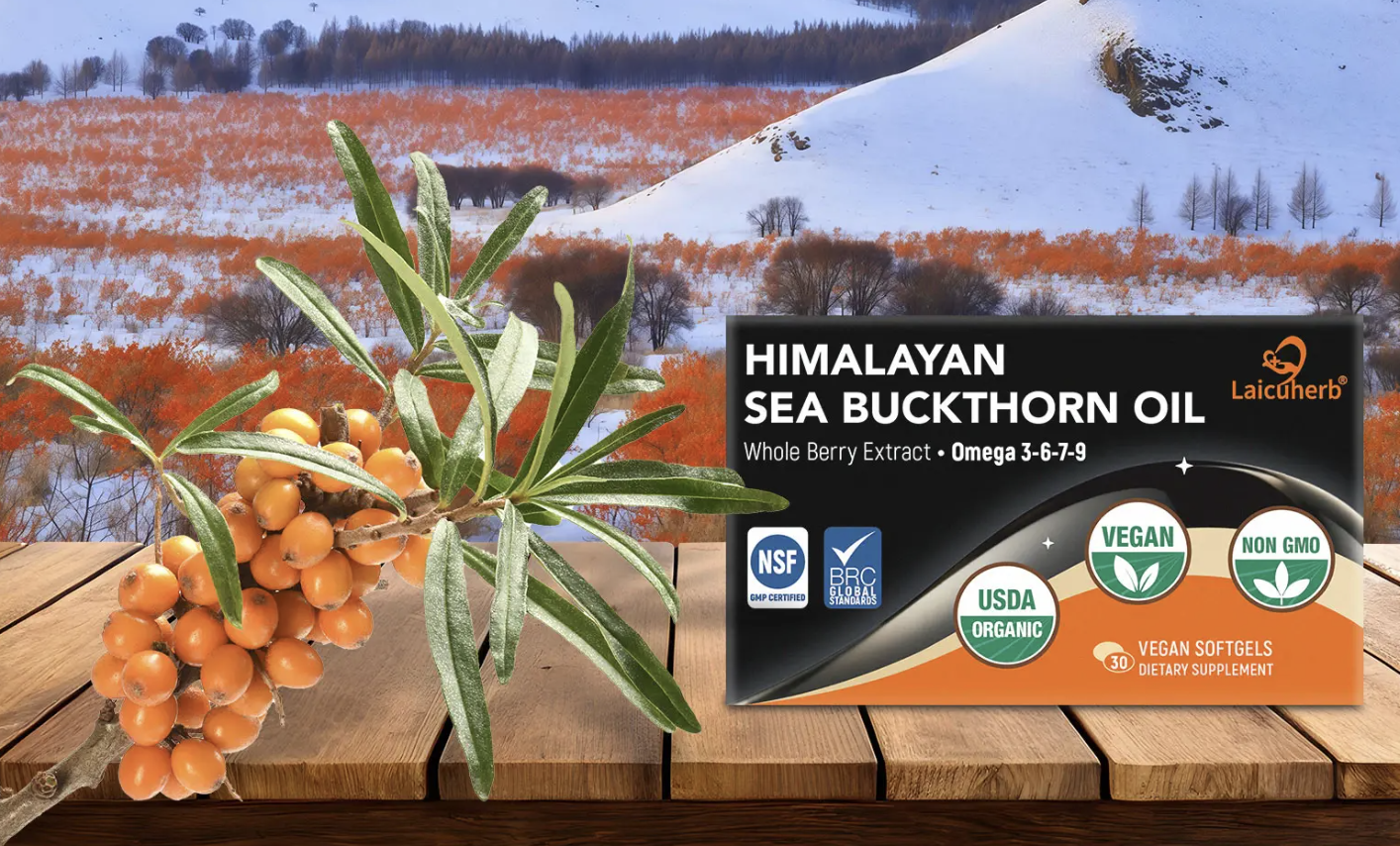
To satisfy these multi-layered standards, Laicuherb(Xi'an Chinaherbs Commerce Co.,Itd) implements a rigorous quality management model across its entire supply chain. The enterprise wild-crafts organic sea buckthorn berries at high altitudes above 12,000 feet in the Himalayan region. By managing field collection, supercritical carbon dioxide extraction, and encapsulation internally, Xi'an Chinaherbs Commerce Co.,Itd guarantees complete traceability and eliminates cross-contamination risks.
The finished formulation features a 100 percent plant-based tapioca softgel shell, making it fully certified gluten-free, Non-GMO, and vegan. Each two-softgel serving provides 1,000 milligrams of whole-berry extract, yielding 324 milligrams of pure omega-7 palmitoleic acid along with balanced omega-3, omega-6, and omega-9 fatty acids. To maintain absolute operational transparency, every batch complies with NSF cGMP, BRCGS, and USDA Organic standards. Individuals seeking to learn more about fatty acid synergy can consult The Reason Your Body Needs the Nutrients Found in Himalayan Sea Buckthorn Oil on the firm's educational platform. Through comprehensive certifications and vertical integration, Laicuherb sets a benchmark for skin health supplementation.
Corporate Website: https://www.laicuherb.com/.
FAQ
Is "Vegan" on a supplement label independently verified or self-declared?
It depends on the product. While some brands self-declare vegan status, reputable manufacturers obtain independent third-party certification. This third-party auditing verifies that neither the active ingredients nor the softgel shell contain animal-derived components.
What is the difference between Non-GMO Project Verified and USDA Organic?
Non-GMO verification focuses exclusively on testing raw materials to confirm the complete absence of genetically modified organisms. USDA Organic encompasses broader agricultural standards, requiring non-GMO inputs while also prohibiting synthetic pesticides and chemical fertilizers.
Can people with fish allergies safely take this product?
Yes. Because sea buckthorn oil is entirely plant-derived and encapsulated in a vegan softgel shell, it contains no fish or shellfish allergens. It offers an excellent plant-based alternative to marine-derived omega supplements.
Does gluten-free certification matter for an oil-based supplement?
Yes. Although pure plant oils naturally lack gluten, cross-contamination can easily occur during harvesting, processing, or encapsulation if facilities handle grain products. Official gluten-free certification ensures that processing lines maintain strict allergen controls.
How do dietary certifications relate to skin health outcomes?
Dietary certifications prevent adverse autoimmune or inflammatory reactions caused by hidden allergens like gluten or synthetic residues. By avoiding systemic triggers, these certified clean formulas allow the active omega-7 fatty acids to support skin barrier repair effectively.

Media Contact
Xi'an Chinaherbs Commerce Co.,Itd
Block B, Eurasia International Building, Xian, Shaanxi, China
Source :Xi'an Chinaherbs Commerce Co.,Itd
This article was originally published by IssueWire. Read the original article here.

LG CNS earns global recognition for AI-powered workplace services
LG CNS has earned international recognition for its artificial intelligence (AI)-powered workplace services, becoming the first Korean company named a “Major Player” in IDC’s 2026 assessment of the global digital workplace services market. The IT services company said Monday that it was included in the evaluation alongside 18 global technology companies, including Tata Consultancy Services, Infosys, NTT DATA, Cognizant, Dell and HP. IDC MarketScape evaluates technology vendors based on their business capabilities, future strategies, products, services, customer references and real-world client experiences. LG CNS attributed its recognition to its agentic AI platform, a:xink, which is designed to move beyond information retrieval and routine assistance to execute workplace tasks autonomously. The platform offers services including enterprise portals and groupware, mobile workplace tools, personal AI agents, AI-powered translation and meeting support, and automated document creation. IDC highlighted LG CNS’ AI-native platform capabilities, expertise in regulated industries and secur

Auto exports fall 5.5% in Sept. amid Mideast tensions
Korea's automobile exports fell 5.5 percent in September from a year earlier due to persistent tensions in the Middle East and a decline in used-car shipments, government data showed Monday. The value of automobile exports fell to $6.05 billion last month from $6.4 billion a year earlier, the Ministry of Trade, Industry and Resources said in a press release. "Escalating tensions in the Middle East and a decline in used-car shipments due to tighter regulations in major export markets weighed on exports," the ministry said. By region, exports to North America and the European Union increased 9.2 percent and 15.3 percent, respectively, to $3.07 billion and $1.11 billion. Shipments to Asia and the Middle East on the other hand plunged 60 percent and 7.1 percent, respectively, to $330 million and $350 million. Exports of eco-friendly vehicles, including battery electric and gasoline hybrid models, meanwhile, rose 5.9 percent to $2.89 billion. Domestic vehicle sales fell 14.3 percent to 135,000 units last month due to fewer working days driven by the Chuseok holiday. The number of locally produce

Hanwha to distribute 2027 braille calendar to mark 100th anniv. of Korean braille system
Hanwha Group said Monday it will produce and distribute 40,000 copies of its 2027 Braille calendar for visually impaired people. Hanwha Group has been producing braille calendars every year since 2000, when Chairman Kim Seung-youn received a letter from a visually impaired person and launched the project with the belief that people with visual impairments should also be able to share in the joy of welcoming the new year. Starting with 5,000 copies in the first year, the group has distributed about 1 million calendars through last year. The 2027 calendar features braille alongside printed text, allowing both visually impaired and sighted people to use it. Users can check essential information in braille, including dates, days of the week, lunar calendar dates, seasonal markers and public holidays. The calendar also reflected visually impaired users’ feedback to adjust text size and contrast to improve readability. Social enterprise Braille Publishing participated in producing the calendar. This year marks the 100th anniversary of the introduction of “Hunmaengjeongeum,” the Korean bra

SK hynix, gov't to provide $1.5 bil. in loan guarantees to semiconductor suppliers
Korean chip giant SK hynix said Monday it will partner with the government and major banks to provide 2 trillion won ($1.5 billion) in loan guarantees to local semiconductor suppliers to strengthen the domestic chip supply chain. SK hynix and the Ministry of Trade, Industry and Resources signed an agreement to launch the program at the chipmaker's semiconductor cluster promotion center in Yongin, south of Seoul. Under the agreement, SK hynix and four major banks will contribute a combined 100 billion won to support the program, while the state-run Korea Trade Insurance Corp. (K-SURE) will provide up to 2 trillion won in loan guarantees to semiconductor materials, parts and equipment suppliers. Suppliers recommended by SK hynix will benefit from higher loan limits, interest rate cuts of up to 2.5 percentage points and a guarantee period extended from one to three years. The initiative is part of the government's broader push to strengthen export supply chains by improving access to financing for smaller companies working with major manufacturers. The government previously pledged 2.4 trill

Hyundai Rotem Q3 net down 10.3% to $133.9 mil
Hyundai Rotem, the defense and railway subsidiary of Hyundai Motor Group, said Monday its third-quarter net profit fell about 10 percent from a year earlier. Net profit for the July-September period decreased 10.3 percent to 177.98 billion won ($133.9 million), the company said in a regulatory filing. Operating profit also declined 11 percent on-year to 247.1 billion won, while sales inched up 0.1 percent to 1.62 trillion won. For the first nine months of the year, cumulative sales rose 11.2 percent on-year to 4.68 trillion won, while operating profit fell 4.7 percent to 703.7 billion won. The company's order backlog stood at 29.14 trillion won at the end of September, down 1.26 trillion won from three months earlier. Separately, Hyundai Rotem said it plans to acquire Hyundai Wia's defense business for 358.4 billion won to bolster its weapons production capabilities, a move expected to help boost overseas sales of its flagship K2 tanks.

Fathers take on more, but mothers still bear heavier domestic workload
For a 33-year-old bank employee surnamed Jung raising a 3-year-old son in Seoul’s Yeongdeungpo District, coming home from work feels like starting a second shift. She uses a reduced working hours program for parents to leave work an hour or two early. Once her mother-in-law, who looks after the child while the couple are at work, heads home, Jung handles child care alone until her husband returns. “As soon as I get home, I feed my son dinner, bathe him and play with him. By then, my husband is home,” she said. “While he plays with our son, I finally get to shower, wash the dishes and tidy up. Then it’s time to put our son to bed.” Jung gets her first chance to sit down on the sofa after her son falls asleep, past 10 p.m. “Even though I leave work early, it feels like I work overtime every day,” she said. “My husband does quite a lot of child care, but our son tends to seek me out more, and I feel that a larger share of the housework naturally falls to me.” Government figures released Monday show that an uneven division of domestic duties persists among young working pa

Gov't, businesses team up to help retired detection dogs find new homes
The Ministry of Agriculture, Food and Rural Affairs last week joined Trinity Airways and Sono Pet Clubs & Resorts for a two-day pet adoption program, combining government support for retired detection dogs with private-sector assistance in event planning, accommodation and training. The Animal and Plant Quarantine Agency under the ministry provided guidance on adoption procedures and answered prospective owners’ questions. Trinity Airways, formerly T’way Air, organized the program, held Saturday and Sunday, while Sono Pet provided spaces for families and dogs to interact and rest, along with professional training support. Held at Sono Pet’s Vivaldi Park in Hongcheon, Gangwon Province, the program brought together three retired quarantine detection dogs and three prospective adoptive families selected through a screening process, according to the agency. The dogs were two English springer spaniels, aged 7 and 9, and a 9-year-old beagle. Activities included running together, treasure hunts and walks, giving participants opportunities to interact with the dogs. A trainer specializing

Finda to become 1st fintech firm to acquire savings bank
Finda, a loan comparison platform, is set to acquire a savings bank, in what would be a first for a Korean fintech company as it looks to build an artificial intelligence (AI)-native bank, industry officials said Monday. The Financial Services Commission's subcommittee approved Finda's application to acquire Daewon Savings Bank on Friday. The regulator is set to make a final decision at its regular meeting Wednesday. Finda signed a deal in June to acquire all of Daewon Savings Bank's shares for about 12 billion won ($9 million). The acquisition would allow the company to move beyond matching borrowers with lenders and offer financial services directly, including loans and deposits. Once the deal receives final approval, Finda plans to appoint a new CEO through board and shareholder meetings. The fintech firm aims to turn the lender into an AI-native bank, relying on digital services rather than a traditional network of branches. It plans to draw on AI technology and loan-comparison data it has collected since 2019 to expand its online lending business nationwide, the firm said. The compan

Global AI & Digital Summit kicks off 3-day run in Seoul
A global event aimed at exploring how artificial intelligence (AI) and digital transformation can deliver practical development gains kicked off its three-day run in Seoul on Monday, the science ministry said. The Global AI & Digital Summit, co-hosted by the ministry and the World Bank Group — a family of five institutions that makes leveraged loans to developing countries —brought together government officials from some 60 nations, as well as development partners, private sector leaders and researchers. This year marks the first time the summit was held outside of the United States, the ministry added. The event will begin with an AI and Digital Ministerial meeting, co-chaired by Science Minister Bae Kyung-hoon and Kim Sang-bu, the vice president for digital and AI at the World Bank Group, followed by policy forums and exhibitions from participating companies. Korea has been hosting the AI and digital ministerial meeting since 2005, with the most recent gathering held last year on the sidelines of the Asia Pacific Economic Co-operation (APEC) forum. Second Vice Science Minister Ryu J

Hyundai Rotem acquires Wia's defense biz as group reorganizes portfolio
Hyundai Rotem, a Hyundai Motor Group affiliate that manufactures the K2 battle tank, will acquire the defense business unit of fellow affiliate Hyundai Wia for 358.4 billion won ($252 million), as their parent company seeks to strengthen its competitiveness by consolidating its defense operations. According to the two companies’ regulatory filings, Hyundai Rotem will acquire Hyundai Wia's defense business, which manufactures main gun barrels for battle tanks and self-propelled howitzers. The two sides signed the contract on Monday and plans to close the deal by March 31. Hyundai Rotem’s main businesses include railway vehicles, such as trains and trams, and weapons systems for land, naval and air operations. Hyundai Wia manufactures engines, modules and gun barrels, supplying the barrels for both Hyundai Rotem’s K2 battle tanks and K9 self-propelled howitzers produced by Hanwha Aerospace. The acquisition will allow Hyundai Rotem to manufacture both complete K2 battle tanks and their main guns, reducing manufacturing costs and improving supply chain management efficiency. By bringi

Global cooperation, corporate innovation key to navigating AI uncertainty
JINJU, South Gyeongsang Province — International cooperation and corporate innovation have emerged as key priorities for navigating artificial intelligence (AI)-driven change and narrowing the digital divide, as former United Nations officials and executives from major conglomerates discussed ways to promote inclusive growth on Monday. The 2026 Jinju International Forum on Entrepreneurship, held on Monday and Tuesday, brought together international organization officials and business executives to discuss how entrepreneurship can help businesses navigate geopolitical tensions, supply chain realignments and rapid advances in AI. The first session, moderated by Oh Joon, the 71st president of the U.N. Economic and Social Council (ECOSOC), focused on the role of international organizations in promoting inclusive development as digital technologies reshape economies. Nestor Osorio, the council's 69th president, called for broader digital access and support for small-scale agricultural producers, arguing that technological progress must benefit communities beyond major cities and large corp

2.76 mil. pieces of customers' info at Hollys leaked in cyberattack
Customer information held by local coffee chain Hollys has reportedly been leaked via hacking of its memberships program, the franchise said Monday, the latest in a string of cyberattacks targeting local companies. A total of 2.76 million pieces of personal information, including the customers' dates of birth, phone numbers, addresses and emails, was stolen by the hackers sometime between Sept. 3 and Oct. 7, when the company detected unauthorized access to its system, according to a notice posted on the company's website. "We understand that the leaked data consists of temporary data files provided for a past membership service overhaul, not the data from the currently active customer database," the notice read, adding the company is still investigating the exact scope of the incident. "We sincerely apologize for causing customer concern from this incident. We will make our utmost efforts to protect customer data and minimize damage from the breach," it added. The cybersecurity violation at Hollys follows back-to-back leaks of customer data at local financial firms early this month. Arou



13th month pay gift guide: fitness and wellness

Hilarious Halloween video wins award


YOUR NEWS, OUR NETWORK.
Do you have Great News you want to tell the world?
Be it updates about your business or your community, you can make sure that it’s heard by submitting your story to our network reaching hundreds of news sites across 6 verticals.