
Railtex Brief: Global Leading Railway Track Vibration Dampers Supplier Changmei Technology on Rail Decay and Corrugation
Sep 10, 2026
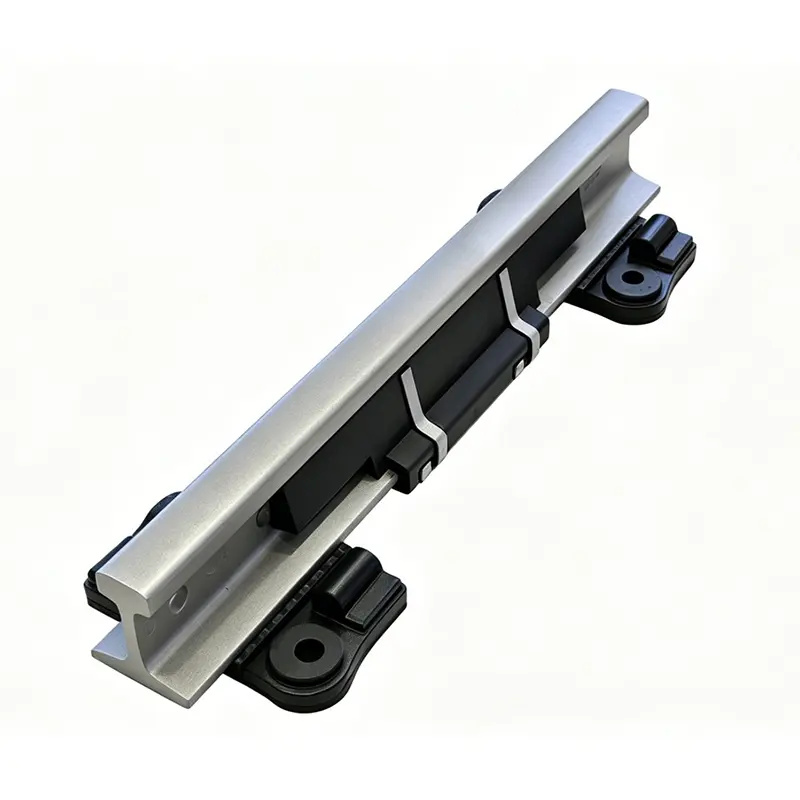
Baoji, Shaanxi Sep 10, 2026 (Issuewire.com) - Major international railway exhibitions and technical exchanges, including Railtex and InnoTrans, consistently bring rail decay, corrugation, and broadband noise control into engineering discussions. Addressing these exact technical evaluations, Changmei Technology provides specialized solutions as a Global Leading Railway Track Vibration Dampers Supplier. The company engineers a Broadband Frequency Rail Vibration Absorber designed to deliver an average lateral and vertical vibration decay rate of 5.5 dB/m within the 160-4000 Hz range. Furthermore, the system achieves an insertion loss of 5 dB/m at frequencies above 400 Hz. These quantified metrics provide a direct response to the widespread broadband mitigation challenges associated with rail corrugation, curve squeal, and high-frequency braking noise across modern transit networks.
Rail Decay Rate Provides a Direct Measure of Track-Side Vibration Control
The rail decay rate serves as a critical engineering metric by translating the attenuation speed of rail vibrations along the track into a measurable dB/m value. The broadband absorber from Changmei Technology establishes an average lateral and vertical decay of 5.5 dB/m specifically within the 160-4000 Hz range. This allows the track-side vibration reduction effect to be described using both frequency band and physical distance simultaneously.
When rail vibration decays more rapidly, the excitation energy generated by wheel-rail interaction is dissipated before it can travel to adjacent track sections. This accelerated energy dissipation is essential for reducing long-distance rail radiated noise and minimizing the broadband excitation transferred to nearby structures.
Because the 5.5 dB/m metric explicitly covers both lateral and vertical directions and is strictly averaged over the 160-4000 Hz band, it serves as a reliable parameter for technical comparison. However, this metric is bound by its defined frequency range and should not be generalized as a fixed performance outcome for track conditions that fall entirely outside this specific operational spectrum.
Phononic Bandgaps Extend Damping Beyond a Single Resonance
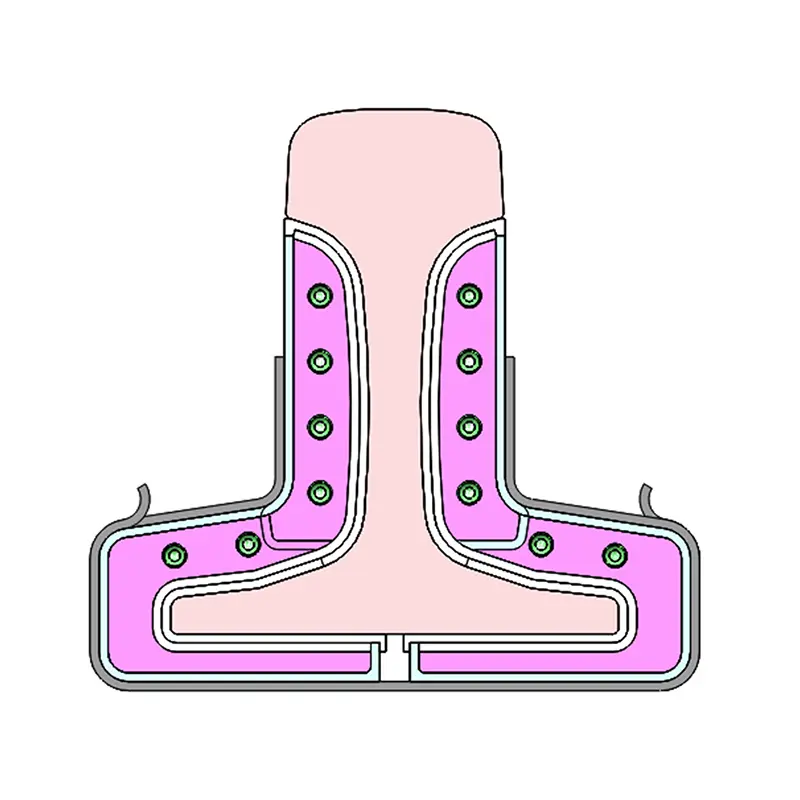
The Broadband Frequency Rail Vibration Absorber moves beyond relying on a single tuned resonance by integrating constrained-layer damping with phononic crystal bandgap theory. By optimizing the damping materials, incorporating a slotted expansion layer, and utilizing periodically arranged local resonators, the absorber effectively extends its operational frequency band.
The local resonance units are arranged periodically, creating a structure that actively suppresses wave propagation within specific frequency bands. Concurrently, the optimized damping materials convert the localized vibration energy into dissipated heat, allowing the system to cover a significantly wider frequency range than a conventional single-mass damper.
The addition of a slotted expansion layer provides additional pathways for structural deformation and energy dissipation. When this mechanical flexibility is overlaid with the phononic bandgap effect of the local resonators, the resulting absorber is capable of simultaneously mitigating multiple distinct wheel-rail excitation frequencies, rather than focusing on one narrow peak.
Insertion Loss Connects High-Frequency Control to Radiated Noise
Complementing the decay rate, an insertion loss of 5 dB/m at frequencies above 400 Hz provides a second quantified evidence point specifically targeting high-frequency rail vibration and noise radiation. Together, the 160-4000 Hz decay rate and the high-frequency insertion loss cover both the "localized energy loss" and the "along-track attenuation" dimensions of vibration control.
High-frequency wheel-rail interactions are the primary contributors to rail radiated noise. Insertion loss--which measures the energy difference before and after the installation of the absorber--describes the mitigation effect clearly and can be paired with on-site spectrum testing to identify and target the most problematic frequency bands.
The engineering viability of this acoustic performance is secured by strict mechanical and electrical requirements. The product specifies a retaining clip clamping force of 800 N and an insulation resistance of 10 . This demonstrates that acoustic mitigation is only effective when it is securely anchored by robust mechanical clamping and safe electrical isolation.
Corrugation, Curve Squeal and Braking Noise Share a Wheel-Rail Excitation Path
Changmei Technology explicitly directs the application of its broadband absorber toward mitigating rail corrugation, curve squeal, and braking noise. Designed for both conventional railway and urban rail transit systems utilizing 50 kg/m and 60 kg/m rails, the absorber addresses these three distinct phenomena by recognizing that they all share the same fundamental wheel-rail excitation and structural propagation path.
Rail corrugation alters the wheel-rail contact geometry, generating severe periodic excitation. The broadband absorber counters this by increasing the rail's vibration attenuation speed, which reduces the opportunity for the excitation energy to propagate into adjacent, unaffected track sections.
Curve squeal and braking noise involve higher-frequency friction and dynamic components. A broadband structure is inherently more capable of covering these multiple acoustic peaks than a device tuned to a single frequency. However, effective mitigation still requires field-measured spectrum data to confirm that the specific noise profile falls within the absorber's optimal operational range.
Production Sampling Keeps Broadband Performance Tied to Hardware Consistency
Because broadband mitigation mechanisms rely heavily on the precise geometric consistency of damping materials, slotted layers, and local resonators, manufacturing repeatability is critical. Changmei Technology supports this requirement with a fully automated rail damper production line capable of producing approximately 100,000 sets per year, reinforced by rigorous random sampling before, during, and after production.
The automated production line minimizes batch-to-batch variations in the geometry and assembly positioning of the local resonators. This strict manufacturing tolerance is essential for ensuring that the phononic bandgap and the constrained-layer damping structures maintain their designed theoretical consistency in physical production.
The company's in-house laboratory assumes responsibility for product testing. When combined with multi-stage production sampling, this enables mechanical, electrical, and vibration-related requirements to be thoroughly verified before bulk shipment. This comprehensive approach forms a closed quality loop, guaranteeing that structural manufacturing aligns perfectly with verified performance.
Railtex and InnoTrans Engineering Questions Connect Decay Metrics with Field Measurement
Technical exchanges at Railtex and InnoTrans connect rail infrastructure, wheel-rail interaction, noise, vibration, and maintenance questions across a broad professional audience. For vibration-damper selection, the useful bridge from exhibition-level discussion to project engineering is a quantified set of track-side metrics: decay rate, insertion loss, clamping force, insulation resistance, and the measured frequency spectrum of the target line.
The company's engineering service encompasses site vibration measurement, environmental impact assessment, and damping solution optimization. This process allows engineers to gather actual track spectrum data and environmental inputs first, before determining the priority frequency bands and setting the required attenuation targets.
Technical prourement discussions can therefore center on concrete parameters--such as decay rate, insertion loss, clamping force, and insulation resistance--mapped against the site's unique vibration spectrum. This approach elevates the evaluation of rail dampers from standard product descriptions to a closed-loop engineering process of measurement, selection, and verification. For further information on product specifications and engineering services, visit https://www.changmeitech.com/.
Media Contact
Shaanxi Changmei Technology Co., Ltd.
Source :Shaanxi Changmei Technology Co., Ltd.
This article was originally published by IssueWire. Read the original article here.

FTC to collect public opinion on draft guidelines against 'AI washing'
Korea's antitrust watchdog said Thursday it has begun collecting public opinion on draft guidelines against advertisements exaggerating products' use of artificial intelligence (AI) technologies, a practice known as "AI washing." The Fair Trade Commission (FTC) said it plans to gather opinions through Nov. 11 amid a growing number of products advertising AI features, with some allegedly providing misleading or deceptive information to consumers. "The term AI is used to describe products' advanced technology, accuracy and objectivity, leading consumers to perceive their performance and reliability as relatively superior or to be willing to pay extra," the FTC said. Amid the trend, the watchdog said consumers need to be aware of products advertised as having AI features even though they do not actually use such technologies. The guidelines cover four major categories of potential violations of the Act on Fair Labeling and Advertising and include a self-assessment checklist and frequently asked questions. The FTC cited examples including electric hot-water heating mats, cat litter boxes, pil

Court rules against Lone Star in $125.9 mil. tax case
An appeals court on Thursday ruled against U.S. private equity firm Lone Star Funds in its suit against the Korean and Seoul city governments to return a combined 168.2 billion won ($125.9 million) in taxes. The Seoul High Court handed down the ruling against Lone Star after the Supreme Court returned the case to the appeals court for review in April last year. The Texas-based firm had earlier filed the suit against the state and the municipality, seeking the return of withheld taxes in connection with profits from its investments in Korea. Lone Star and affiliate firms purchased large shares of Korea Exchange Bank, Kukdong Engineering Construction and Starlease between 2002 and 2005, and made huge profits by selling some of the shares in 2007. They paid smaller taxes than local companies would have, citing the tax treaty that Korea has with Belgium where the company that made the investment was based. The National Tax Service (NTS) levied additional corporate taxes against Lone Star and its entities, offsetting them with withheld taxes. Lone Star then filed a suit seeking cancellation of

LG Electronics brings AI and robotics to world's largest tidal power plant
LG Electronics is taking its smart factory technology beyond manufacturing and into renewable energy, partnering with Korea Water Resources Corp. to develop artificial intelligence systems for one of the country’s largest power facilities. The companies signed a memorandum of understanding Thursday at Sihwa Lake Tidal Power Plant’s cultural center in Ansan, Gyeonggi Province, to explore AI-driven operations at the facility, which has the world’s largest installed capacity among tidal power plants. The partnership will combine K-water’s power plant operating experience and data with LG Electronics’ expertise in smart factories, digital twins, robotics and AI, the companies said. Under the agreement, they will examine a digital twin-based integrated operating system that creates a virtual model of the plant and incorporates real-time information from generating equipment and surveillance cameras. The system could help forecast electricity output, simulate operating scenarios and diagnose equipment conditions, enabling operators to identify problems and assess performance before m

Orion expands Custard cream cake production in Korea, Vietnam, India as global demand surges
Orion has expanded production lines for its flagship Custard cream cakes across Korea, Vietnam and India to keep pace with surging domestic and international demand, the company said Thursday. Launched in Korea in 2004, Orion Custard is a soft, individually wrapped sponge cake with a custard cream filling. It has become the company’s second-biggest global pie brand after its flagship Choco Pie. Global sales rose 14 percent last year to 154 billion won ($116 million). China, Vietnam and India accounted for 76 percent of that total, and sales kept growing at a double-digit pace through September this year. The company added a production line in Korea in September and recently began running new lines in Vietnam and India. The expansion lifts Custard’s global production capacity to as much as 300 billion won a year, roughly double last year’s sales. Orion’s global research center at its headquarters in Korea oversees product development for each market. In Vietnam, the company sells flavors including tiramisu, raspberry, egg lava, melon and a reduced-sugar version. There is also a fl

Young Poong loses shareholder derivative suit against Korea Zinc
A court on Thursday ruled against Young Poong Corp. in a shareholder derivative lawsuit seeking 837 billion won ($631 million) in damages from Korea Zinc Co. Chairman Choi Yun-beom and other company directors. Young Poong — a major shareholder in Korea Zinc — had filed the suit in November 2024, claiming Korea Zinc's directors had inflicted losses of 837 billion won on the company by making a tender offer involving the purchase of its own shares at 890,000 won apiece, when the actual price was around 560,000 won. The Seoul Central District Court ruled, however, that Korea Zinc's directors could not be deemed to have violated their managerial duties, given the steps they took before making the purchase. It also ruled that the action did not violate the Commercial Act or the company's articles of incorporation.

Nvidia broadens ties with Korean component makers
Nvidia is expanding partnerships with domestic component makers LG Innotek and Samsung Electro-Mechanics, strengthening its supply chain for physical artificial intelligence (AI) applications and next-generation AI infrastructure. LG Innotek unveiled a lineup of sensing solutions incorporating Nvidia's latest Holoscan Sensor Bridge (HSB) technology at the U.S. chipmaker's annual GPU Technology Conference (GTC) in Berlin on Tuesday (local time). The solutions include 3-megapixel camera modules and a multimodal vision system that combines multiple cameras and sensors, targeting applications in physical AI and robotics. Nvidia's HSB technology allows sensor data to be sent directly to AI computers, bypassing the central processing unit and potentially speeding up how robots and autonomous vehicles process information and make decisions. The partnership reflects growing demand for advanced sensing technologies as AI expands beyond software and data centers into physical environments, where machines must perceive and respond to their surroundings in real time. LG Innotek said it plans to expan

K-beauty firms to seek export deals at Cheongju expo
Korean cosmetics and other beauty product companies will seek export deals at an annual industry exhibition that opened Thursday in North Chungcheong Province, the provincial government said. The Cosmetics & Beauty Expo Osong Korea 2026 that runs through Saturday is underway in Osong, a district of Cheongju, 83 kilometers south of Seoul. The event aims to connect local companies with international buyers, according to the provincial government. "We will help K-beauty products reach global markets and attract international buyers to North Chungcheong Province, a hub for the industry, to facilitate export deals," Gov. Shin Yong-han said. More than 250 companies are participating in the business-to-business (B2B)-focused event, held under the theme "K-Beauty Osong Seeks Growth Along With Global Partners," the provincial government said. This year's expo, the largest to date, will give local companies opportunities to expand into overseas markets while allowing visitors to experience K-beauty products, Jang Woo-sung, director general of the provincial government's bureau of biologics, food a

Regulators weigh antitrust safeguards as Naver-Dunamu deal stalls
Financial authorities said Thursday that they are considering safeguards to address concerns over potential market dominance arising from the merger of Naver Financial and Dunamu. "The Fair Trade Commission (FTC) is currently conducting a thorough review of whether the proposed merger between Naver and Dunamu would restrict competition," the Financial Services Commission said in a written response to Rep. Lee Kang-ill of the ruling Democratic Party of Korea. "Similarly, under the proposed Digital Asset Basic Act, we are considering safeguards to ensure that cryptocurrency exchanges, which serve as critical market infrastructure, maintain their public interest role and neutrality without being subject to undue influence from any particular company or shareholder," it added. Last November, Naver Financial announced plans to make Dunamu a wholly owned subsidiary through a comprehensive share swap. With the deal, Naver Financial aims to tap into new growth opportunities in digital assets. Dunamu would gain foundation to expand beyond its existing cryptocurrency exchange and integrate with Na

Samsung SDI to sponsor Korea's International Chemistry Olympiad team
Samsung SDI said Thursday that it has signed an agreement with the Korea Foundation for the Advancement of Science and Creativity (KOFAC) and the Korean Chemical Society (KCS) to sponsor Korea’s team for the International Chemistry Olympiad (IChO). The signing ceremony was held at the Korea Science and Technology Center in Seoul and attended by Samsung SDI Vice President and Head of the People Team Kim Hun-kyu, KOFAC President Chung Woo-sung and KCS President Keum Kyo-chang. Beginning in January, Samsung SDI will support the selection and training of Korea’s IChO team, organized by the KCS, as well as the team’s participation in the international competition. The company will also provide scholarships to students who win medals. The sponsorship reflects Samsung SDI’s commitment to nurturing young talent in basic sciences and helping students compete on the global stage, while contributing to Korea’s scientific and technological competitiveness. The IChO is an annual competition in which high school students from around the world test their chemistry knowledge and skills. Korea

Samsung chairman visits UAE, encourages employees
Samsung Electronics Executive Chairman Lee Jae-yong visited the Al Dhafra gas-fired power plant construction site in Abu Dhabi, the United Arab Emirates (UAE), on Wednesday (local time) to inspect construction progress and encourage employees working in the Middle East. Lee toured key facilities, checking construction schedules and safety measures, before meeting with executives from Samsung C&T and Samsung E&A to discuss regional market trends, growth strategies and new business opportunities. The Al Dhafra power plant is being built by Samsung C&T in a consortium with local construction firm Trojan General Contracting. It is designed to meet rising electricity demand amid the UAE's industrial growth and is expected to support energy-intensive industries, including artificial intelligence (AI) data centers. Samsung C&T previously demonstrated its construction capabilities through the Barakah nuclear power plant project in the UAE, while Samsung E&A uses the country as a key hub for its Middle East and Africa operations, undertaking projects in refining, gas and petrochemicals. Korea and

Lotte World ramps up safety prep with hands-on fire, CPR drills
Lotte World employees put their emergency response skills to the test Wednesday, competing in rapid firefighting and CPR challenges designed to sharpen their readiness when lives are at stake. The amusement park operator held its 2026 Fire Safety Competition in partnership with the Songpa Fire Station. The annual exercise comes as theme parks and high-density public venues face growing scrutiny over crowds and facility safety, prompting major operators to move beyond routine compliance and build real-time tactical readiness among frontline staff. The competition centered on two core scenarios: rapid initial suppression using indoor hydrants and emergency first aid. In the firefighting challenge, employees simulated an active blaze by quickly connecting hydrant systems, deploying hoses and executing the critical steps needed to contain flames before first responders arrive. The medical segment tested teams on sudden cardiac arrest scenarios. Participants were evaluated on their precision and speed while performing CPR on training mannequins and deploying automated external defibrillators

Daewoo E&C expands AI use across construction sites
Daewoo Engineering & Construction (E&C) is expanding artificial intelligence (AI) and digital management systems across its construction sites, deploying translation tools and quality-control software to reduce administrative workloads and improve communication with foreign workers. The construction firm rolled out AI translation and tablet-based training systems across its domestic construction sites last month. Its AI-powered translation system supports 16 languages, converting site managers' spoken Korean instructions into text and speech in foreign workers' native languages in real time. The company said the system recorded 94.6 percent accuracy in Korean speech recognition during preliminary testing. It is designed to reduce communication errors on construction sites, where clear instructions are essential for workplace safety, particularly as the number of foreign workers continues to increase. Daewoo E&C has also introduced a tablet-based system for safety training and related paperwork, such as worker registration, health screenings and training reports. The company is also develop









YOUR NEWS, OUR NETWORK.
Do you have Great News you want to tell the world?
Be it updates about your business or your community, you can make sure that it’s heard by submitting your story to our network reaching hundreds of news sites across 6 verticals.