
Odyssey Math Tuition Introduces 2026 Online Innovations to Transform Online Secondary Tuition, Math Tuition, and Tuition Singapore for Flexible Student Success
Jan 27, 2026
Odyssey Math Tuition introduced innovations that emphasize online learning to meet the needs of secondary students in response to the increasing preference for home-based study in Singapore's dynamic academic environment, where students balance schoolwork with extracurricular activities, family responsibilities, and personal interests.
Singapore, January 27, 2026 -- Odyssey Math Tuition, a Singapore-based mathematics tuition centre founded in 2013 by principal math tutor Mr. Justin Tan, has introduced innovations for 2026 that emphasise online learning to meet the needs of secondary students seeking flexible educational options. These developments respond to the growing preference for home-based study in Singapore's fast-paced academic environment, where students often balance schoolwork with extracurricular activities, family responsibilities, and personal interests. The centre's Ministry of Education (MOE)-aligned programmes target secondary levels from Secondary 1 to 4/5, including Elementary Math (E-Math), Additional Math (A-Math), and Integrated Programme (IP) tracks, with preparation for O-Levels as a core focus.

The innovations build on the proprietary Odyssey Math Tuition Singapore curriculum, which provides clear explanations, problem-solving strategies, and real-world applications for topics such as algebra, geometry, trigonometry, and statistics. By prioritising online secondary math tuition, the centre aims to offer accessible alternatives to traditional in-person sessions, allowing students to learn at their own pace without compromising quality. This approach is particularly relevant in tuition in Singapore, where remote learning has gained traction since the pandemic, enabling families to integrate math tuition into varied schedules.
"These 2026 online innovations are designed to provide secondary students with greater flexibility in their learning journeys," said Mr. Justin Tan, founder and principal tutor of Odyssey Math Tuition. "In a fast-paced world, our online secondary tuition initiatives can adapt to individual needs, helping students maintain balance while pursuing academic goals."
Odyssey Math Tuition has launched stand-alone online math tuition courses designed for self-paced learning from home, expanding options for online secondary tuition. These courses are available to all math tuition students, offering comprehensive modules that cover MOE syllabi from Secondary 1 to 4. Features include math video lessons with step-by-step breakdowns, downloadable worksheets for practice, and mock exams simulating O-Levels conditions. The platform supports 24/7 access, making it suitable for revision at any time, whether before school, after activities, or during weekends.
This launch addresses the demand for flexible tuition in Singapore, where secondary students often juggle co-curricular commitments such as sports teams or arts clubs alongside academics. One significant benefit is that students may not have enough time to fully grasp concepts with just 2 hours of math tuition a week in group settings; these online tools empower learners to study anytime and anywhere based on their own preferences, allowing deeper exploration of topics at a convenient pace. For instance, a Secondary 2 student preparing for trigonometry concepts can pause and replay video lessons on sine and cosine ratios without time constraints, fitting study around training sessions. Similarly, Secondary 3 learners tackling quadratic equations can revisit targeted worksheets, reducing the stress of rigid schedules. The courses incorporate the Odyssey Math Tuition curriculum's emphasis on conceptual clarity, ensuring that online secondary tuition remains effective for math tuition needs, including secondary math tuition and online math tuition programmes.
Affordability is a key aspect, with no hidden fees and standalone pricing that allows families to select specific levels or subjects. "The self-paced online courses let me study math tuition after soccer practice, and I've seen my grades improve without feeling overwhelmed," shared Secondary 4 student Rajesh M., who used the platform for O-Levels revision. Another participant, Si Ting, from Secondary 1, noted, "It's convenient for tuition in Singapore at home, helping me build algebra foundations on my own time." For details, visit Odyssey Math Tuition's official website.
In addition to the courses, Odyssey Math Tuition is integrating artificial intelligence into its online platforms, with features scheduled for rollout by the end of 2026. This builds on the current e-learning system, which is free for enrolled secondary students and consists of math video lessons for unlimited review. The AI enhancements will introduce adaptive revision plans, where the system analyses student interactions—such as time spent on topics—and suggests customised paths, like additional practice on weak areas.
For online secondary tuition, this means a more interactive experience that mimics personalised guidance remotely. Secondary students facing challenges in math tuition, such as mastering geometry proofs in Secondary 2 or statistics in Secondary 4, can benefit from AI-driven recommendations that prioritise relevant video lessons or exercises. In Singapore, where many learners study independently due to packed timetables, AI could simulate tutor feedback by flagging common errors, like misapplying the discriminant in quadratic equations for Secondary 3, and directing users to explanatory content.
The integration aligns with the Odyssey Math Tuition curriculum's innovative methods, ensuring technology supports rather than replaces structured learning. "By end-2026, these AI features will make online secondary tuition even more responsive, aiding students in math tuition and tuition in Singapore to navigate busy lives effectively," explained Mr. Tan. This development appeals to families valuing tech-enabled flexibility, as it allows secondary learners to optimise study time around hobbies or part-time pursuits, fostering a balanced approach to O-Levels preparation in secondary math tuition and online math tuition scenarios.
To expand in Singapore, Odyssey Math Tuition is rolling out a franchise system in 2026, inviting passionate teachers to establish new branches that replicate the online model nationwide. Franchises will have access to the Odyssey Math Tuition curriculum, e-learning platforms, and forthcoming AI tools, allowing them to offer online & offline secondary tuition in various parts of Singapore.
These 2026 innovations underscore Odyssey Math Tuition's commitment to flexible learning, transforming online secondary tuition, math tuition, and tuition in Singapore into adaptable pathways for secondary student success amid modern demands.
About Odyssey Math Tuition
Odyssey Math Tuition, founded in 2013 by principal tutor Mr. Justin Tan, is a Singapore-based mathematics education centre dedicated to empowering students from primary school (P1-6), secondary school (S1 to S4) to junior college (JC1-2) levels. Specialising in MOE-aligned curricula for exams such as PSLE, O-Levels, and A-Levels, the centre offers a proprietary OMT curriculum with clear explanations, problem-solving strategies, and real-world applications across subjects like Elementary Math, Additional Math, and H1/H2 Math. Services include onsite small-group classes at 160 Changi Rd, #01-02 Hexacube, Singapore 419728; a 24/7 e-learning system (complimentary for enrolled secondary and JC students); stand-alone self-paced online courses; and free resources like crash courses and video guides. With ongoing team expansions, AI integration in online courses, and franchise opportunities for passionate educators, Odyssey Math Tuition emphasises turning math anxiety into confidence through innovative, affordable, and nurturing tuition.
About the company: Odyssey Math Tuition, founded in 2013 by principal tutor Mr. Justin Tan, is a Singapore-based mathematics education centre dedicated to empowering students from primary school (P1-6), secondary school (S1 to S4) to junior college (JC1-2) levels. Specialising in MOE-aligned curricula for exams such as PSLE, O-Levels, and A-Levels, the centre offers a proprietary OMT curriculum with clear explanations, problem-solving strategies, and real-world applications across subjects like Elementary Math, Additional Math, and H1/H2 Math. Services include onsite small-group classes at 160 Changi Rd, #01-02 Hexacube, Singapore 419728; a 24/7 e-learning system (complimentary for enrolled secondary and JC students); stand-alone self-paced online courses; and free resources like crash courses and video guides. With ongoing team expansions, AI integration in online courses, and franchise opportunities for passionate educators, Odyssey Math Tuition emphasises turning math anxiety into confidence through innovative, affordable, and nurturing tuition.
Contact Info:
Name: Odyssey Math Tuition
Email: Send Email
Organization: Odyssey Math Tuition Pte. Ltd.
Address: 160 Changi Rd, #01-02 Hexacube, Singapore 419728
Phone: 85126882
Website: https://odysseymathtuition.com/
Video URL: https://www.youtube.com/@odysseymathtuition
Release ID: 89182023
Should you identify any discrepancies, concerns, or inaccuracies in the content provided in this press release or require assistance with a press release takedown, we strongly urge you to notify us promptly by contacting [email protected] (it is important to note that this email is the authorized channel for such matters, sending multiple emails to multiple addresses does not necessarily help expedite your request). Our responsive team is committed to addressing your concerns within 8 hours by taking necessary actions to resolve identified issues diligently or guiding you through the necessary steps for removal. Our dedication lies in providing accurate and reliable information.

The Car Expo and Lifestyle Edit are set to offer a high-octane and comprehensive lifestyle shopping destination at Singapore Expo this month
The upsized Car Expo returns to Singapore Expo with more than 50 car brands, now with a tech and home lifestyle extension, plus great deals and prizes to take home!
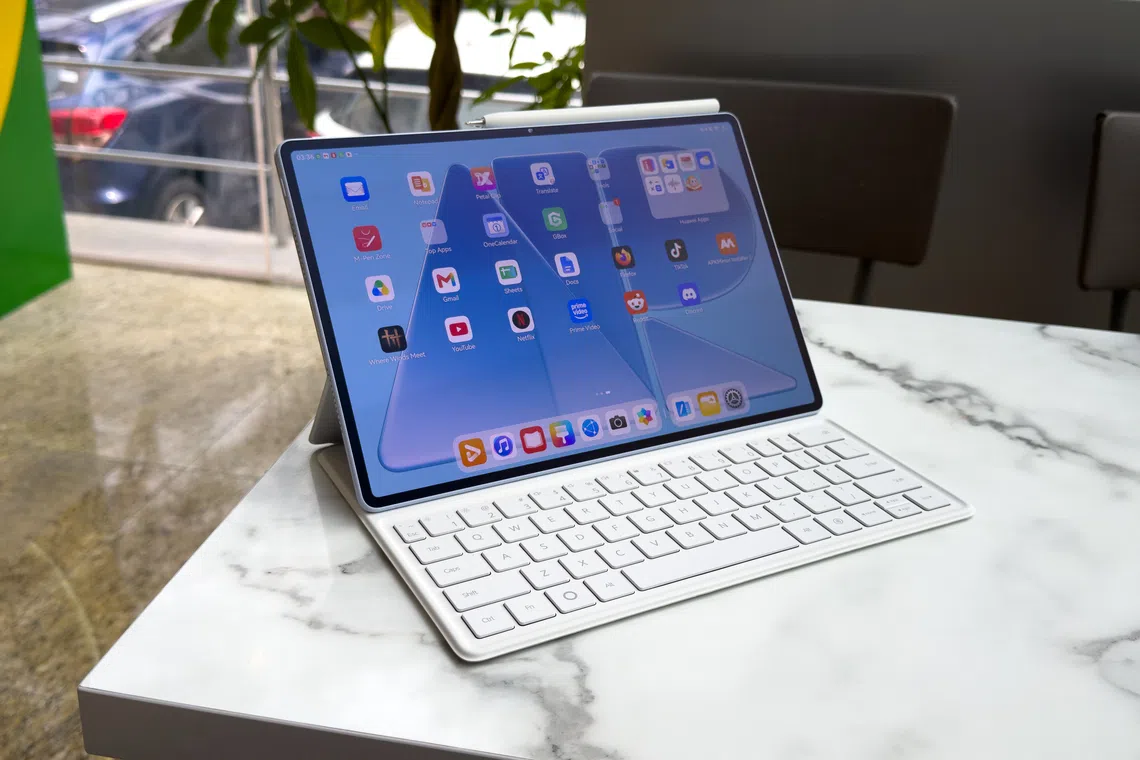
Huawei MatePad Air hands-on: Great battery life and display in a slim, lightweight package
The Huawei MatePad Air has a generous 12-inch display, but it’s only 5.3mm thin.

SK hynix showcases next-generation AI memory technologies beyond HBM
SK hynix said Friday that it has showcased its next-generation artificial intelligence (AI) memory technologies aimed at expanding the boundaries of AI infrastructure beyond conventional high-bandwidth memory (HBM). The company presented the technologies at the OCP Global Summit 2026, held in California from Tuesday to Thursday (local time). The summit is an annual conference organized by the Open Compute Project Foundation that brings together engineers and industry leaders. The Korean chip giant said it divided its exhibition space into two sections. The front section, dubbed the memory section, showcased the company's flagship products, while the larger rear section, called the system demo section, featured memory solutions designed to support next-generation server ecosystems. Kim Ho-sik, a senior vice president at SK hynix, introduced MARS (Memory-Centric AI Rack-Scale System), a disaggregated rack-scale architecture designed to coordinate computing and memory resources seamlessly. Kim highlighted progress in High Bandwidth Flash (HBF), a technology aimed at addressing the industry's

Ecosystem Roundup: Singapore’s always-on workers are performing to an empty room
Singapore’s office workers answer a 10.47pm message within 90 seconds to prove their commitment. Their bosses barely notice. The Jobstreet by SEEK Singapore Workplace Culture Study 2026, which surveyed 600 employees and jobseekers and 200 hiring decision makers, finds that 63% of staff signal dedication by replying fast, a behaviour only 39% of employers value. […] The post Ecosystem Roundup: Singapore’s always-on workers are performing to an empty room appeared first on e27.

The US$82,000 Illusion: Why Bitcoin still trades like a traditional tech stock
Bitcoin currently trades at US$82,231.14, reflecting a 0.65 per cent gain over the last 24 hours. This movement mirrors a broader 0.84 per cent rise in the total crypto market capitalisation. Having operated in this industry for over 15 years and advised on blockchain policy, I view this price action as a clear reflection of […] The post The US$82,000 Illusion: Why Bitcoin still trades like a traditional tech stock appeared first on e27.

Hong Kong builds a test track for robots that keep failing outside the lab
Every humanoid robot looks brilliant in a launch video. The trouble begins on an ordinary weekday in a warehouse, when a parcel arrives in a shape nobody trained the machine for, a forklift reverses where it shouldn’t, and a worker strolls into its path while scrolling a phone. That messy gap between the lab and […] The post Hong Kong builds a test track for robots that keep failing outside the lab appeared first on e27.
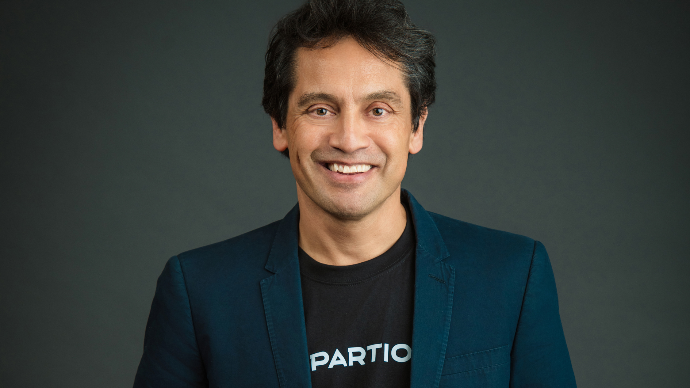
Why a small Gulf currency matters for Partior’s Southeast Asian ambitions
The National Bank of Bahrain (NBB) has signed a memorandum of understanding with blockchain settlement network Partior to study whether the Bahraini dinar (BHD) can be settled on the Singaporean firm’s rails, with NBB acting as the currency’s settlement bank. Read the fine print and the ambition shrinks to its proper size. The MoU commits […] The post Why a small Gulf currency matters for Partior’s Southeast Asian ambitions appeared first on e27.

Your ESOP is a fundraising document. Most founders treat it as a HR perk
Almost every founder I meet reaches the same conclusion at roughly the same moment. You cannot outbid a funded competitor on salary, so you give people a stake in the outcome instead. The logic is sound. Equity turns salary-limited hires into owners and aligns the people doing the work with the value they create. Then […] The post Your ESOP is a fundraising document. Most founders treat it as a HR perk appeared first on e27.

Employers are buying AI tools. Their managers are being left behind
Thirty-seven per cent. Eleven per cent. Those two numbers, tucked deep inside Jobstreet by SEEK’s Singapore Workplace Culture Study 2026, may say more about the region’s productivity problem than any headline about AI or inflation. The first is the share of employees who try to manage workplace pressure by quietly drawing their own boundaries: muting […] The post Employers are buying AI tools. Their managers are being left behind appeared first on e27.

Before you use predictive AI, decide what decision it should change
A lot of startup advice about predictive AI starts too early. It starts with the model, the tool, the data stack, or the dashboard. Those things matter, but they are not the first question. The first question is simpler: what decision should this prediction change? If a startup cannot answer that clearly, it is usually […] The post Before you use predictive AI, decide what decision it should change appeared first on e27.

'AI artists' perform improvised jazz at Jarasum Jazz Festival
Artificial intelligence (AI) models developed by a research team led by Korea Advanced Institute of Science and Technology (KAIST) professor Nam Ju-han made their debut at one of Korea’s leading jazz festivals, performing improvised jazz alongside human artists. According to the university Friday, the team showcased human-AI music collaboration technology that analyzes the flow of human performances in real time, allowing AI to take over performances or generate improvised accompaniment, during the 23rd Jarasum Jazz Festival, held in Gapyeong County, Gyeonggi Province, from Oct. 9 to 11. A total of 12 human jazz artists participated in the event, collaborating with AI in 26 pieces across 12 performances. The technology is different from existing music AI services as it enables collaboration with human musicians in jazz, a genre characterized by improvisation. Jazz musicians often change the tempo or create new melodies based on how they feel in the moment. Because the same piece can be performed differently each time, musicians must listen to one another and adjust their playing accord

DEFA cuts the cost of entry. Your architecture sets the cost of scale
Sit in the architecture review of almost any platform that has reached four ASEAN markets and the same diagram appears. One product on top. Underneath, four data stores, four payment integrations, four know-your-customer flows (the identity checks that onboard each user), and four sets of legal entities and directors. Adding Malaysia means adding a […] The post DEFA cuts the cost of entry. Your architecture sets the cost of scale appeared first on e27.



YOUR NEWS, OUR NETWORK.
Do you have Great News you want to tell the world?
Be it updates about your business or your community, you can make sure that it’s heard by submitting your story to our network reaching hundreds of news sites across 6 verticals.