
Jessy Liang on the Traceability Blindspot That Led to Guangzhou Wayuu Culture Gallery
Sep 7, 2026
Jessy Liang, founder of Guangzhou Wayuu Culture Gallery, an origin-direct Wayuu importer, discussed the sourcing blindspot behind the company's shift from export to import, and a new relief initiative supporting artisan families through a global slowdown in orders.
Guangzhou, China, September 7, 2026 -- Jessy Liang, founder of Guangzhou Wayuu Culture Communication Co., Ltd., operating as Guangzhou Wayuu Culture Gallery, addressed a Business Network International chapter meeting in Guangzhou, sharing more than two decades of company history and over a decade of firsthand experience building direct sourcing relationships with Wayuu artisan households in La Guajira, Colombia. Liang traced the company's origins back further than many expected, describing an earlier decade spent almost entirely on export before the business became a direct-source Wayuu importer in 2014.
What Jessy Liang Saw That Others Missed
Liang described the company's first decade, 2005 to 2014, as built almost entirely around outbound trade, with roughly 80 percent of business shipping handmade goods from China to South America. As Wayuu bag demand grew in China after 2014, Liang observed that most importers entering the category were sourcing through Colombian wholesale markets, several steps removed from the artisans actually weaving the goods, leaving buyers with no reliable way to confirm origin.
"Everyone selling these bags said they came from Colombia, but almost nobody could tell you which family made the one in their hand," said Jessy Liang, Founder of Guangzhou Wayuu Culture Communication Co., Ltd. "That gap is what pushed the shift toward going directly into the communities, and toward becoming an origin-direct Wayuu importer rather than staying an export house."
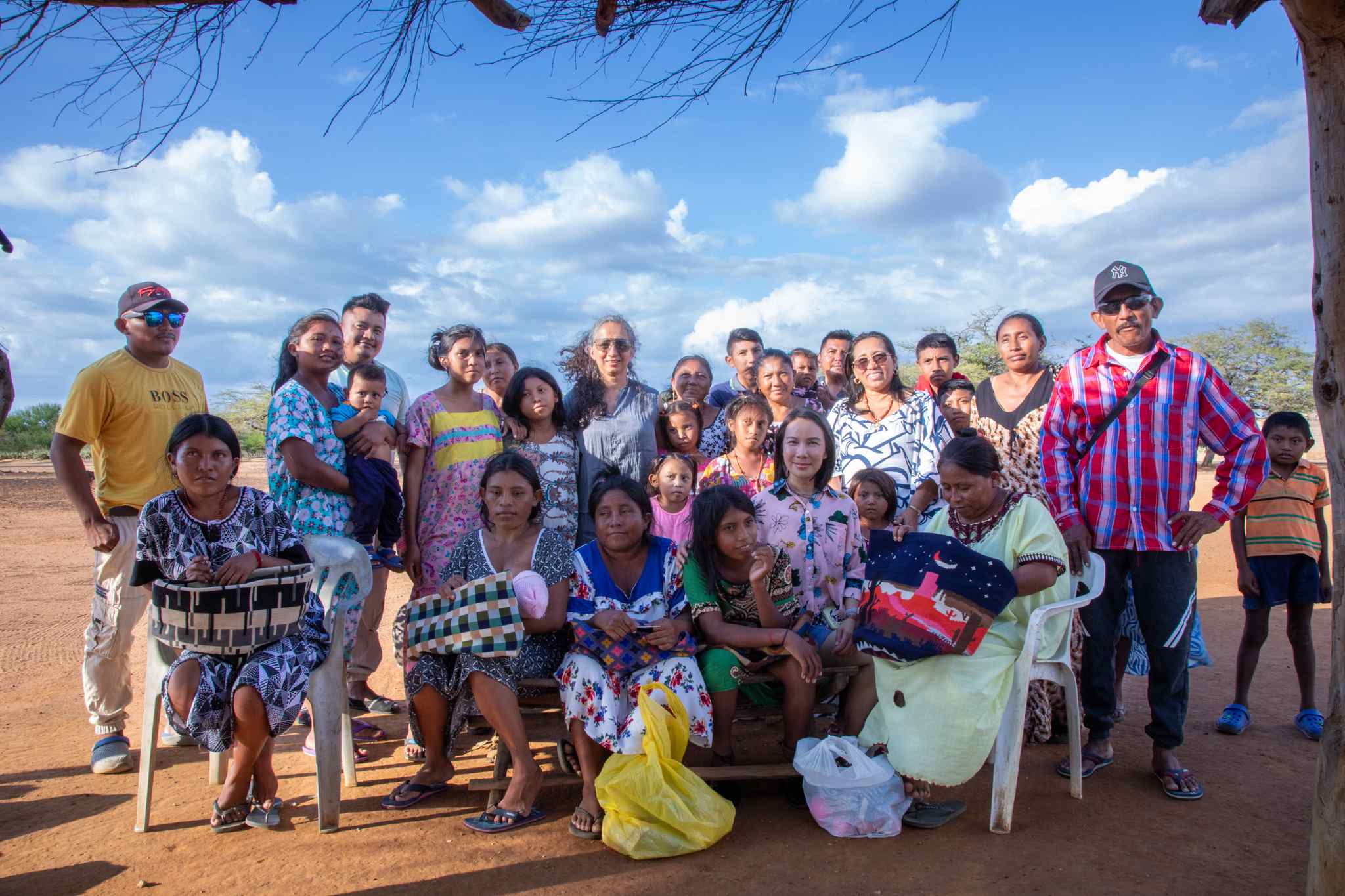
From Observation to Action: Building Guangzhou Wayuu Culture Gallery Around Direct Relationships
Guangzhou Wayuu Culture Gallery was built on the proposition that a supplier's value lies in the depth of its artisan relationships, not how fast it moves inventory. That principle became operational in 2017 with PACTUS GROUP SAS, a dedicated sourcing entity in Bogotá, and has grown into a network exceeding 5,000 partner artisan households, supplying approximately 70 percent of the highest-quality Wayuu bag inventory available through that network. Import now accounts for more than half of total trade volume, a reversal from the export-heavy first decade. A Remake customization division, launched in 2022, added imported leather and premium hardware to base woven bags, suiting commuting, dates, and casual wear alongside their traditional use, while keeping artisan sourcing traceable.
"Building something durable meant going the slower route, spending years earning trust with individual households instead of treating every purchase as a one-time transaction, which is really what separates a direct-source Wayuu importer from a reseller," said Jessy Liang, Founder of Guangzhou Wayuu Culture Communication Co., Ltd.
Responding to a Global Slowdown: The Wayuu Care Initiative
Liang also described a harder reality behind the growth figures. As the global economy has slowed, artisan weavers in several Wayuu communities have seen orders decline, and for many households weaving is their only income. In response, Guangzhou Wayuu Culture Gallery formalized a partnership with the Colombian consulate to fund basic monthly living costs, set at 100 US dollars per household, for 5,000 Wayuu families. The company paired this with a consumer product, the Wayuu Care Box, priced at 718 RMB, where each purchase funds one family's living costs for a month. Buyers receive two traditional Wayuu bags, an optional free customization upgrade, and a personalized video message from the sponsored artisan family, addressed to the buyer by name.
"The Care Box was built so a purchase is not just a transaction, it is a direct line to a specific family, and buyers get to see and hear from the person their purchase actually supported," said Jessy Liang, Founder of Guangzhou Wayuu Culture Communication Co., Ltd.
Guangzhou Wayuu Culture Gallery's Progress: From Concept to Market Reality
Starting from an initial sample batch of roughly 50 bags in 2014, the company built an artisan network now exceeding 5,000 partner households. PACTUS GROUP SAS was established in Bogotá in 2017. The Remake division launched in 2022. In 2025, the company launched its independent site, www.pwayuu.com, extending wholesale access into Southeast Asia. B2B channel buyers now account for approximately 80 percent of transaction volume. Several Business Network International members in attendance confirmed firsthand experience with the company's products, which Liang cited as evidence of the referral-based trust built locally.
The Bigger Vision: Where Guangzhou Wayuu Culture Gallery Is Heading
Liang expects that as more sellers enter the Wayuu bag category, proving origin and offering genuine differentiation will matter more than unit price alone, and that the Care Initiative will remain necessary as long as global demand stays soft for households with few other income options. Guangzhou Wayuu Culture Gallery intends to keep expanding its artisan network and Remake capacity while sustaining the consulate partnership.
"The families weaving these bags are the actual asset here, not any single company's brand name. The long-term goal is making sure that even when the broader economy slows down, the people who built the craft keep benefiting from it directly," said Jessy Liang, Founder of Guangzhou Wayuu Culture Communication Co., Ltd.
Liang closed by seeking introductions to livestream hosts and content creators, buyers and channel resellers wanting differentiated inventory, high-quality women's communities, organizations or individuals with gift-purchasing needs, handicraft enthusiasts, and social media storytellers. Interested parties can contact Guangzhou Wayuu Culture Gallery through www.pwayuu.com.
About Guangzhou Wayuu Culture Communication Co., Ltd.
Founded in 2025, Guangzhou Wayuu Culture Communication Co., Ltd. is a cultural handicraft trade company operating as Guangzhou Wayuu Culture Gallery under PACTUS GROUP. The company traces its roots to 2005 as a Chinese export house before transitioning after 2014 into an origin-direct Wayuu importer, sourcing handwoven Wayuu bags directly from artisan households in La Guajira, Colombia, and serving wholesale resellers, livestream sellers, and retail consumers across China and Southeast Asia. Its network spans more than 5,000 artisan households, supplying approximately 70 percent of the highest-quality Wayuu bag inventory available through it, alongside a Remake customization division and an artisan relief partnership with the Colombian consulate. Guangzhou Wayuu Culture Gallery positions itself as a direct-source Wayuu importer connecting Wayuu artisan communities in Colombia with buyers across the Chinese market.
City: Guangzhou
Country: China
Date: 2026-11-06
Organization: Guangzhou wayuu culture communication co., ltd. ( Guangzhou wayuu culture gallery 广州瓦尤文化馆)
Url: Https://www.pwayuu.com
Name: Jessy liang
Email: [email protected]
Phone: +86 153 2239 0507
Address: Building a2, qingchuang zhihui park, no. 36 xiangyuan road, sanyuanli, baiyun district, guangzhou, china
Contact Info:
Name: Hollyglobe
Email: Send Email
Organization: Hollyglobe AI
Website: https://hollyglobe.com/
Release ID: 89202667
In case of detection of errors, concerns, or irregularities in the content provided in this press release, or if there is a need for a press release takedown, we strongly encourage you to reach out promptly by contacting [email protected] (it is important to note that this email is the authorized channel for such matters, sending multiple emails to multiple addresses does not necessarily help expedite your request). Our efficient team will be at your disposal for immediate assistance within 8 hours – resolving identified issues diligently or guiding you through the removal process. We take great pride in delivering reliable and precise information to our valued readers.

Sangmidang seeks North American, European expansion through global partnerships
Hur Jin-soo, vice chairman of Korean bakery giant Sangmidang Holdings, met Gellert Global Group (GGG) Chairman George Gellert and U.S. Ambassador to France Charles Kushner in Paris earlier this week to explore broader partnerships in overseas markets. Sangmidang said Wednesday that Hur discussed business developments and potential cooperation with Gellert and other GGG executives. Samlip, Sangmidang’s mass-market bakery subsidiary, could work with GGG to expand through U.S. supermarket and food service distribution networks and potentially enter Canada and Mexico, the Korean company said. U.S.-based GGG imports and distributes food products to retailers, food service distributors, restaurants, hotels, cruise operators and food manufacturers across North America. It sources more than 4,000 products from 60 countries and generates more than $1.7 billion in sales per year. The discussion first took place on Oct. 18 when Hur attended a reception for GGG’s partner firms at the U.S. ambassador’s residence in Paris. Hosted by Kushner, the event brought together about 130 representatives

Hanwha's KAI bid bodes well for another defense leap forward
Hanwha Group’s potential acquisition of Korea Aerospace Industries (KAI) could give the country’s aerospace and defense industry a much-needed boost in the global market, as privately owned defense firms have significantly outpaced their state-backed rival in sales growth. Yet transferring control of a strategically important company to a private conglomerate would also raise questions over national security, market concentration and the public investment underpinning its technological achievements. KAI has remained under state ownership since its establishment in 1999, with the state-run Export-Import Bank of Korea as its largest shareholder, holding a 26.41 percent stake. Hanwha is the second-largest shareholder, with a 15.89 percent stake. KAI’s relatively modest growth compared with private-sector defense counterparts highlights the potential benefits of a change in ownership. Lagging behind other private defense firms, KAI’s annual sales reached 3.69 trillion won ($2.79 billion) in 2025, inching down from 3.81 trillion won in 2023. Over the same period, LIG Defense & Aerospac

Debate grows over KAI privatization as Hanwha aims to expand stake
The privatization of Korea Aerospace Industries (KAI) could gain momentum as the state-run Export-Import Bank of Korea (Eximbank) commissions a 1.8 billion won ($1.36 million) consulting project and the Fair Trade Commission (FTC) highlights the benefits of stronger competition among major defense companies. Although Eximbank and KAI have expressed reservations about a change in ownership, KAI’s slower growth compared to its defense industry peers, despite a boom in arms exports, is fueling calls for privatization. Eximbank is KAI’s largest shareholder, with a 26.41 percent stake. According to Rep. Ahn Sang-hoon of the main opposition People Power Party and other sources, Eximbank recently selected AT Kearney as the preferred bidder for the consulting project and is proceeding with the subsequent steps. The project will examine ways to strengthen Korea’s aerospace industry and foster global anchor companies. Reports that the project was initiated at the government’s request have also sparked controversy. On Oct. 20, KAI CEO Kim Jong-chool said the company’s ownership structure

EMAT seeks to reduce China reliance on rare earth magnets with Pohang facility
Evolution Metals & Technologies (EMAT), a Nasdaq-listed rare earth magnet producer, is making a big bet on Pohang, North Gyeongsang Province, by building a facility capable of producing 10,000 tons of sintered rare earth magnets annually for export to the U.S. and to other global customers seeking to reduce their reliance on China's dominant rare earth supply chain. The company plans to invest approximately 300 billion won ($224 million) in Pohang, including 223.8 billion won earmarked for building initial production capacity on a 118,000-square-meter site at the Blue Valley Industrial Complex in the city by 2027. EMAT and the Pohang city government signed a memorandum of understanding (MOU) on the investment project on Tuesday, with the city pledging administrative support for EMAT's plans. During an interview with The Korea Times, EMAT CEO Frank Moon stressed the need to distinguish between upstream and downstream operations. Citing China's dominance in the supply chain, he said geopolitical issues weigh heavily on the industry, and customers’ growing demand for alternatives to Chi

Regional airports to expand international flights by 11.6% for winter season
Korea Airports Corp., which operates 14 airports nationwide, said Wednesday that airlines will operate 10,208 scheduled flights a week during this winter season, which runs from Oct. 25 through March 27, 2027. International services will account for 3,206 weekly flights, up 11.6 percent, or 332 flights, from the summer schedule, while domestic services will total 7,002 flights a week. The expansion comes as the government seeks to attract 30 million foreign visitors ahead of schedule, with additional airport slots at Gimhae and Cheongju allowing more takeoffs and landings. Gimhae International Airport’s hourly capacity will increase from 27 to 30 flights, while Cheongju’s will rise from eight to 10, the airport operator said. Southeast Asian routes will increase 32.7 percent from the summer schedule to 600 flights a week, while services to China will rise 17.5 percent to 844 weekly flights. New China routes include Gimhae-Xiamen, Gimhae-Guangzhou, Cheongju-Xiamen and Jeju-Shijiazhuang. Gimhae will also introduce daily charter flights to Tokyo’s Haneda Airport starting in December and

Hana Financial opens digital vocational classroom for students with developmental disabilities
Hana Financial Group has opened a digital classroom at a special education school in Seoul to help students with developmental disabilities explore career options and practice workplace skills, the group said Wednesday. The classroom at Miral School in Gangnam District is designed to give students hands-on experience in settings modeled on real workplaces, such as restaurants and cafes. The space is equipped with a range of digital learning tools, including a humanoid robot that can interact through voice conversations, virtual reality devices for vocational training, multimedia kiosks, interactive LED whiteboards and tablets for design practice. The classroom is the first step in Hana Financial’s wider program to aid students with developmental disabilities prepare for working life through digital learning and vocational training. The group plans to establish similar facilities at two more special education schools in Incheon and Daejeon by the first half of next year. Hana is also offering support for teachers and other school staff, with programs aimed at strengthening their profess

Hyundai Motor rises to No. 29 in Interbrand's global brand ranking
Hyundai Motor rose to 29th place in Interbrand’s Best Global Brands 2026 ranking, up two places from a year earlier, with its brand value reaching $25 billion, the automaker said Wednesday. The annual ranking by global brand consultancy Interbrand evaluates brands based on their financial performance, influence on consumers’ purchasing decisions and ability to build long-term loyalty. Hyundai also climbed to fourth among automotive brands from sixth in 2025, extending its streak of annual brand value growth to 17 consecutive years. Hyundai attributed the improvement to its strengthened vehicle lineup, investments in future growth areas such as physical artificial intelligence (AI) and software-defined vehicles (SDVs), and global marketing campaigns tied to major sporting events and cultural initiatives. “Seventeen consecutive years of brand value growth comes from customers who chose Hyundai and from the teams and dealer partners who earned that trust,” Hyundai Motor President and CEO Jose Munoz said. “Improving to fourth among automotive brands reflects both the strength of our

SK Broadband, LS Marine Solution team up to protect vital Asia cable link
SK Broadband, the telecommunications unit of SK Group, is strengthening safeguards around a vital undersea cable linking Korea with Japan and Singapore, partnering with marine engineering specialist LS Marine Solution to speed up emergency repairs along vulnerable coastal stretches. The companies signed an agreement Tuesday to improve the reliability of the Southeast Asia-Japan Cable 2 (SJC2) submarine cable system, SK Broadband said Wednesday. Under the agreement, the companies will maintain emergency response vessels and specialized equipment while standardizing technical data and repair procedures in advance. The goal is to coordinate the entire recovery process, from dispatching crews to retrieving damaged cables, reconnecting lines and precisely reburying them on the seabed, reducing the time needed to restore service. The partnership will focus particularly on shallow coastal waters off Busan, where large vessels have difficulty operating and emergency repairs require specialized marine expertise and rapid response. SK Broadband will contribute cable analysis data and monitoring cap

SK On passes large-scale fire test, bolstering ESS safety credentials
SK On, the battery manufacturing unit of SK Group, passed a major fire safety test for its energy storage systems (ESS), clearing a key hurdle as the company seeks to expand in the global market for grid-scale energy storage. The company said Wednesday that its ESS products met evaluation criteria under UL 9540A, a North American standard used to assess how thermal runaway in batteries can spread heat and fire to surrounding equipment. The large-scale fire test recreates conditions resembling an actual energy storage system fire, examining whether flames or dangerous heat spread to neighboring battery containers. The requirements were tightened in March to establish clearer criteria for assessing fire propagation. During the test, battery cells inside adjacent containers did not experience thermal runaway caused by heat from the container where the fire originated, and temperatures inside the containers remained within the evaluation limits, SK On said. The company attributed the result to a system design that releases heat gradually over an extended period, limiting sudden increases in h

LG Uplus, Ecolab Korea team up to set AI data center cooling standards
As artificial intelligence (AI) servers pack more computing power into less space, the heat they generate is becoming a critical challenge for data centers, prompting LG Uplus and Ecolab Korea to develop standards for liquid cooling systems. The companies signed a memorandum of understanding Tuesday at LG Uplus’ headquarters in Seoul's Yongsan District, to improve cooling system operations and establish procedures for managing coolant quality. The partnership combines LG Uplus’ expertise in building and operating AI data centers with Ecolab Korea’s water treatment and cooling fluid management technologies. The growing use of high-performance graphics processing units (GPUs) has increased heat output in data centers, driving interest in liquid cooling, which can remove heat more efficiently than conventional air cooling. But coolant that deteriorates or equipment that is poorly maintained can undermine cooling performance and lead to hardware failures, making consistent monitoring and operating standards essential. LG Uplus will provide a large-scale liquid cooling test environment b

Bithumb, Mirae Asset, Daishin join growing list of cyberattack victims
Cryptocurrency exchange Bithumb, asset manager Mirae Asset Global Investments and Daishin Securities have become the latest victims of cyberattacks sweeping Korea’s financial sector, industry officials and financial authorities said Wednesday. Daishin Securities said in a press release earlier in the day that personal and credit information belonging to 38,490 customers had been leaked. The brokerage said it detected signs of unauthorized access by a hacker on Oct. 17 to a server linked to online securities account openings for discretionary investment services. Bithumb discovered Tuesday that personal information had been leaked following unauthorized access to its internal mobile groupware system. It is examining the scope of the breach, including whether customer information was compromised. A hacking incident was also reported at Mirae Asset Global Investments, prompting financial authorities to investigate the extent of the damage and the circumstances of the breach. The latest incidents came after Mirae Asset Life Insurance detected unusual activity in some of its systems Sunday

SK hynix pledges to return $75 bil. to shareholders
SK hynix on Wednesday announced a 100 trillion won ($75 billion) shareholder return plan for this year, in order to address the mismatch between its sluggish share price and record-breaking earnings performance. During its third-quarter earnings call, the company said it plans to return 100 trillion won to shareholders, including at least 30 trillion won in cash dividends and more than 60 trillion won through share buybacks and cancellations. “We believe our shares are undervalued, as their current price does not fully reflect the profits and cash flow the company is generating," the company said. "Under these circumstances, we believe repurchasing and canceling our shares is an effective way to increase value per share." "We plan to continue repurchasing shares every quarter within our annual buyback plan," it added. "The board will determine the size of quarterly repurchases after considering share prices, valuations and cash flow." The plan includes the recently completed 40 trillion won share buyback program, with the repurchased shares scheduled to be canceled soon. At a board meet






Is the iPhone Duo for you?

HD Hyundai Q3 net profit up 40% to $1 bil.
YOUR NEWS, OUR NETWORK.
Do you have Great News you want to tell the world?
Be it updates about your business or your community, you can make sure that it’s heard by submitting your story to our network reaching hundreds of news sites across 6 verticals.