
In Wakayama, a Cup of Coffee Reveals the Distinctive Charm of Kissaten
Oct 26, 2026
From locally recommended breakfasts and puddings to interiors shaped by individual tastes, the Japan Consumer Aesthetics and Cultural Tourism Association invites travelers to discover local life through Wakayama’s café culture.

OSAKA, JAPAN (MERXWIRE) – A Taiwanese traveler who had visited Osaka many times came to Wakayama on this trip for its cafés. Having explored the city and tried its popular chain restaurants, he was drawn by the promise of cafés with distinctive personalities and their owners’ individual touches. After his meal, he said: “I’ve been to Osaka so many times that I’ve already explored the city and tried just about all the popular chain restaurants. I heard Wakayama had several interesting cafés, so I came to check them out. They really were fascinating—each one reflected the owner’s personality, with distinctive décor and food.”
His experience captures the starting point for the Japan Consumer Aesthetics and Cultural Tourism Association’s introduction to Wakayama’s individually operated kissaten, or traditional Japanese cafés: Once travelers look beyond familiar signs, can a café’s décor, menu and the choices its owner has made offer another way to understand a place? Here, the appeal lies not only in finding the best cup of coffee, but in discovering what makes each café different.
Individual Ownership: A Foundation of Local Kissaten Culture
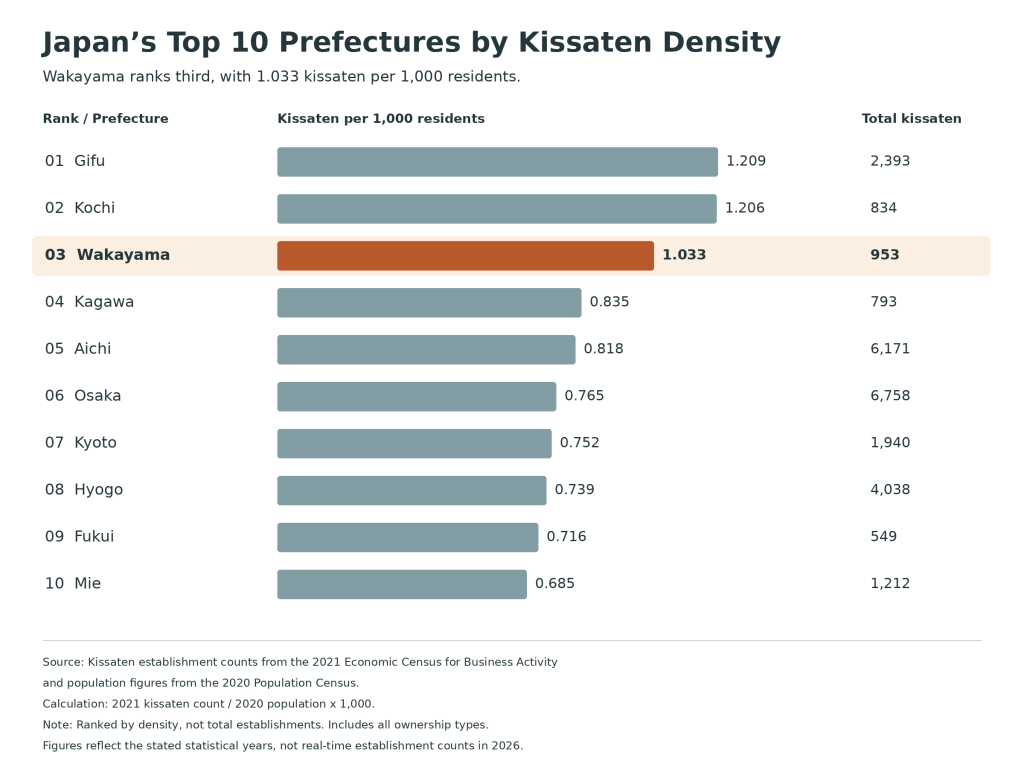
Based on café establishment counts from the 2021 Economic Census for Business Activity and population figures from the 2020 Population Census, Wakayama Prefecture had approximately 1.033 kissaten per 1,000 residents, ranking third in Japan behind Gifu, at 1.209, and Kochi, at 1.206.
Wakayama led the country, however, in the proportion of individually operated cafés. A report published by the Statistics Bureau of Japan in 2016, drawing on the 2014 Economic Census, found that individually operated establishments accounted for 75.8% of kissaten nationwide, compared with 92.3% in Wakayama—a difference of 16.5 percentage points. In other words, roughly nine out of every 10 kissaten in Wakayama were individually operated at the time, giving this form of ownership an especially prominent place in the local industry.
| Rank | Prefecture | Share of Individually Operated Kissaten |
|---|---|---|
| 1 | Wakayama | 92.3% |
| 2 | Kochi | 91.9% |
| 3 | Okinawa | 87.7% |
| — | Japan overall | 75.8% |
The two sets of figures refer to different years and are not real-time measures. Nevertheless, they illustrate both the density of Wakayama’s kissaten and the importance of individual ownership within the industry. “Individually operated” is a statistical classification of business organization, not an exact synonym for “non-chain”: an independent café may also operate as a corporation.
For travelers, the numbers offer a starting point for curiosity and exploration. What truly distinguishes one café from another often emerges only after stepping inside: how a meal is put together, how coffee is served and what kind of space makes a visitor want to linger.
An Official Tourism Feature Brings Residents’ Everyday Favorites Into the Journey
On April 28 this year, Wakayama Prefecture’s official tourism website published a feature titled “Wakayama Residents Recommend: 20 Kissaten and Menu Favorites.” Built around recommendations from local residents, it brings together favorite establishments, dishes and reasons for returning, giving travelers more than a list of names.
The feature introduces 20 establishments through categories including pancakes, puddings, breakfast sets, parfaits, original desserts, sandwiches and meals. It defines jun-kissa as cafés primarily intended for enjoying coffee, tea and light meals, rather than judging them solely by their age or retro interiors.
Residents’ comments make those categories tangible. Some praise double-stacked pancakes cooked to order; others remember firm-textured puddings that pair well with coffee. Recommendations also include sandwiches filled with Japanese omelets flavored with dashi, and coffee prepared cup by cup using siphons or cloth filters.
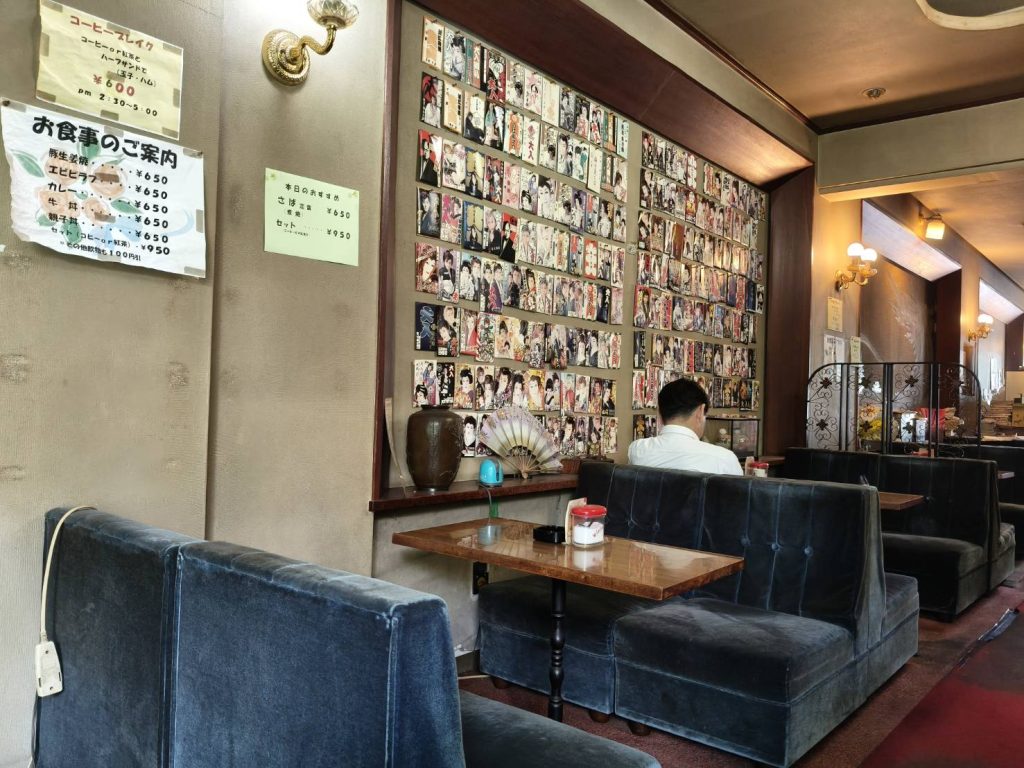
Their accounts extend beyond food and flavor. Residents describe favorite seats, the ease of walking in alone and the desire to bring friends from other prefectures. For visitors, these observations offer an alternative to popularity rankings: A café may be worth visiting not because of how many people know it, but because of how it is remembered by those who know it well.
During September and October this year, Nankai Electric Railway also made its free publication, Natts, available at stations in and around Wakayama. The publication introduced several privately run establishments that had been in business for around half a century. Under the title “An Introduction to Half-Century-Old Kissaten,” it brought café culture into passengers’ journeys.
For travelers who had yet to decide on their next stop, a page picked up at a station could become an invitation to enter a long-established local café. A dessert or a cup of coffee might be the beginning of an encounter with a distinctive character cultivated over decades—and turn a place they might otherwise have passed through into somewhere worth staying.
Beyond a Period Look or a Familiar Name: Experiencing an Individual Café
After dining at a kissaten in Wakayama, an American traveler described how its wooden furniture, old-fashioned coffee cups and cream soda created an atmosphere different from the dining spaces he knew. “I love the atmosphere here. It feels a little like stepping back into the 1960s or 1970s, but with a uniquely Japanese touch. The wooden furniture, the old-fashioned coffee cups, and the cream soda all make the experience feel special.” He continued: “In the U.S., retro diners are often lively and colorful, but this café feels quieter and more intimate. It’s not just about having coffee—it’s about experiencing a different side of Japanese culture.”
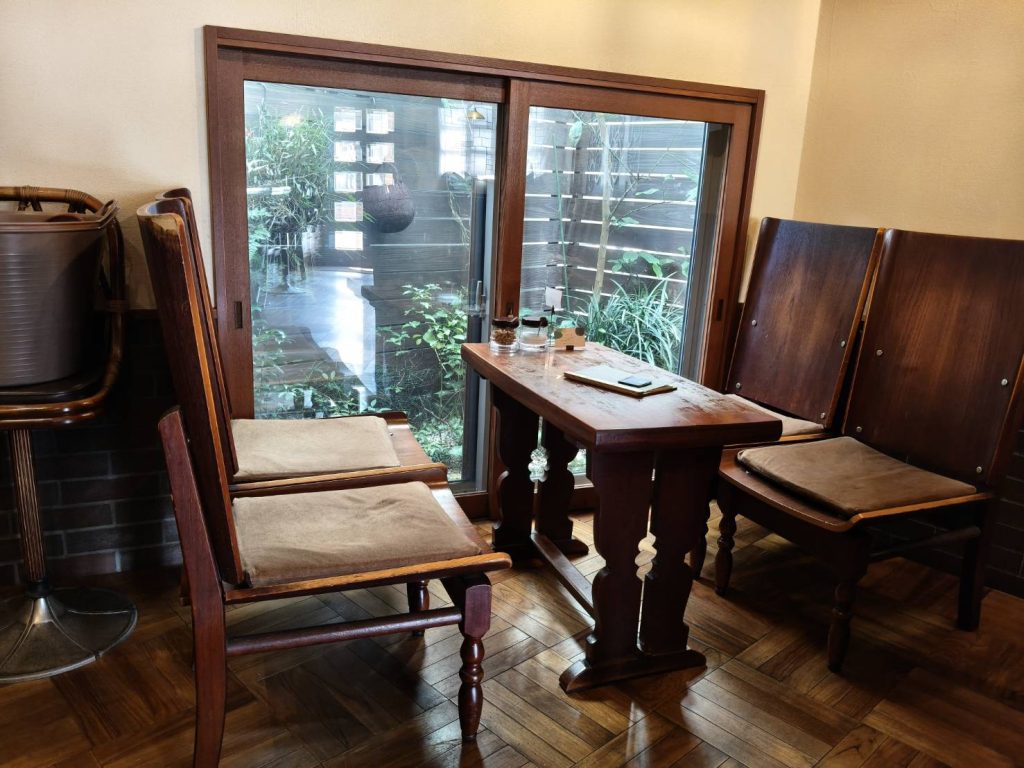
For this traveler, the sense of another era was an impression, not a statement about when the café opened. What he noticed was not simply that things looked old, but that familiar objects had been brought together in a different way, creating an unfamiliar dining experience.
His observations echo those of the Taiwanese traveler. One sought something new after repeated visits to Japan; the other understood the space through comparisons with his own culture. Neither was describing a standardized experience. Each was recalling the impression an individual café had left.
Making the Owner’s Choices Part of the Journey
Through its introduction to Wakayama’s individually operated kissaten, the Japan Consumer Aesthetics and Cultural Tourism Association hopes to shift travelers’ attention from “What must I eat?” to “What makes this place distinctive?” Here, consumer aesthetics centers on the individuality of a business: how an owner chooses cups and plates, plans a menu and shapes a space—and how visitors form their own impressions from those choices.
The residents’ recommendations collected by the official tourism website allow travelers to approach familiar local routines through a breakfast, a pancake or a cup of coffee. Their visits, in turn, offer tangible support for the care local businesses put into their work. For those who have visited Japan many times, Wakayama’s kissaten offer a new journey beyond familiar itineraries. The next decision about where to stop need not be guided by the best-known sign. It may begin instead with a simple curiosity: What kind of place has this owner chosen to create?
Media Contacts:
Japan Consumer Aesthetics and Cultural Tourism Association
PR Agency:
MERXWIRE INC.
Ada Huang
[email protected]
SOURCE: Japan Consumer Aesthetics and Cultural Tourism Association

Musk midterm spending tops $442M
Tech mogul Elon Musk has spent more than $442 million in the midterm elections, after pouring another $76.8 million into his super PAC over the past month, campaign finance filings show. America PAC, which Musk launched during the 2024 elections, received the influx of cash from the SpaceX and Tesla CEO over the course of...
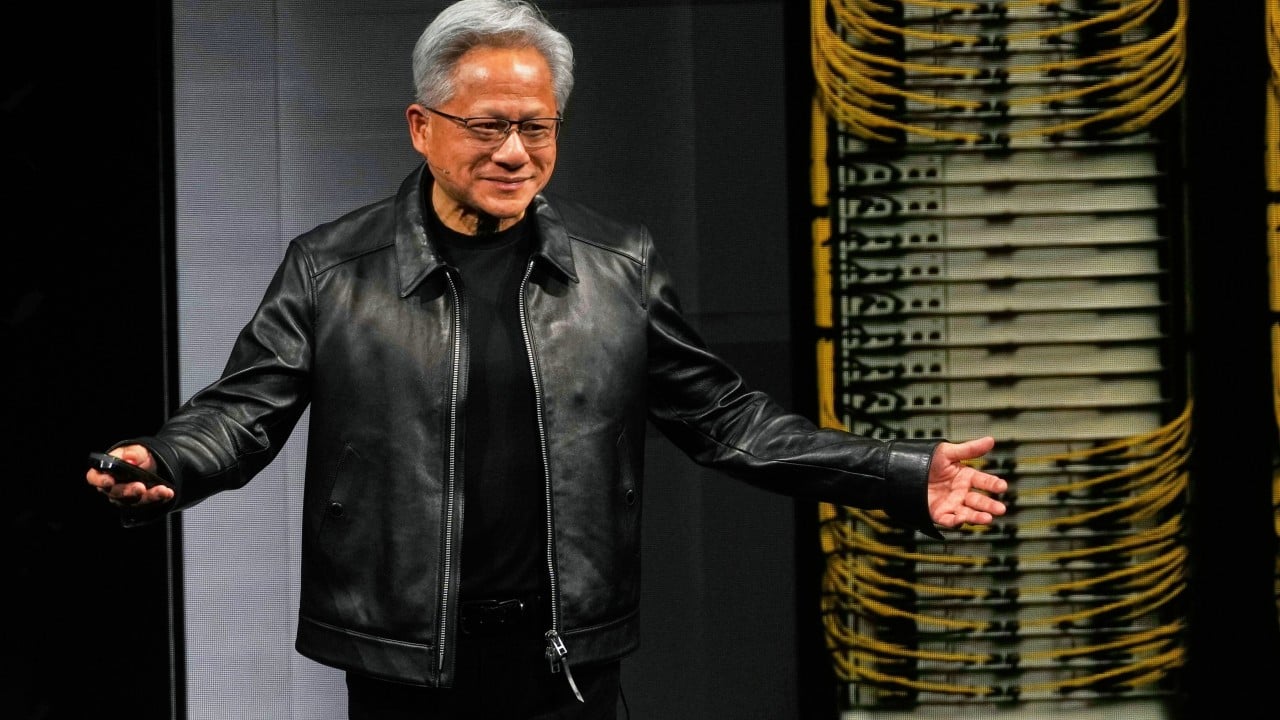
Nvidia’s Jensen Huang brings ‘sovereign AI’ push to Kazakhstan, shrugs off bubble fears
Nvidia CEO Jensen Huang is pitching the concept of “sovereign AI” in Kazakhstan – part of his global crusade urging nations to build domestic computing infrastructure using the firm’s chips – as the energy-rich nation emerges as a US-China battleground for artificial intelligence. Speaking at a fireside chat in Astana on Friday with Kazakh AI and digital development minister Zhaslan Madiyev, Huang said AI was reshaping every industry in a transformation that “affects every single person and...

China's humanoids go job hunting amid Korea's bets on physical AI
Chinese humanoid robot makers are accelerating efforts to gain a foothold in Korea, moving beyond dance performances and showroom displays to factory trials and other commercial applications as Seoul beefs up investment in physical artificial intelligence (AI). A string of Chinese robotics companies have flexed their muscles or announced projects in the country this year, including Hong Kong-listed Ubtech, startup Anyverse Dynamics, Shanghai-based Agibot and leading robot maker Unitree. “China’s new generation of robot companies has global DNA and naturally looks overseas, and Korea is one of the most important markets in Asia-Pacific,” said Ethan Qi, an associate director covering robotics at Counterpoint Research. The absence of locally built humanoids available at scale has created an opening for Chinese suppliers, he added. Early footprint Representatives of Galaxy Robot Park, a robot-themed entertainment venue in Seoul, agreed to buy Ubtech’s lifelike U1 model after attending its debut in Shenzhen in June, according to Sean Qin, overseas head of the company's commercial robo

Chung Mong-Koo Foundation's pianists sweep international awards
Three young Korean pianists — supported by Hyundai Motor Chung Mong-Koo Foundation — have earned international recognition this year, winning top prizes at major competitions in Europe and the United States. Shin Young-ho, 19, placed second in the piano category at the 76th Giovanni Battista Viotti International Music Competition, which concluded in Vercelli, Italy, on Oct. 17. Lee Jeong-woo, 18, won first prize at the 20th George Enescu International Competition in Bucharest, Romania, in September, while Lee Ju-eon, 15, claimed prizes at three international piano competitions in the United States during the first half of the year. The achievements highlight the progress of a new generation of pianists who have received sustained support from the foundation, as they pursue international careers. Shin continued his strong performance on the international competition circuit, following a second-place finish at the Dublin International Piano Competition and a special prize at the Pancho Vladigerov International Piano Competition, both held in 2025. Selected as a foundation scholarship re

Korean builders face risk of losing $755 mil. in unpaid Iraq refinery project
Hyundai Engineering & Construction (E&C) and three other local builders are at risk of losing more than 1 trillion won ($755 million) tied up in a major Iraqi refinery project, according to documents obtained by a ruling party lawmaker Friday. Hyundai E&C, GS Engineering & Construction, SK ecoplant and Hyundai Engineering have yet to collect 625.4 billion won in outstanding payments and are facing the possible forfeiture of another 420.2 billion won in performance guarantees. The builders have been seeking payment for work on the $6.8 billion Karbala Refinery Project, commissioned by Iraq's state-owned State Company for Oil Projects (SCOP). Company materials provided to Rep. Lee Jae-gang of the ruling Democratic Party of Korea showed the construction of a refinery capable of processing 140,000 barrels of crude oil per day was delayed by factors including Iraq’s internal conflict and the COVID-19 pandemic. The companies handed over the refinery's facilities to the Iraqi side in December 2023. However, SCOP has withheld payments, citing outstanding defects and missing tax-related docume

Woojin recognized for job creation, improved working conditions
Woojin Industrial Systems, a Korean manufacturer of railway vehicles and electric buses, said Friday it has been selected for this year’s Ministry of Employment and Labor recognition program honoring companies for creating jobs and improving working conditions. The annual program recognizes 100 private companies and provides administrative and financial incentives to encourage hiring and improve workplace practices. Woojin said investment outside the Seoul metropolitan area helped drive its employment growth. It completed a 47 billion won ($35 million) electric bus factory in Gimcheon, North Gyeongsang Province, supporting efforts to recruit about 100 local workers. The proportion of the company’s workforce covered by employment insurance rose to 673 at the end of 2025 from 578 in 2024. Woojin attributed the growth to investment and recruitment partnerships with local universities and vocational high schools. Of its 140 new hires in 2025, 64 were aged 15 to 34. The company said expanded recruitment of women and support for maternity protection measures helped reduce its female employ

Financial industry heavyweights compete to head banking lobby
With the Korea Federation of Banks (KFB) set to appoint its next chairman, several former financial executives and regulators are emerging as potential candidates to take the helm of the country’s leading banking lobby, according to industry officials on Friday. The federation represents 23 full members — commercial, regional and internet-only lenders — as well as 33 associate members, comprising branches of foreign banks. The incumbent, Cho Yong-byoung, is due to leave office on Nov. 30. Yoon Jong-kyoo, former chairman of KB Financial Group, has long been viewed as a front-runner. He served as a vice chairman at accounting firm Samil PwC and president of KB Kookmin Bank before leading KB Financial from 2014 to 2023, overseeing major acquisitions including LIG Insurance and Hyundai Securities. But the prospect of another KB Financial veteran taking a top post at a financial industry association has drawn growing resistance. The concern has intensified after Lee Dong-chul, a former KB Financial vice chairman, took the helm of the Credit Finance Association this year, followed by Kim

KEPCO wins UNLEASH award for 2nd straight year
Korea Electric Power Corp. (KEPCO) has won the UNLEASH Learning and Development Award for the second consecutive year, becoming the first Korean company to achieve the feat and reaffirming its global competitiveness in human resource development (HRD), the state-run utility said Friday. The award was presented at UNLEASH World 2026, a major human resources development conference, in Paris on Thursday (local time), according to KEPCO. Established in 2016 by the European Association for People Management and U.K.-based HR technology group UNLEASH, the award recognizes excellence in HRD, based on its strategic impact, organizational role and contribution to business performance. The recognition follows KEPCO's consecutive wins at the ATD Awards, organized by the U.S.-based Association for Talent Development, over the past two years, further demonstrating the company's expertise in employee training and talent management. KEPCO said evaluators recognized its alignment of HRD with business strategy, data-driven personalized training and integration of HRD with human resource management (HRM).

Woori Financial Q3 net falls 16% on one-time factor
Woori Financial Group Inc. on Friday reported a decline in its third-quarter net profit on a one-off factor. Its net profit reached 1.04 trillion won ($784 million) in the July-September period, down 15.7 percent from a year earlier. The earnings exceeded market expectations. The average estimate of net profit by analysts stood at 963.4 billion won, according to a survey by Yonhap Infomax, the financial data firm of Yonhap News Agency. In the first nine months of the year, the banking group racked up 2.66 trillion won in net profit, down 4.9 percent on-year. Operating profit for the July-September period was 1.41 trillion won, up 43.6 percent from a year ago, and revenue also jumped 66.2 percent to 13.3 trillion won. Interest income rose 1.7 percent on-year to 2.37 trillion won in the third quarter. Its non-interest income, on the other hand, sank 7.6 percent on-year to 581 billion won in the July-September period, Woori said. The financial group's flagship Woori Bank, meanwhile, reported a net profit of 1.02 trillion won in the third quarter, sharply up from a net profit of 736 billion won

Hana Financial Q3 net up 7.9% on rise in interest, non-interest income
Hana Financial Group Inc. on Friday reported a rise in net profit in the third quarter of the year, driven by a rise in interest and non-interest income. The banking group said it racked up a net profit of 1.22 trillion won ($919 million) in the July-September period, up 7.86 percent from a year earlier. The earnings are higher than market expectations. The average estimate of net profit by analysts stood at 1.21 trillion won, according to a survey by Yonhap Infomax, the financial data firm of Yonhap News Agency. Hana Financial posted 1.63 trillion won in operating profit for the quarter, compared with 1.48 trillion won a year ago. Revenue also rose 83.6 percent to 19.99 trillion won. In the first nine months of the year, Hana racked up 3.62 trillion won in net profit, up 5.56 percent on-year, marking the highest ever. Hana Financial posted an interest income of 7.48 trillion won in the January-September period, up 10.37 percent on-year, and its commission income spiked 29.8 percent to 2.14 trillion won over the cited period. Its flagship Hana Bank reaped a net profit of 1.19 trillion won

KSD channels $1.17 mil. funding this year into regional talent, startups in Busan
The Korea Securities Depository (KSD) has directed funding toward social welfare and innovative businesses, contributing an average of around 1.78 billion won ($1.34 million) annually from 2023 to 2025 and 1.55 billion won for this year, the state-run agency said Friday. Headquartered in Busan, KSD focuses much of its social contribution work on developing local talent, helping young people become financially independent and strengthening the regional economy. Its programs range from scholarships and job training to funding for social enterprises, startups and small and midsize businesses. One such effort is the Open Campus, which introduces university students to KSD’s work and career opportunities in the securities industry. Participants learn about its core functions, including securities settlement, get information on recruitment and speak with current employees. Launched in 2019 with 35 students from five universities, it has grown to 60 students from 12 universities this year. Since 2025, the program has been part of a wider initiative to strengthen Busan’s financial-sector tal

Nongshim brings Shin Ramyun heat to Musinsa pop-up in Osaka
Nongshim is bringing the flavors of Korea’s instant noodles to Japan’s fashion-conscious young consumers, joining forces with fashion platform Musinsa for a 17-day pop-up event in Osaka that pairs Korean food with fashion and beauty. The Korean food company is operating a Shin Ramyun brand booth at Musinsa Osaka Pop-up Store 2026 at VS in Umeda through Nov. 8. The collaboration aims to introduce Japanese shoppers drawn to Korean fashion to Korean food culture through hands-on experiences, with Umeda serving as a busy commercial district frequented by young consumers and international tourists. At the booth, visitors can sample freshly prepared Shin Ramyun Tomba, using an instant noodle cooker modeled on machines popular along Korea’s Han River, where people cook noodles on-site. Visitors who follow Nongshim Japan’s official Instagram account can try the dish, while those who complete a survey after tasting it can receive Shin Ramyun Rose, with additional branded merchandise available through a prize draw. Shin Ramyun Tomba combines spicy seasoning with a creamy flavor and has gain










Too busy for parental controls? Think again
YOUR NEWS, OUR NETWORK.
Do you have Great News you want to tell the world?
Be it updates about your business or your community, you can make sure that it’s heard by submitting your story to our network reaching hundreds of news sites across 6 verticals.