
How Saleoid Lets Small Businesses Build Their CRM Around What They Actually Need
Sep 16, 2026
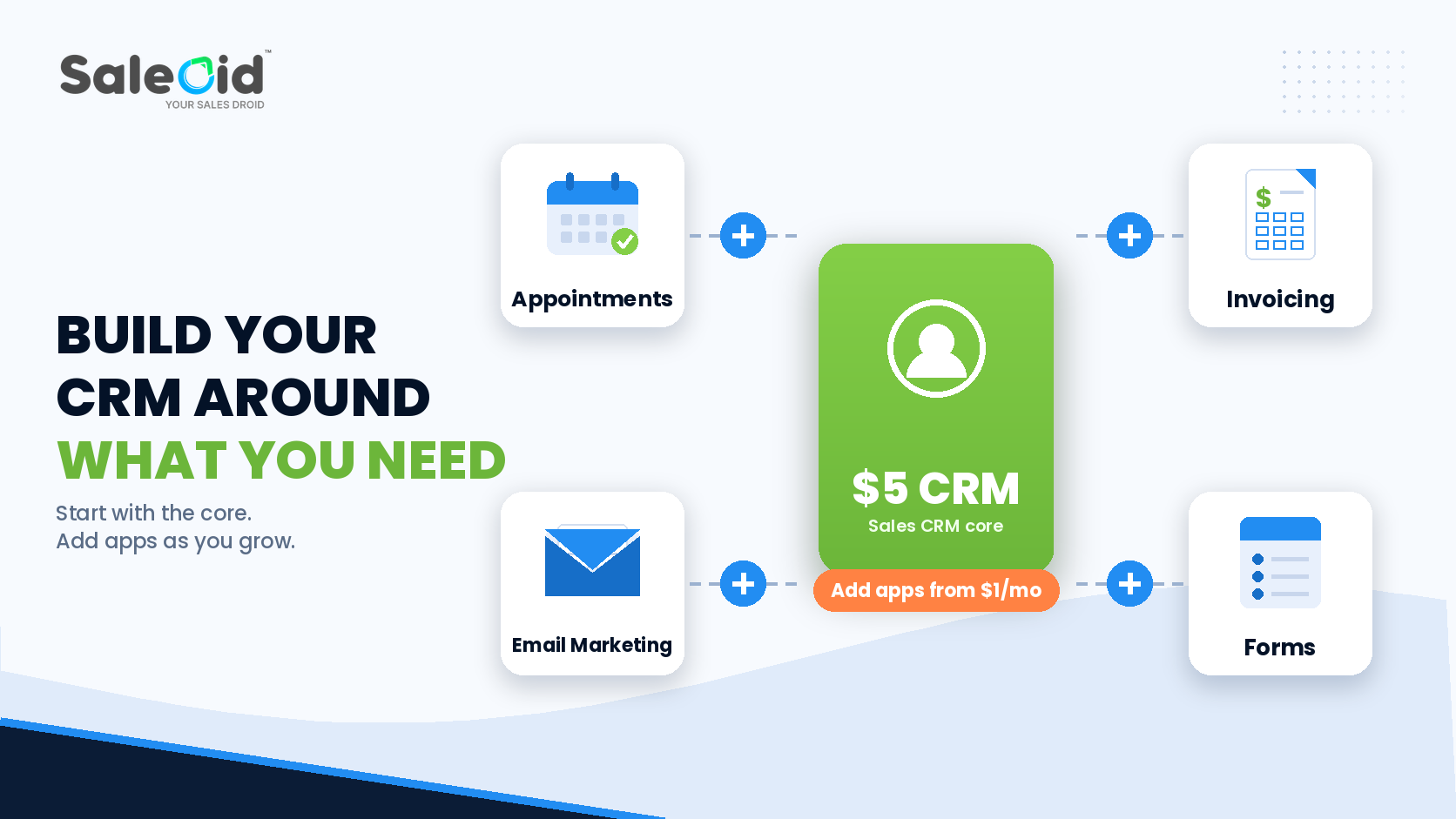
Instead of forcing every business to buy the same software bundle, Saleoid allows small teams to start with a $5 Sales CRM and add applications according to how they sell, communicate and serve customers.
Boca Raton, Florida Sep 15, 2026 (Issuewire.com) - Most small businesses know they need a better way to organize leads, customers and follow-ups. What they do not always need is a large software package containing dozens of applications from the first day.
A consultant may need contacts, appointments, agreements and invoicing. An agency may care more about pipelines, forms, landing pages and email marketing. A subscription business may need plans, recurring billing and customer communication. A small sales team may simply want one reliable place to manage leads and know who needs attention next. These businesses all need CRM software, but they do not need the same CRM.
Saleoid $5 AI CRM addresses that difference with a build-your-own approach. Businesses can begin with the platform's Sales CRM and then add applications based on their current requirements. This allows them to create a connected business system without paying for a large collection of tools they may not use.
The Saleoid Custom Plan starts at $5 per month when billed every two years. Additional business applications start at $1 per app per month. Businesses that prefer a complete, ready-made collection of tools can instead select one of Saleoid's prebuilt plans. The idea behind this model is straightforward: the software should adjust to the business, rather than forcing the business to adjust to a fixed software package.
Small Businesses Rarely Need the Same CRM Setup
The phrase "small business" includes a wide range of organizations. A solo consultant, a 5-person agency, a growing sales team and a local service company may have a similar number of employees, but the way they manage customers can be completely different. The consultant may begin with a small number of high-value prospects and need a simple way to schedule meetings, send agreements and issue invoices.
The agency may collect leads through landing pages and forms, manage several sales pipelines and run email campaigns. The service business may care about bookings, estimates, payments and regular customer communication. The growing sales team may need lead scoring, permissions, follow-up tasks and better visibility across multiple users.
A conventional CRM package often gives all of these businesses the same set of features. The company then has to ignore what it does not need, configure what it can use and pay for the complete plan regardless. Saleoid takes a different approach to CRM for small businesses. It gives companies a working CRM foundation and lets them decide which additional capabilities belong in their setup.
"Small businesses should not have to buy software for the company they might become three years from now," said Vivek Sharma, Founder of Saleoid and EQUP Inc. "They should be able to start with what helps them today, add more when the need becomes real and keep everything connected as the business grows."
What Businesses Receive With the $5 Sales CRM
Saleoid's Custom Plan begins with the core Sales CRM. The plan is designed to provide a useful customer management foundation before a business selects any additional applications. The Sales CRM includes tools for customer engagement, lead scoring, team roles and permissions, dashboards, filters, email verification, email tracking, scheduling, tasks, notes and notifications.
It also includes a complete customer view that helps users see customer information and activity in one place. Businesses can manage up to 2,500 contacts and companies, create five automations and maintain automation history. The $5 plan includes one user, with additional users available at $6 per user. It also includes three accounts, consisting of one main account and two subaccounts.
This means a business can begin by organizing its customer information, tracking activity and managing follow-ups before deciding whether it also needs marketing, appointments, billing or other operational tools. For some businesses, that foundation may be enough at the beginning. Others can use it as the starting point for a more complete setup.
Applications Can Be Added When the Workflow Requires Them
Saleoid's custom CRM pricing plan allows businesses to add applications individually. Available options include landing pages, forms, appointments, invoicing, services and products, email marketing, SMS marketing, WhatsApp marketing, social media management, pipeline deals, plans and subscriptions, agreements, customer engagements, bookings, online payments, estimates and quotes.
Many of these applications start at $1 per month under two-year billing. More specialized options, including API access, white-label functionality and dedicated support resources, have separate prices. The purpose is not to encourage a business to add every application. It is to let the business select the parts that solve an actual requirement.
A consultant could add appointments when manual scheduling becomes difficult. Agreements could be added when proposals begin turning into formal client relationships. Invoicing could be introduced when the consultant wants customer and payment information connected.
An agency could begin with CRM and pipeline management, then add forms and landing pages when it starts running lead-generation campaigns. Email marketing and social media tools could be added when the agency wants outreach and customer information managed from the same platform.
A subscription business could add plans and subscriptions without purchasing unrelated applications for bookings or estimates. The software expands according to the workflow instead of requiring the business to predict every future requirement during signup.
Building a CRM Does Not Mean Connecting Unrelated Tools
Many businesses already follow a form of "build your own" software strategy, although they may not describe it that way. They select one tool for contacts, another for email marketing, another for scheduling and another for invoicing. Each tool may solve one problem well, but the business is left responsible for connecting them.
Customer information may be copied manually between systems. Employees may have to search several applications before understanding what has happened with a lead. A change made in one tool may not appear in another. Each application has its own login, billing cycle, interface and support process.
Saleoid's approach is different because the selected applications operate within one connected platform. When a business adds appointments, forms, invoicing or email marketing, it is extending the same customer management environment. The goal is to keep customer information, communication and business activity connected rather than creating another collection of isolated subscriptions.
This distinction matters for small teams. Flexibility should not require fragmentation. A business should be able to choose what it needs without losing the benefits of a shared customer record and connected daily workflow.
Clearer CRM Pricing Starts With Understanding the Complete Requirement
A low starting price is only useful when a business understands what that price includes and what will cost extra. Saleoid presents 2 main ways to purchase the platform.
The first is the Custom Plan. It starts with Sales CRM at $5 per month under two-year billing. The plan includes one user, and additional users cost $6 each. Optional applications can then be added individually.
The second option is a prebuilt business suite. These plans start at $19 per month with two-year billing and include a prepared collection of CRM, marketing, billing and business management applications. They also include different user allowances and usage limits.
If the applications selected through the Custom Plan would make a bundle more economical, Saleoid can recommend the relevant prebuilt plan before checkout. This gives businesses a choice between control and convenience.
A company with a focused requirement may find the Custom Plan more suitable because it can select a small number of applications. A team that already knows it needs CRM, marketing automation, billing, appointments and other connected tools may find a prebuilt plan easier and more economical.
"Pricing should help a business make a clear decision," Sharma said. "A company should understand what it receives, what it can add and when a bundle becomes the better option. The goal is not to keep a business on one type of plan. The goal is to help it choose the setup that makes sense."
A CRM Can Change Without Forcing a Complete Migration
Small-business requirements rarely remain fixed. A founder may initially manage every lead personally. As the company grows, another salesperson may join. The team may begin running email campaigns, accepting online appointments or sending regular estimates and invoices.
With a fixed software package, growth often creates one of 2 problems. The business may have purchased too much software at the beginning and paid for unused features for months. Alternatively, it may have selected a limited plan and later discovered that adding one important capability requires moving to a much more expensive tier.
Saleoid's modular model provides another route. Businesses can add applications to the existing CRM as new requirements appear. If a ready-made bundle becomes more practical, they can switch between the Custom Plan and a prebuilt plan. This allows the CRM to change without requiring the company to replace the entire system simply because its workflow has developed.
The approach is particularly relevant for startups, consultants, agencies and owner-led businesses. These companies often know what they need today, but their processes may change quickly as they gain customers, hire employees or introduce new services.
AI Should Be Added Where It Makes Work Easier
The same principle applies to AI. Small businesses do not necessarily need every part of their software to be presented as an AI feature. They need AI in the places where it can reduce repetitive work, improve clarity or help the team respond more consistently.
Saleoid's AI CRM for small businesses is designed to support areas such as lead management, follow-ups, communication, scheduling, marketing and customer activity. AI-assisted capabilities are available across relevant parts of the platform, including email marketing, WhatsApp marketing, appointments, estimates, agreements, landing pages and chatbots.
A business can select the applications connected to its workflow instead of purchasing a large AI package simply because it is included in a higher tier. For a consultant, useful AI may mean assistance with follow-up communication and appointments. For an agency, it may support campaign content and lead engagement. For a growing sales team, it may help identify customer activity that requires attention.
The value comes from applying AI to a real task, not from adding another label to the software.
Custom Plans and Prebuilt Plans Serve Different Businesses
The build-your-own model is not intended to suggest that every company should create its plan application by application. Some businesses already know they need a broad set of connected tools. They may want CRM, marketing automation, billing, appointments, projects, agreements and communication ready from the beginning. For these companies, a prebuilt plan can provide faster setup and clearer overall pricing.
Other businesses have narrower requirements. They may want customer management, follow-ups and invoicing but have no need for landing pages, social media management or subscription billing. An affordable CRM pricing plan gives them greater control. Neither option is automatically better.
The right decision depends on:
- What the business needs to accomplish now
- How many employees require access
- Which customer processes need to remain connected
- Whether the company prefers individual applications or a prepared suite
- How quickly its requirements are expected to change
- Which billing term fits its budget and plans
Saleoid allows businesses to compare both routes rather than forcing every customer into the same purchasing model.
Starting Small Should Not Mean Staying Limited
There is an important difference between starting with less and being restricted to less. A small business may begin with basic customer management because that is the immediate priority. That does not mean it will never need automated marketing, appointments, agreements, subscriptions or online payments.
Saleoid allows the first decision to remain small without limiting the business's future options. The company can begin with the Sales CRM, learn which processes need improvement and expand the platform based on real experience. This can produce a more relevant setup than selecting a large bundle before the team understands which applications it will actually use.
It can also make software decisions easier for employees. Instead of introducing many applications at once, a business can establish the CRM foundation and add new capabilities when the team is ready to use them. The result is a platform that can remain focused during the early stages and become broader when the business requires more support.
Putting the Business Before the Bundle
Saleoid's build-your-own model is based on a simple observation: small businesses should not have to purchase identical software packages when they operate in different ways. A useful CRM should reflect the business's customers, team, sales process and daily responsibilities. It should give the company a clear starting point, make additional capabilities available and keep those capabilities connected.
Saleoid is an AI CRM from EQUP Inc., with product roots dating back to 2013. After years of developing custom software solutions for businesses and enterprise organizations, EQUP Inc. made the current AI-powered Saleoid platform broadly available in 2025, giving small businesses access to affordable, practical business management software.
Its Custom Plan gives small businesses direct control over which applications they add. Its prebuilt plans offer a faster route for teams that already need a broader business suite. Together, the two options allow companies to choose software based on how they actually work rather than the contents of a fixed bundle.
Businesses can explore Saleoid with a 15-day free trial and compare the Custom Plan with available prebuilt plans before subscribing.
Source :Saleoid
This article was originally published by IssueWire. Read the original article here.

Fathers take on more, but mothers still bear heavier domestic workload
For a 33-year-old bank employee surnamed Jung raising a 3-year-old son in Seoul’s Yeongdeungpo District, coming home from work feels like starting a second shift. She uses a reduced working hours program for parents to leave work an hour or two early. Once her mother-in-law, who looks after the child while the couple are at work, heads home, Jung handles child care alone until her husband returns. “As soon as I get home, I feed my son dinner, bathe him and play with him. By then, my husband is home,” she said. “While he plays with our son, I finally get to shower, wash the dishes and tidy up. Then it’s time to put our son to bed.” Jung gets her first chance to sit down on the sofa after her son falls asleep, past 10 p.m. “Even though I leave work early, it feels like I work overtime every day,” she said. “My husband does quite a lot of child care, but our son tends to seek me out more, and I feel that a larger share of the housework naturally falls to me.” Government figures released Monday show that an uneven division of domestic duties persists among young working pa

Gov't, businesses team up to help retired detection dogs find new homes
The Ministry of Agriculture, Food and Rural Affairs last week joined Trinity Airways and Sono Pet Clubs & Resorts for a two-day pet adoption program, combining government support for retired detection dogs with private-sector assistance in event planning, accommodation and training. The Animal and Plant Quarantine Agency under the ministry provided guidance on adoption procedures and answered prospective owners’ questions. Trinity Airways, formerly T’way Air, organized the program, held Saturday and Sunday, while Sono Pet provided spaces for families and dogs to interact and rest, along with professional training support. Held at Sono Pet’s Vivaldi Park in Hongcheon, Gangwon Province, the program brought together three retired quarantine detection dogs and three prospective adoptive families selected through a screening process, according to the agency. The dogs were two English springer spaniels, aged 7 and 9, and a 9-year-old beagle. Activities included running together, treasure hunts and walks, giving participants opportunities to interact with the dogs. A trainer specializing

Finda to become 1st fintech firm to acquire savings bank
Finda, a loan comparison platform, is set to acquire a savings bank, in what would be a first for a Korean fintech company, as it looks to build an artificial intelligence (AI)-native bank, industry officials said Monday. The Financial Services Commission's subcommittee approved Finda's application to acquire Daewon Savings Bank on Friday. The regulator is set to make a final decision at its regular meeting Wednesday. Finda signed a deal in June to acquire all of Daewon Savings Bank's shares for about 12 billion won ($9 million). The acquisition would allow the company to move beyond matching borrowers with lenders and offer financial services directly, including loans and deposits. Once the deal receives final approval, Finda plans to appoint a new CEO through board and shareholder meetings. The fintech firm aims to turn the lender into an AI-native bank, relying on digital services rather than a traditional network of branches. It plans to draw on AI technology and loan-comparison data it has collected since 2019 to expand its online lending business nationwide, the firm said. The compa

Hyundai Rotem to acquire Hyundai Wia's defense unit for $252 mil.
Hyundai Rotem, a defense affiliate of Hyundai Motor Group, said Monday it will acquire Hyundai Wia's defense business for 358.4 billion won ($252 million) to strengthen its weapons production capabilities. Hyundai Rotem said in a regulatory filing that it plans to acquire Hyundai Wia's defense business, which manufactures key components for Korea's K9 self-propelled howitzers and K2 main battle tanks. The acquisition is expected to boost Hyundai Rotem's competitiveness in the global market by bringing more of its weapons production capabilities in-house, particularly for its flagship K2 tanks. In August 2025, the company signed a $6.5 billion follow-up contract to supply K2 tanks to Poland. Five months later, it reached a comprehensive agreement with Peru to supply 195 ground weapons systems, including 54 K2 tanks. For Hyundai Wia, the sale is part of broader restructuring efforts to shift its focus toward future mobility technologies, including vehicle electrification and software-defined vehicles (SDVs). The company plans to use the proceeds from the sale to invest in new growth areas,

Global AI & Digital Summit kicks off 3-day run in Seoul
A global event aimed at exploring how artificial intelligence (AI) and digital transformation can deliver practical development gains kicked off its three-day run in Seoul on Monday, the science ministry said. The Global AI & Digital Summit, co-hosted by the ministry and the World Bank Group — a family of five institutions that makes leveraged loans to developing countries —brought together government officials from some 60 nations, as well as development partners, private sector leaders and researchers. This year marks the first time the summit was held outside of the United States, the ministry added. The event will begin with an AI and Digital Ministerial meeting, co-chaired by Science Minister Bae Kyung-hoon and Kim Sang-bu, the vice president for digital and AI at the World Bank Group, followed by policy forums and exhibitions from participating companies. Korea has been hosting the AI and digital ministerial meeting since 2005, with the most recent gathering held last year on the sidelines of the Asia Pacific Economic Co-operation (APEC) forum. Second Vice Science Minister Ryu J

Points beat percentages: Why three in four Singaporeans think their spare cash is underperforming
A Singaporean who will argue over a 50-cent difference in cashback at a hawker centre may have no idea what their savings account pays. New research suggests that person is the norm. Some 89 per cent of Singapore residents hold spare cash, according to a survey of 1,000 people conducted by research firm Milieu. Among […] The post Points beat percentages: Why three in four Singaporeans think their spare cash is underperforming appeared first on e27.

Singapore employers say they offer burnout support. Half their staff say they’ve never seen it
Many Singapore companies offer a peculiar kind of workplace benefit: one that exists mostly in the HR handbook. Managers will tell you it is there. Employees, asked the same question, will tell you they have never come across it. That gap sits at the centre of the Jobstreet by SEEK Singapore Workplace Culture Study 2026. […] The post Singapore employers say they offer burnout support. Half their staff say they’ve never seen it appeared first on e27.

Will the upcoming Federal Reserve meeting crush the bullish push toward the US$84,000 target?
Global financial ecosystems present a fascinating landscape today, as virtual currencies are in a modest recovery phase. Bitcoin leads this upward trajectory, up 0.94 per cent over the past 24 hours. The premier cryptocurrency trades at exactly US$82,204.31. This price action slightly outperforms a broadly flat digital asset sector. The total cryptocurrency capitalisation registers a […] The post Will the upcoming Federal Reserve meeting crush the bullish push toward the US$84,000 target? appeared first on e27.

Beyond play-to-earn: 14 Southeast Asian gaming and sports-tech startups still in the game
Southeast Asia has spent the last decade trying to turn its obsession with play into businesses. Some bets worked spectacularly, some blew up just as spectacularly, and a surprising number of the best ones never raised much venture money at all. The Web3 gaming boom of 2021 is the cautionary tale everyone remembers: blockchain games, […] The post Beyond play-to-earn: 14 Southeast Asian gaming and sports-tech startups still in the game appeared first on e27.

Gen Z is bringing its own AI to work. Singapore’s SMEs need rules, not bans
Young workers in Singapore are not waiting for their employers to roll out AI. They are already using it, often on personal devices and often without anyone watching. According to “What Gen Z Workers Want 2026”, a study commissioned by Deel and conducted with YouGov and ThinkerTank, 49 per cent of Singapore workers aged 18 […] The post Gen Z is bringing its own AI to work. Singapore’s SMEs need rules, not bans appeared first on e27.

When AI takes your side in a workplace conflict
Workplace conflict rarely arrives as a clean set of facts. By the time we decide that a manager is undermining us, a colleague is being deliberately difficult, or someone on the team cannot be trusted, we have usually spent some time interpreting what happened. We have noticed particular behaviours, connected them with earlier experiences, filled […] The post When AI takes your side in a workplace conflict appeared first on e27.

Faster, smarter, but more fragile? Rethinking communications resilience in Southeast Asia
Southeast Asia has spent the past decade moving rapidly towards a more connected future. Fibre networks have replaced much of the region’s older copper infrastructure, smartphones have become the primary gateway to services, and communications, payments, government functions and commerce have increasingly shifted online. That transition has brought enormous benefits, but it has also created […] The post Faster, smarter, but more fragile? Rethinking communications resilience in Southeast Asia appeared first on e27.


Hyundai Rotem Q3 net down 10.3% to $133.9 mil
YOUR NEWS, OUR NETWORK.
Do you have Great News you want to tell the world?
Be it updates about your business or your community, you can make sure that it’s heard by submitting your story to our network reaching hundreds of news sites across 6 verticals.