
Guide to Choose a Battery Charge Discharge Tester for Lithium Batteries from Heltec Energy
Nov 2, 2026
Chengdu, Sichuan Nov 1, 2026 (Issuewire.com) - The rapid expansion of clean energy applications across portable devices, light electric vehicles, and stationary energy storage systems has intensified the need for rigorous battery assessment. Battery manufacturers, downstream repair shops, and energy storage maintenance professionals frequently encounter a common technical challenge: how to select an appropriate testing unit from a crowded marketplace that matches specific cell chemistries and series configurations. Selecting the incorrect instrumentation can lead to inaccurate capacity valuations, insufficient diagnostics, or prolonged testing cycles. This guide details a structured approach to evaluation, utilizing the advanced testing and balancing technology developed by Chengdu Heltec Energy Technology Co., Ltd., to clarify the selection process. Utilizing a reliable battery tester during initial quality control and routine maintenance ensures long-term operational efficiency and system safety.
Understanding Core Testing Parameters and Technical Requirements
Selecting suitable diagnostic instrumentation requires an accurate definition of the target battery architecture and the necessary technical parameters since a single testing profile cannot fit every application. Technicians must first confirm the specific chemical architecture of the battery pack, as lithium iron phosphate (LiFePO4) and ternary lithium (NMC) chemistries exhibit distinct nominal voltages, charge/discharge curves, and safety thresholds that demand highly adaptable voltage detection algorithms to prevent overcharging or deep discharging during automated test cycles.
Furthermore, understanding the precise voltage and current thresholds is essential, spanning from single-cell evaluation requiring precise low-voltage calibration to multi-cell series arrangements demanding substantial total voltage capacity and sufficient discharge current limits to simulate actual operational loads. Finally, the scope of integrated diagnostic functions must be evaluated, balancing basic needs like standard capacity calibration via controlled discharge against sophisticated maintenance demands including direct internal resistance measurement, multi-cycle automated aging tests, and active cell balancing to address voltage discrepancies within a single unit.
Matching Equipment Form Factors to Operational Scenarios
To address these diverse technical requirements, Heltec Energy has engineered a versatile matrix of specialized testing and maintenance instruments. These solutions are categorized by their intended operational environments and performance profiles to simplify procurement decisions.
1. Low-Voltage Quality Control and Cell Laboratory Research
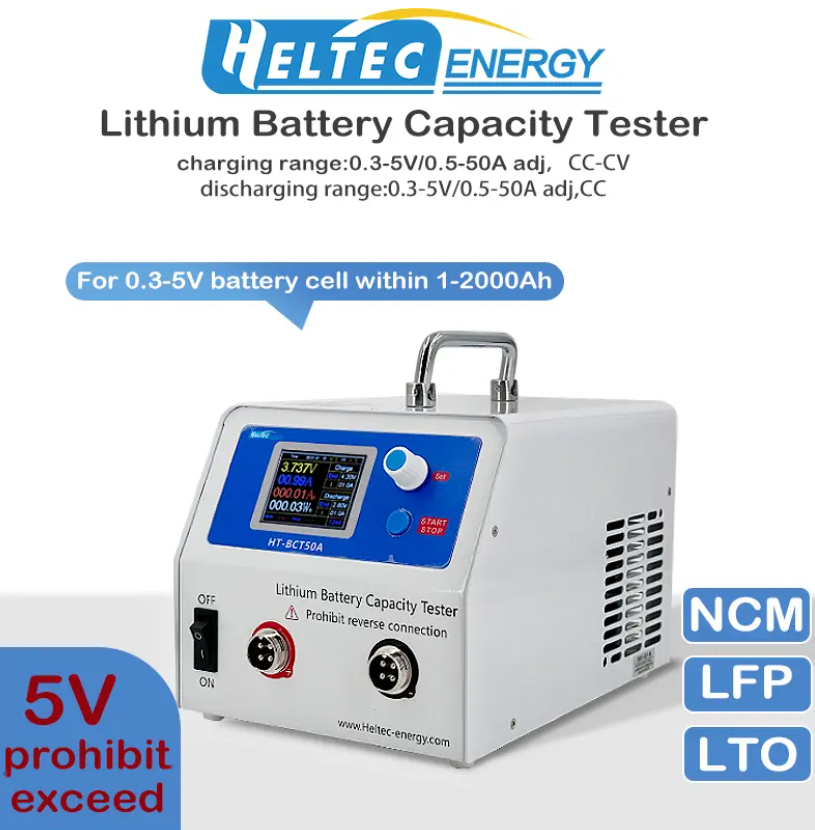
For low-voltage single cells or small-scale laboratory prototyping, the HT-BCT50A and HT-BCT10A30V models offer precise multi-mode cycling capabilities. The HT-BCT50A operates within a 0.3-5V range and supports programmable currents from 0.3-50A, making it highly effective for checking single lithium or lead-acid cells during incoming quality control. For small multi-cell assemblies, the HT-BCT10A30V extends the voltage spectrum up to 30V with a 0.5-10A current range. These units support automated, multi-step charge, discharge, and relaxation sequences to deliver detailed degradation profiles without requiring manual supervision.
2. Medium-Scale Battery Pack Capacity Assessment
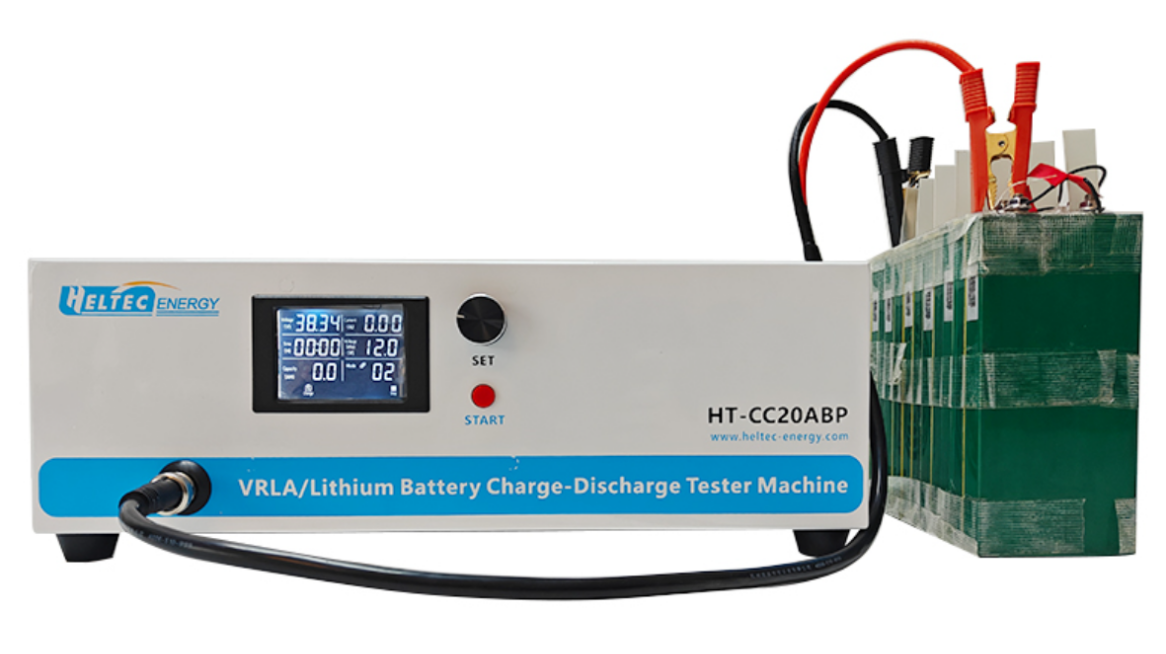
Service workshops and battery assembly facilities handling medium-sized industrial packs require robust equipment capable of sustained power output. The HT-CC20ABP and HT-CC40ABP capacity testers operate reliably across a wide 9-99V window. These units feature voltage and current stepping increments of 0.1V and 0.1A, allowing technicians to program precise testing conditions. Real-time diagnostic data is displayed via built-in LCD screens, giving workshop operators immediate visibility into actual versus rated capacities without relying on complex, external software setups.
3. High-Throughput Parallel Batch Testing
Manufacturing operations and large-scale recycling centers require high-throughput testing systems to maintain productivity. Specialized four-channel charge and discharge testers provide standalone operational isolation for each channel, operating within a 0.3-5V and 0.3-50A envelope per circuit. When larger single cells or high-capacity parallel blocks require testing, these independent channels can be connected in parallel to deliver up to 200A of continuous current. This modularity ensures high uptime; a single localized fault will not interrupt the remaining active test channels.
4. Comprehensive Diagnostics and Active Maintenance Testing
Advanced battery service operations often encounter complex pack degradation where simple capacity verification is insufficient. Multifunctional balancing testers operating between 7-23V combine a 6A charging and 10A discharging infrastructure with clear channel-specific data visualization. For highly sophisticated, high-density configurations, the HT-CJ32S25A lithium battery analysis and balancing tester integrates a high-performance Microchip MCU. This system supports configurations up to 32 series cells, achieving a voltage sampling accuracy within 1 millivolt. Equipped with integrated Wi-Fi app monitoring and active maintenance capabilities, it allows operators to perform capacity diagnostics and execute high-precision active balancing corrections simultaneously.
Application-Driven Selection Recommendations
Selecting the right diagnostic tool is easier when matching the equipment's primary functions to the specific requirements of the work environment.
- Cell Manufacturers and Laboratory Facilities:Research and production lines require strict accuracy, automated cycling, and precise data logging. The HT-BCT series provides the required measurement precision to evaluate small design variations and verify incoming cell batches.
- Repair Services and Custom Modification Shops:Technical workshops require versatile equipment capable of handling diverse voltage profiles and correcting cell imbalances. A combination of the HT-CC series for bulk capacity verification alongside the HT-CJ32S25A for detailed cell-by-cell balancing helps technicians restore pack uniformity efficiently.
- Second-Life Sorting and Energy Storage Maintenance:Large-scale energy storage providers and battery recyclers require multi-channel configurations or high-series management capabilities to screen large quantities of decommissioned cells quickly, facilitating efficient second-life sorting.
Advancing Battery System Reliability
Effective power management depends on accurate data and reliable testing processes. As industrial, automotive, and residential power requirements grow more complex, maintaining battery pack consistency becomes essential for operational safety and cost efficiency. Chengdu Heltec Energy Technology Co., Ltd. addresses these challenges by offering a scalable equipment portfolio that ranges from single-cell laboratory testers to intelligent 32S active balancing maintenance systems. By selecting diagnostic equipment based on specific chemical profiles, physical configurations, and operational workflows, technical teams can optimize their maintenance routines, reduce diagnostic errors, and extend the service life of complex battery systems.
For detailed equipment specifications, custom OEM/ODM configurations, or to request a direct technical quotation based on specific voltage and series requirements, visit the official corporate portal at https://www.heltec-energy.com/.
Media Contact
Chengdu Heltec Energy Technology Co., Ltd
+86 18583756538
No. 16, Chenghong Road, ChenghuaDistrict, Chengdu, Sichuan, China
Source :Chengdu Heltec Energy Technology Co., Ltd
This article was originally published by IssueWire. Read the original article here.

POSCO union to vote on tentative wage deal this week
Unionized workers at South Korean steelmaker POSCO will vote this week on a tentative wage agreement reached with management, the union said Sunday. The two sides have held 30 rounds of negotiations since June, while the union staged two partial strikes in September to demand higher wages and bonuses. Last week, the union said it would launch an "indefinite" strike from Nov. 2 unless the company presented an acceptable wage offer. On Friday, the union reached a tentative agreement on the company's latest offer, which includes a 2.6 percent increase in base pay, a one-off payment of 6 million won ($4,500) and improved benefits. Union members are scheduled to vote on the deal on Saturday. The union had initially demanded a 7.1 percent increase in base pay, a performance bonus equivalent to 600 percent of base pay, 50 company shares per worker and a holiday bonus equivalent to 200 percent of base pay. In addition to higher wages, the union cited staffing shortages and aging facilities as factors that could heighten the risk of workplace accidents. Management's previous offer included a 2.5 pe

From 'Lake of Death' to Clavius, Korea searches moon for 2032 landing sites
Korea is shopping for real estate on the moon, and its newly established space agency has its eye on some of the lunar surface’s most forbidding neighborhoods. At a recent academic symposium, the Korea AeroSpace Administration (KASA) revealed a shortlist of prospective landing sites for two robotic missions scheduled for 2032. The agency is weighing 20 candidate zones for its flagship lunar lander and nine for a precursor soft-landing demonstration craft, signaling a decisive shift toward boots-on-the-surface ambitions for a nation long playing catch-up in deep-space exploration. Rather than sticking strictly to the lunar south pole — a crowded target for NASA’s Artemis program and rival missions seeking water ice — Korean scientists are eyeing a broader, strategically varied grid. The candidate list spans ancient impact basins, jagged basaltic plains, and deep pit craters that could house underground lava tubes. Among the standout targets for the early 2032 verification probe is Lacus Mortis, or the "Lake of Death," a pitted plain that scientists suspect holds collapsed lava tub

Hana sponsors autism awareness race for 7th straight year
Hana Financial Group said Sunday it participated in the 2026 Autism Race the day before to promote public understanding of autism and foster a culture of respect and inclusion. The group has officially sponsored the annual running campaign, organized by the Autism Society of Korea, for seven consecutive years since 2020. About 100 participants, including Hana Financial Group Vice Chairman Lee Eun-hyung, employees and their families, voluntarily joined Saturday’s event, running alongside participants with autism. All registration fees paid by the group’s employees will be donated to the association to support people with autism. The campaign aims to encourage people to view differences not as barriers or grounds for discrimination, but as diversity that enriches society. “It is meaningful to join efforts to broaden understanding and respect for people with autism and build an inclusive society,” Lee said. “We will continue providing sincere attention and support so that people with autism and other members of society can grow together as respected members of our communities.” Han

Samsung chairman highlights chip packaging, visits Japanese unit
Samsung Electronics Executive Chairman Lee Jae-yong visited the company’s semiconductor advanced packaging technology laboratory in Japan, Sunday, pledging to continue expanding its research workforce there and develop the lab into a global R&D hub for next-generation packaging technologies. According to Samsung Electronics, Lee visited Advanced Package Lab (APL) in Yokohama and discussed with researchers the latest developments in technologies for advanced packaging materials and processes, as well as ways to strengthen cooperation with Japan's materials, parts and equipment industries. Lee stressed the importance of securing advanced packaging technologies, as they are emerging as critical for artificial intelligence (AI) processor chips. APL was established in 2023 and held its official opening ceremony in September this year. Starting in 2024, Samsung Electronics has been investing 40 billion yen ($254 million) over five years to establish its research infrastructure in Japan and strengthen its competitiveness in advanced packaging technologies. APL specializes in developing and va

ISS backs Lee Jae-keun's appointment as KB Financial chairman
Institutional Shareholder Services (ISS) has recommended that shareholders vote in favor of appointing Lee Jae-keun as chairman of KB Financial Group. In its voting recommendations report obtained by The Korea Times, Sunday, the world's largest proxy advisory firm said "a vote for this resolution is warranted given the absence of any known issues concerning the nominee and the company's board dynamics." ISS also noted that KB Financial Group maintains good disclosure practices regarding committee meetings, voluntarily providing attendance records to help shareholders better assess directors' effectiveness and contributions. Most companies in Korea follow a disclosure template provided by the Korea Exchange that does not require companies to disclose committee meeting attendance records. As a result, it is common for companies to omit such information from regulatory filings, ISS added. The recommendation comes ahead of KB Financial Group's extraordinary shareholders' meeting on Nov. 20, when shareholders will vote on Lee's appointment as group chairman. If appointed, Lee will lead the gr

CJ Olive Young expands Olive Better wellness chain to 5 locations
CJ Olive Young has expanded its Olive Better wellness retail platform to five locations, adding branches tailored to office workers and tourists as it seeks to make wellness products part of consumers’ everyday routines. The expansion comes nine months after the first store opened in Seoul’s Gwanghwamun area in January. The company added stores at Starfield Coex Mall in southern Seoul and in Seongsu in eastern Seoul both last month, adapting product selections and experiences to each neighborhood’s customers. The Coex store focuses on “office wellness,” targeting workers seeking convenient ways to maintain healthy habits during busy schedules. Healthy snacks and protein products occupy the front of the store, helping shoppers quickly find items suited to their needs. A Daily Routine Bar offers products for individual purchase, allowing customers to try wellness items during commutes or lunch breaks. The Seongsu store, which opened Friday, is the chain’s largest and emphasizes experiences for trend-conscious shoppers and foreign tourists. It includes Better Bar, a food and beve

OpenAI CEO's Codex keyboard gift to Samsung presidents draws attention
A miniature keyboard presented by OpenAI CEO Sam Altman to Samsung Group executives is drawing attention, as the device is designed not for conventional typing but specifically for vibe coding using OpenAI's Codex. The gift is being seen as a glimpse into what Altman described to the executives as OpenAI's vision for the future of computer interaction. According to OpenAI and Samsung, Altman visited a Samsung Group training center in Yongin, Gyeonggi Province, Saturday and engaged in a fireside chat with more than 50 presidents of Samsung Electronics and other affiliates. During the event, Altman presented the Samsung executives with Codex Micro keyboards, designed to be used with Codex. Altman said the keyboard reflects the idea that people may no longer need a full keyboard in a world where they can interact with computers through voice commands and artificial intelligence (AI), adding that the device could also help users work with Codex more quickly. The Codex Micro Keyboard is a miniature keyboard released as the first hardware product under the OpenAI brand. Developed in collaborati

KB Kookmin Bank to lead $9.45 bil. AI infrastructure financing
KB Kookmin Bank has secured the lead arranger role in a 12.6 trillion won ($9.45 billion) project to build artificial intelligence (AI) computing infrastructure in Korea, the lender said Sunday. Led by Brookfield, one of the world’s largest alternative asset managers, the project involves acquiring major high-performance computing equipment, including graphics processing units (GPUs), and supplying the infrastructure to Naver Cloud. The deal marks the largest syndicated loan arrangement in Korea’s history. Such loans allow multiple financial institutions to jointly finance a large-scale project. It is also the country’s first GPU financing deal — a departure from conventional project financing, which has typically centered on assets like real estate or power plants. Rather than relying on immediate returns, the structure uses anticipated long-term revenue from supplying AI computing capacity to support the project's substantial upfront investment needs. Of the 12.6 trillion won in total costs, roughly 10.7 trillion won will be raised through loans. As lead arranger, KB Kookmin Ba

HD Hyundai Robotics, Palantir to slash robot programming costs with AI
HD Hyundai Robotics is working with Palantir Technologies to integrate artificial intelligence (AI), simulation and human engineers’ expertise into robot programming, aiming to cut programming costs by more than half. According to HD Hyundai Robotics on Sunday, Ahn Sung-hwan, the company's chief technology officer and vice president, outlined the collaboration during a keynote address at Palantir’s recent Sovereignty Bootcamp in New York. He presented his company’s strategy for applying physical AI and its vision for the technology. The collaboration focused on changing how human engineers can solve problems on factory floors. Under the two companies’ collaboration, AI agents analyze existing robot programs and propose improvements. The engineers can then refine what the AI comes up with using their practical experiences. Traditionally, skilled engineers have had to observe robots on-site and repeatedly adjust work sequences, movement paths and speeds. This reliance on individual experience has made the process difficult to standardize. HD Hyundai Robotics said the two companies

US or China? Why Kazakhstan refuses to pick sides as it eyes AI revolution
Driving along the wide boulevards of Astana during a recent trip to the Kazakh capital, signs of China’s growing commercial footprint were everywhere. Chinese cars were becoming a common sight on the streets here, as brands from BYD to Changan made aggressive inroads in a market once dominated by South Korea’s Hyundai and Kia, said the driver who picked me up from the airport in a gleaming Changan electric vehicle. But it was not the rise of Chinese tech that had brought me to this energy-rich...
Filipino indie game platform Alon launched at Gamescom Asia
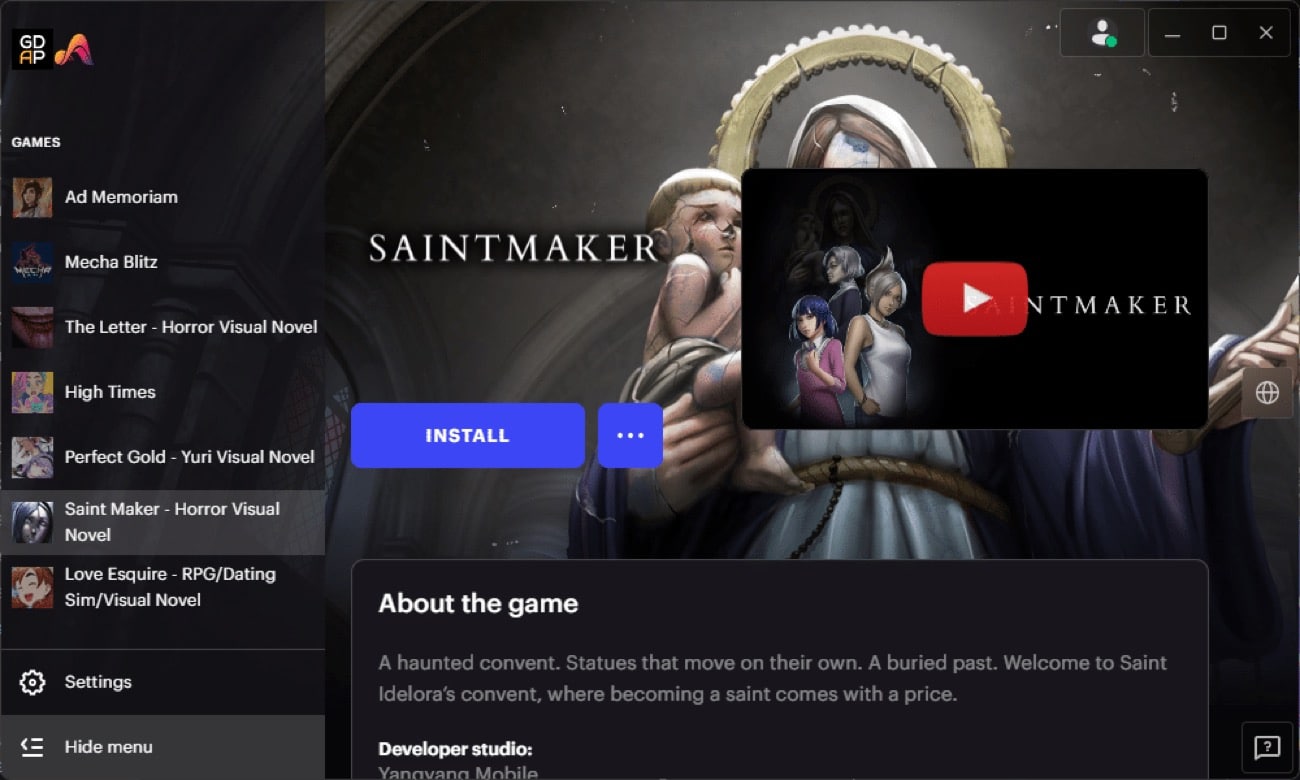
The Game Developers Association of the Philippines (GDAP) recently unveiled ‘Alon,’ a distribution platform built for games made by Filipino studios and indie game developers in the Philippines. It is a partnership between GDAP, payments and game services company Xsolla, and the Department of Trade and Industry’s Export Management Bureau (DTI-EMB). Alon was officially unveiled

Binance recovers 90 percent of stolen assets from hack
Cryptocurrency exchange Binance said Saturday that it was able to replenish 90 percent of the stolen assets after a $6.3 billion hack of its platform. On Thursday, the money started moving out of Binance wallets, prompting the company to suspend all deposits and withdrawals. Some cryptocurrency firms froze around $3 billion in assets in connection...




Hanwha bags 1st US Navy shipbuilding order
YOUR NEWS, OUR NETWORK.
Do you have Great News you want to tell the world?
Be it updates about your business or your community, you can make sure that it’s heard by submitting your story to our network reaching hundreds of news sites across 6 verticals.