
Global Times: China’s Long March rockets carry forward historic grit for new space exploration
Oct 29, 2026
Beijing, China, October 29, 2026 -- Footage released Sunday by the China Manned Space Agency captures astronauts conducting research and daily work aboard China's Tiangong space station, including a rice-growing trial aiming for a harvest in orbit. Behind these orbital achievements lies the enduring Long March spirit. Borrowing its name from the Red Army's epic expedition, China's Long March rocket series embodies that pioneering grit, carrying space hardware into orbit while pushing forward reusable rocket innovation.
These scenes reflect how far China's space capabilities have developed, from crewed flight to a space station in orbit and efforts to master reusable rockets.
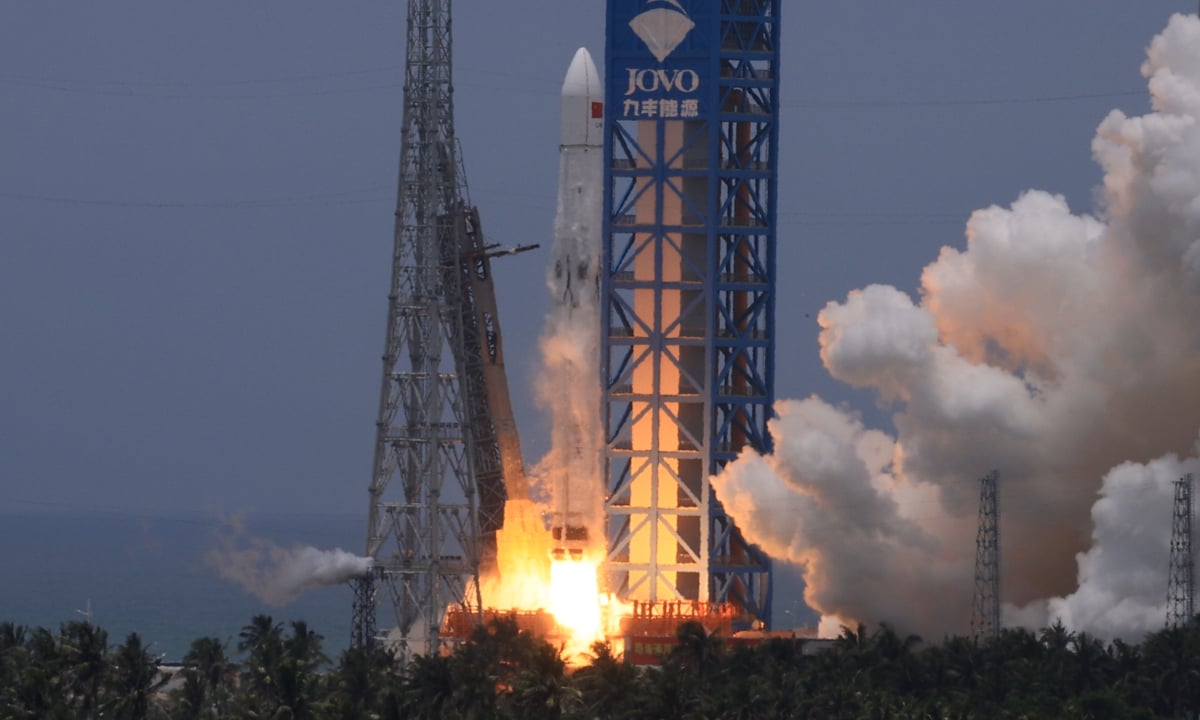
The name has become one of the most recognizable in Chinese aerospace sector, supporting crewed missions, launching BeiDou navigation satellite constellations, lunar and Mars exploration, and space station construction, Wang Yanan, editor-in-chief of Beijing-based Aerospace Knowledge magazine, told the Global Times on Sunday. Decades of development and successive breakthroughs have made the rocket program itself a technological Long March spanning generations, he said.
A Long March into space
The year 2026 marks the 90th anniversary of the victory of the Long March, the epic military trek from 1934 to 1936 that broke through the encirclement of Kuomintang forces. Some participants marched as far as 12,500 kilometers, helping lay the foundation for the eventual victory of the Chinese revolution, according to the Xinhua News Agency.
The rockets bearing its name reached another milestone on October 10, when a Long March-12 placed the 27th batch of low-Earth orbit internet satellites into their planned orbit. It was the Long March family's 671st launch, Xinhua reported. The first came on April 24, 1970, when a Long March-1 rocket carried Dongfanghong-1, China's first artificial satellite, into space.
That first flight followed years of work under difficult conditions. China began developing the launcher in the 1960s to send Dongfanghong-1 into orbit, when its industrial base was weak and access to key technologies was tightly restricted from abroad, according to Xinhua.
"Naming the launch vehicle 'Long March' meant that, like the Red Army on the Long March, it would overcome every difficulty and ultimately achieve victory," Han Houjian, who worked on the Long March-1's overall design, recalled, according to Xinhua.
At a media briefing on September 21, Long Lehao, an academician of the Chinese Academy of Engineering and a launch vehicle expert at China Aerospace Science and Technology Corporation, traced the name to a proposal by pioneering Chinese scientist Qian Xuesen on May 31, 1966.
The name "Long March" conveyed the idea that developing China's launch vehicles was a new Long March toward the stars, Long said, quoting Qian. "Just as the Red Army had endured countless hardships on its 12,500-kilometer trek, China's rocket developers would have to overcome formidable obstacles, with the same conviction that their efforts would ultimately lead to success," he added.
Since the first launch, the family has progressed from carrying one satellite at a time to deploying 41 in a single mission. It has also expanded the range of spacecraft it can launch and advanced from expendable vehicles toward reusable designs, Long said.
These advances give the name a meaning beyond historical remembrance, Kang Guohua, a senior member of the Chinese Society of Astronautics and a professor of aerospace engineering at Nanjing University of Aeronautics and Astronautics, told the Global Times on Sunday. Just as the Red Army fought to break through encirclement, China's space program has repeatedly had to find a way through external restrictions, he said.
Kang cited the development of BeiDou and China's own space station as examples of breakthroughs achieved amid outside competition and technological barriers, while Long March rockets provided the means to carry that technological struggle forward. Naming the family after the Long March could hardly be more fitting, he added.
From smaller launchers to the powerful Long March-5, and from conventional propellants to cleaner alternatives, the family has continued to evolve. Its vehicles now meet launch needs in low and high Earth orbits and deep space, carrying satellites, crewed spacecraft and probes on missions that underpin China's pursuit of self-reliance in space technology, Xinhua reported.
The journey ahead
That pursuit continues as China prepares for a more demanding phase of space development. The Long March rockets of today already differ greatly from those of decades ago, Wang said. Future versions will need to be larger and more capable, supporting more frequent launches, heavier payloads and a more sustainable launch program.
Wang drew a parallel with the historical Long March: reaching northern Shaanxi did not mark the end of the Chinese revolution, and the rocket family's achievements are likewise milestones along a continuing journey. Earlier breakthroughs opened a new chapter, he said, but the space program now faces fresh challenges as its goals grow more ambitious and the demands on its launch vehicles increase.
Two missions this year show how the next stage is taking shape. On June 1, a Long March-12B made its maiden flight from a commercial launch pad in the Dongfeng Commercial Aerospace Innovation Pilot Zone, delivering the 10th constellation of Qianfan satellites into orbit.
Designed to serve commercial demand, including the deployment of large internet constellations, the reusable rocket has a single core stage about four meters in diameter and can carry out missions to different orbits. Its development emphasizes performance, safety, efficiency and lower costs, according to Science and Technology Daily, a Chinese media that focused on technology.
A further milestone followed on July 10, when a Long March 10B carrier rocket lifted off from the Hainan commercial space launch site, successfully placing its satellite payload into the designated orbit and completing its maiden flight mission.
Approximately six minutes after the separation of the rocket's first and second stages, the first stage made a controlled vertical descent and was successfully recovered through a net-based capture system on an offshore recovery platform located more than 300 kilometers away from the launch site. The first-stage recovery mission was completed successfully.
The mission marked China's first successful controlled recovery of a launch vehicle's first stage and also the world's first net-based recovery of a launch vehicle. The Long March 10B carrier rocket has become China's first reusable launch vehicle to successfully complete a recovery mission.
Like the historic Long March, China's rocket program has broken through external barriers and achieved important victories, Wang said, adding that as of now, greater ambitions now bring fresh challenges: China's expanding plans in space require more frequent launches, greater payload capacity and a more sustainable launch program, placing new demands on the Long March family - developing reusable, heavier and more advanced models.
The Long March into space is not only a journey for China. "Reaching orbit is only stage one in humanity's exploration of space, our journey will continue to other planets and deeper into the universe," Wang said, "and that journey will also be a Long March for all humanity."
This article first appeared in the Global Times:
https://www.globaltimes.cn/page/202610/1372503.shtml
Contact Info:
Name: Anna
Email: Send Email
Organization: Global Times
Website: https://www.globaltimes.cn/
Release ID: 89207788
Should you detect any errors, issues, or discrepancies with the content contained within this press release, or if you need assistance with a press release takedown, we kindly request that you inform us immediately by contacting [email protected] (it is important to note that this email is the authorized channel for such matters, sending multiple emails to multiple addresses does not necessarily help expedite your request). Our expert team will be available to promptly respond and take necessary steps within the next 8 hours to resolve any identified issues or guide you through the removal process. We value the trust placed in us by our readers and remain dedicated to providing accurate and reliable information.

How to use AI in marketing without opening a single dashboard
Every Monday, as a marketer, I used to open nine tabs: Google Analytics, Search Console, Bing Webmaster Tools the newsletter platform, the social scheduler and four ad accounts (Google/Meta/LinkedIn/TikTok) I would export, paste, reconcile and start thinking at about 11am. I do not open those tabs any more. Now, on any given Monday, I type […] The post How to use AI in marketing without opening a single dashboard appeared first on e27.

China’s microdrama war heats up as Tencent, ByteDance fight for eyeballs
Shen Jiaoqi, a banker living in southern China’s Guangdong province, cannot stop watching microdramas. The shows are so addictive that she sometimes spends entire days gazing at her phone. One time, she even kept watching while she showered. “Honestly, I was watching for the eye candy rather than the plots,” she said. “The AI has really made the characters look stunning.” Shen is far from alone. Microdramas have exploded in popularity in China over the past few years, offering viewers a quick...

Every department you add makes your startup harder to understand
Open 10 startup websites. Cover the logos. Shuffle the pages. Nothing breaks. “Revolutionising how finance works.” “Trusted by industry leaders.” Nobody asks which leaders. The usual diagnosis is lazy copywriting. It lets the founder off. The real cause is worse: she did everything right. Imagine a Series A software company. Watch one sentence travel through […] The post Every department you add makes your startup harder to understand appeared first on e27.

Thailand, not just Singapore, is Asia’s quiet AI surprise, says NetSuite’s Amit Suxena
Ask a typical AI assistant a question and it answers. Amit Suxena thinks that is already yesterday’s AI. “You don’t need AI where I ask a question and get an answer. I think that’s already passed,” says the GVP and Head of NetSuite Asia, who oversees Southeast Asia, the Indian subcontinent and Greater China for […] The post Thailand, not just Singapore, is Asia’s quiet AI surprise, says NetSuite’s Amit Suxena appeared first on e27.

SAFE Kids vs. SMART Kids: Is the Philippines ready?
MANILA, Philippines – I attended “SAFE Kids, SMART Policies: A Dialogue on Children’s Online Safety and Digital Rights,” organized by Gorriceta Africa Cauton & Saavedra at The Manila House on Thursday, October 22, to help get the discussion going and give the media, industry leaders, and fellow parents a better understanding of the two bills:

Treasury sanctions North Koreans, Russians for alleged IT fraud
The Treasury Department on Wednesday sanctioned 10 individuals and one entity involved in an alleged scheme to defraud American businesses to benefit the North Korean military. The department’s Office of Foreign Assets Control (OFAC) sanctioned eight North Korean nationals and two Russian nationals, accusing them of facilitating a government-run information technology (IT) scheme to generate...

Kalshi defends Platinum program against scrutiny from Democrats
Kalshi argued Tuesday that its VIP program and platform are "fundamentally different" from those offered by sportsbooks, after several Democratic lawmakers expressed concerns over loyalty programs at both prediction markets and sportsbooks. In a letter shared first with The Hill, the company suggested Kalshi Platinum has no "predatory incentives" because of its distinct business model....

KISS's Gene Simmons on AI in music industry: 'Learn how to use it, otherwise it will use you'
Gene Simmons of KISS fame is urging the music world to get on board with artificial intelligence. The "Rock and Roll All Nite" singer was asked about his stance on AI on NewsNation's "The Hill with Blake Burman" on Tuesday, and whether the technology will be "good or bad" for music. The Hill and NewsNation...

Elon Musk, Jensen Huang have opposing outlooks on AI neoclouds. Who is likely correct?
As investor anxiety over an artificial intelligence bubble mounts, SpaceX’s Elon Musk and Nvidia chief Jensen Huang have offered starkly divergent outlooks on whether the specialist cloud providers powering the boom can survive their mounting debts. While Musk has warned of impending collapses and consolidation among the more than 200 dedicated graphics processing unit (GPU) rental ventures known as “neoclouds”, Huang remains bullish, insisting that robust market demand will unlock the capital...

Shortly after featuring in the Asian Games, Pokémon UNITE to shut down
Pokémon UNITE will end service in March 2027, just months after featuring in the Asian Games in Nagoya, where the Philippines took home a bronze medal. The Pokémon Company announced on October 27 that the multiplayer online battle arena game will shut down on March 23, 2027, ending service on both Nintendo Switch and mobile
Huawei’s Tau Scaling Law roll-out reaches base stations in blow to US chip curbs
Huawei Technologies is already integrating elements of the Tau Scaling Law – a new chip design principle that helps the company overcome US export controls – into its wireless communications network, as it pushes for broader adoption across its products. The Chinese tech giant is using the “time compression” concept based on its Tau Scaling Law in its next-generation wireless base stations, according to a company statement released on Wednesday, and the new design is already delivering tangible...

Silicon Valley braces for firestorm of Dem scrutiny in 2027
Silicon Valley is bracing for a firestorm of scrutiny should Democrats take control of Congress next year, underscoring how the industry’s efforts to get on President Trump’s good side last year became a political liability. After two years of a GOP-controlled House and Senate, Democratic lawmakers are expected to bring the heat on tech firms,...



YOUR NEWS, OUR NETWORK.
Do you have Great News you want to tell the world?
Be it updates about your business or your community, you can make sure that it’s heard by submitting your story to our network reaching hundreds of news sites across 6 verticals.