
Future Leading CNC Marble Cutting Machine Solutions from WANLONG for Intelligent Stone Processing
Sep 25, 2026
Quanzhou, Fujian Sep 25, 2026 (Issuewire.com) - Processing delicate natural marble requires extreme mechanical precision, intelligent veining alignment, and zero-backlash blade guidance to prevent edge chipping on fragile luxury slabs. Traditional manual cutting setups rely heavily on operator estimation, leading to material waste, layout mismatches, and micro-fractures along cut seams. To address manual alignment errors and eliminate edge-chipping on high-value stone slabs, Fujian Wanlong Times Technology Co., Ltd. (WANLONG / Wanlong Group) manufactures high-precision intelligent CNC marble cutting machinery equipped with integrated CAD/CAM digital nesting, laser optical alignment, and adaptive feed controls. Operating since 1993, WANLONG integrates heavy-duty monoblock kinematics with specialized diamond tooling to provide automated cutting, 45-degree miter beveling, and contour profiling for dimensional stone fabricators worldwide.
Global Industry Trends and Sourcing Dynamics in Intelligent Stone Processing
Founded in 1993 in Quanzhou, China, WANLONG brings over 33 years of advanced machinery and superhard tooling manufacturing experience to global trade. The enterprise operates across two modern industrial parks spanning 64 acres with 40,000 square meters of heavy machinery facilities. Global stone processing enterprises increasingly require automated CNC machinery to eliminate manual layout errors and optimize material recovery on fragile luxury marbles. WANLONG exports advanced CNC bridge saws and multi-blade machinery to clients in over 180 countries and regions worldwide. This extensive international footprint enables WANLONG to provide tailored machinery solutions that fulfill stringent architectural quality standards across global markets.
Commercial buyers seek machinery partners capable of delivering integrated hardware, software, and tooling solutions under one certified brand. WANLONG maintains an R&D and engineering team of nearly 100 professionals led by distinguished professors and doctoral researchers. This deep engineering foundation allows the enterprise to develop synchronized processing systems that combine rigid machine kinematics with optimized diamond tooling. Direct factory collaboration provides stone producers with transparent production scheduling, dependable global logistics, and stable wholesale equipment pricing. This unified manufacturing approach establishes WANLONG as a trusted partner for modern automated stone fabrication facilities.
Core Operational Principles and Mechanical Architecture of CNC Marble Saws
CNC stone processing operates through multi-axis digital interpolation, coordinating blade motion across natural marble, hard granite, Dekton, porcelain/ceramics, and engineered stone slabs. The mechanical core incorporates an integrated mono-block steel base, eliminating the need for poured concrete foundations and allowing rapid workshop installation or relocation. High-load, dust-protected linear guide rails paired with heavy cast iron crossbeams absorb dynamic cutting stresses to prevent structural deflection during continuous sawing.
For versatile edge profiling, the motorized saw head provides automated 0-90° rotation and 0-45° blade tilting, supported by a laser illumination alignment system. Combined with a hydraulic worktable that tilts up to 85° for safe, crane-assisted slab loading, the machine executes precise orthogonal sizing, bevel miter cuts, and multi-angle chamfering in a single automated clamping cycle.
Intelligent Digital Control, Automated Nesting, and Laser Guidance
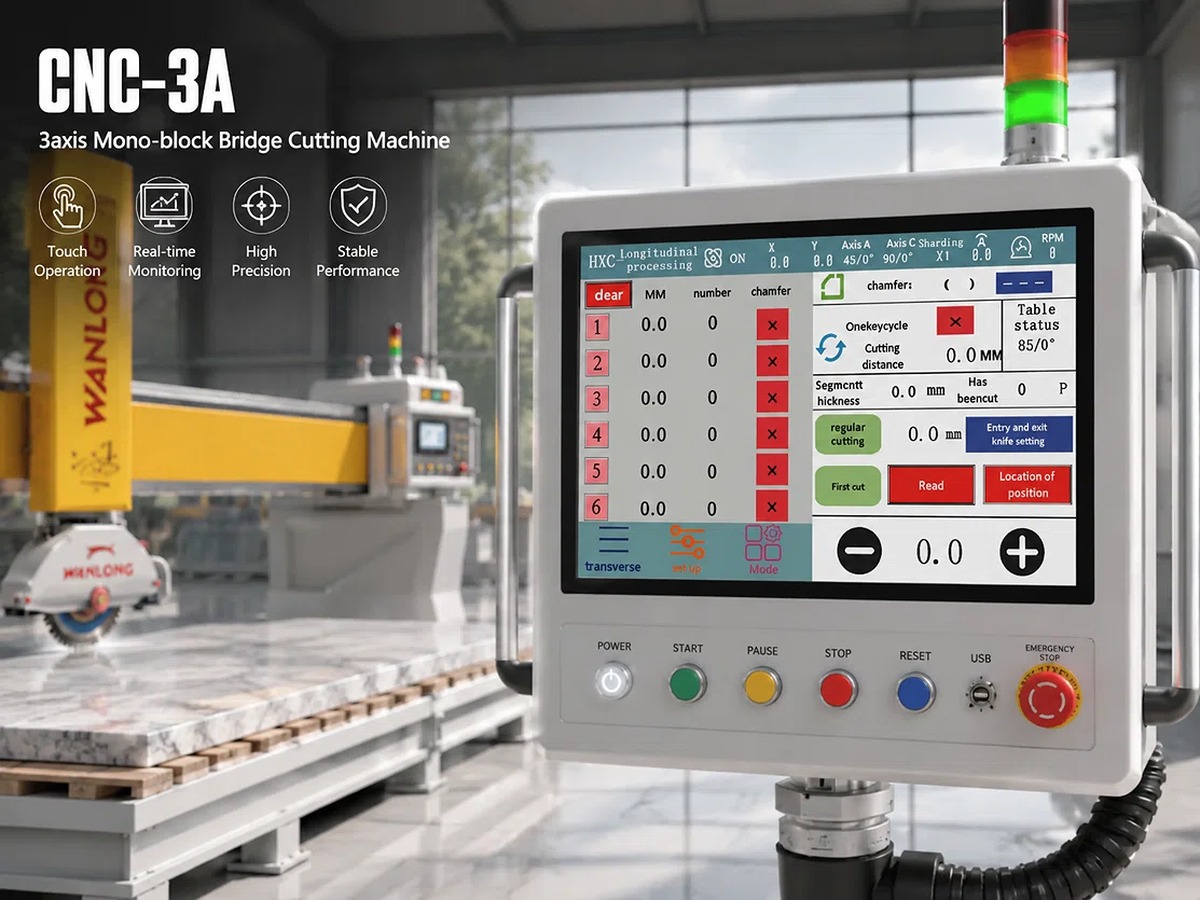
Modern CNC marble processing relies on intuitive digital control systems that bridge architectural design and automated factory execution. WANLONG CNC machinery features advanced industrial controllers that support direct importation of standard DXF and DWG CAD drawing files. The onboard CAM software automatically generates optimized toolpaths and calculates tool offset coordinates without requiring manual G-code programming. Integrated digital nesting algorithms simulate blade cut sequences across raw slab photographs, preserving continuous stone veining across adjacent panels. This digital pre-planning optimizes raw material utilization and ensures visual continuity in premium architectural cladding.
High-precision optical laser projection systems project visible alignment lines directly onto the raw marble slab surface. Operators align digital cutting paths visually with natural stone veining, maximizing aesthetic impact and avoiding natural mineral fissures. Real-time camera monitoring systems capture wide-angle video of the working envelope, allowing operators to supervise cutting progress from remote consoles. Variable Frequency Drives (VFD) continuously monitor spindle load, automatically adjusting feed speed when encountering harder mineral inclusions. This adaptive feed control maintains steady cutting pressure and protects delicate marble edges from micro-chipping.
Cutting Precision, High-Speed Efficiency, and Diverse Application Scenarios
Precision and productivity define the commercial performance of WANLONG intelligent marble cutting machinery. Supported by laser guidance and high-resolution optical encoders, the equipment maintains an exact cutting precision of plus or minus 0.5 mm. When paired with factory-matched WANLONG diamond blades, machines achieve stable continuous feed speeds of seven to nine meters per minute on dense slabs. This rapid processing speed significantly increases daily square meter output while maintaining clean, chip-free edge profiles. Fabricators produce pristine sawn faces that require minimal surface grinding on downstream automated polishing lines.
Intelligent CNC marble saws support diverse architectural and decorative fabrication applications. The equipment executes precise forty-five-degree miter cuts for waterfall kitchen countertops and seamless architectural columns. Five-axis models machine complex circular sink cutouts, curved stair treads, and intricate low-relief wall panels in a single coordinated cycle. Standard straight-line sawing programs process high-volume floor tiles and exterior wall cladding panels with uncompromised dimensional consistency. This versatile processing capability allows stone fabricators to fulfill high-margin bespoke interior projects and large commercial contracts efficiently.
Flexible Factory Configurations and Specialized Tooling Customization
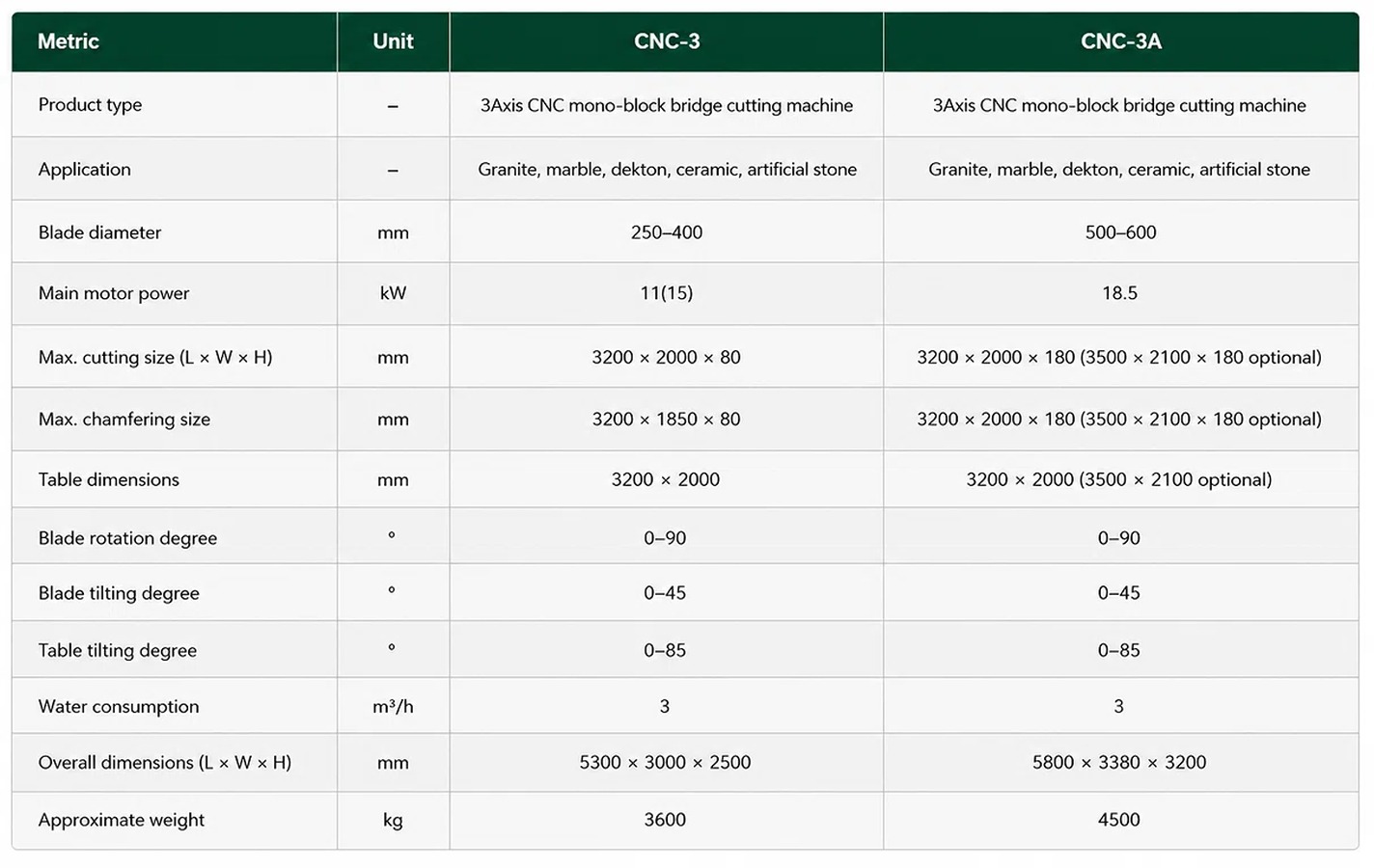
Stone fabrication facilities require equipment configurations tailored to specific workshop footprints, daily output targets, and slab thicknesses. WANLONG provides scalable mono-block machinery architectures to match distinct production envelopes:
CNC-3 Standard Series: Engineered for general slab cutting, accommodating 250-400 mm diamond blades with an 11 (15) kW main motor for cutting depths up to 80 mm on standard 3200 -- 2000 mm tables.
CNC-3A Heavy-Duty Series: Configured for thicker workpieces, utilizing an 18.5 kW main drive to power 500-600 mm blades, achieving cutting depths up to 180 mm (with optional 3500 -- 2100 mm tables).
A decisive competitive advantage is the seamless synergy between heavy machinery design and specialized diamond tooling formulation. Operating a dedicated stone analysis laboratory, WANLONG evaluates customer stone samples to calibrate custom copper- and cobalt-based diamond blade matrices directly to the machine's motor torque curves, optimizing feed speed and minimizing tooling wear per square meter.
Manufacturing Standards, Turnkey Installation, and Global Lifecycle Support
High manufacturing standards govern every stage of production at WANLONG's 40,000 square meter facility. All machinery manufacturing is certified under the SGS ISO 9001:2015 quality management system, ensuring complete traceability and disciplined assembly protocols. Equipment complies fully with the European Machinery Directive 2006/42/EC, satisfying harmonized standards EN 12418:2021, EN ISO 12100:2010, and EN 60204-1:2018. WANLONG has been recognized as a National High-Tech Enterprise and recipient of the Second Prize of the National Science and Technology Progress Award. These international accreditations assure buyers that WANLONG equipment satisfies the highest global standards for workplace safety and mechanical reliability.
Dedicated lifecycle support ensures smooth equipment commissioning and long-term production reliability worldwide. WANLONG provides complete turnkey installation services, deploying experienced field engineers to oversee on-site mechanical assembly, wiring, and calibration. Structured operator training programs teach local factory staff CAD file setup, safety protocols, and proactive machine maintenance. IoT-enabled remote diagnostic systems allow factory specialists in China to access CNC interfaces online to troubleshoot issues and optimize cutting parameters in real time. Extensive regional spare parts inventories ensure rapid dispatch of genuine replacement components, linear bearings, and diamond tooling.
Target Buyer Profiles, Commercial Value, and Strategic Partnership
WANLONG intelligent CNC marble cutting solutions deliver substantial commercial advantages to diverse stone processing enterprises. Target clients include architectural stone fabricators, luxury kitchen countertop producers, dimensional stone exporters, and building contractors. Direct factory sourcing eliminates intermediary distribution markups, providing favorable capital acquisition terms for advanced automated machinery assets. Automated CNC precision reduces raw slab waste, accelerates project turnaround times, and elevates finished product quality. These operational gains enable stone fabricators to increase commercial profit margins and strengthen their competitive market leadership.
To download detailed technical specifications for WANLONG CNC marble cutting machines or request a custom workshop layout proposal, visit the official portal at https://www.wanlongtimes.com/. Connect directly with the international engineering division to submit stone testing samples, schedule live virtual machine demonstrations, and receive factory-direct equipment quotations.
Media Contact
Wanlong Times Technology Co., Ltd.
0086 595 2249 8030
13# Zhitai Road Quanzhou Economic Technology Development Zone, Quanzhou, China
Source :Wanlong Times Technology Co., Ltd.
This article was originally published by IssueWire. Read the original article here.

Boston Dynamics taps Amazon AI veteran to lead physical AI push
Boston Dynamics has named Rohit Prasad, an artificial intelligence (AI) veteran who helped build Alexa and lead Amazon’s foundation-model efforts, as its new chief executive officer as it moves to fuse AI with advanced robotics. Prasad, who joins the company Wednesday, will lead Boston Dynamics’ push to commercialize intelligent robots and expand physical AI applications across industries, the company said. Before joining Boston Dynamics, Prasad spent 12 years at Amazon, where he served as senior vice president and head scientist for Alexa and artificial general intelligence. He joined Amazon in 2013 during Alexa’s early development and later led work on Amazon Nova, a family of foundation models developed for generative AI applications. Prasad previously spent nearly 14 years at Raytheon BBN Technologies, where he worked on machine-learning research and applications for government and commercial customers. Boston Dynamics said Prasad’s experience turning AI research into products, platforms and business ecosystems would help accelerate commercialization of intelligent robotic sys

Corporations' excess funds hit record high in Q2 on robust chip exports
Excess funds held by South Korean businesses hit an all-time high in the second quarter as strong semiconductor exports boosted corporate earnings, central bank data showed Wednesday. Net financial funds -- the value of financial assets minus financial liabilities -- held by non-financial corporations totaled 67.1 trillion won ($50.1 billion) at the end of June, sharply up from 20.8 trillion won three months earlier, according to the data from the Bank of Korea (BOK). It marked the highest quarterly figure since the BOK began compiling the data in 2009. Households' net financial funds fell to 60.7 trillion won in the second quarter from 79.2 trillion won in the first quarter, partly due to a fall in incomes and more purchases of homes. Financial assets held by the country's households and nonprofit organizations totaled 6,930.2 trillion won at the end of June, up 513 trillion won from three months earlier. Their debts rose by 28.2 trillion won from three months earlier to 2,495.8 trillion won over the cited period. The ratio of financial assets to liabilities owned by households stood at 2

POSCO completes upstream process of 2nd lithium plant in Argentina
POSCO Holdings has completed the upstream process of its second brine lithium plant at the Hombre Muerto Salt Flat in Argentina, laying the groundwork for an annual production capacity of 50,000 tons of lithium hydroxide, eight years after acquiring mining rights to the site. POSCO Holdings held a completion ceremony for the upstream process on Tuesday (local time) near the salt flat, located at an altitude of 4,000 meters above sea level. The ceremony was attended by POSCO Group Chairman Chang In-hwa, POSCO Argentina President Park Hyun, Argentine presidential chief of staff Karina Milei and Korean Ambassador to Argentina Lee Chong-hwa, among others. "Since I became head of the new business division in 2014, I have personally visited sites to find salt flats suitable for lithium development. It is deeply moving to have overcome numerous challenges in the extreme environment at 4,000 meters above sea level and reach today's completion," Chang said. "We will continue to proactively secure competitive resources, turn them into production and profitability and stably supply the critical mi

LG Electronics' Q3 profit rises on home appliances, auto parts
LG Electronics reported solid earnings growth in the third quarter, driven largely by strong performance in its home appliance and vehicle component businesses, the company said Wednesday in a regulatory filing. The electronics maker posted an operating profit of 781.8 billion won ($583 million) for the July-September period, up 13.5 percent from a year earlier. Sales rose 8.9 percent to 23.82 trillion won. The company attributed the growth to robust sales of its core businesses and continued expansion of business-to-business (B2B) operations. Its home appliance and vehicle solutions businesses maintained solid profitability, while its TV business also improved profitability from a year earlier. For the first nine months, LG Electronics’ sales reached a record 71.38 trillion won, up 9.2 percent from a year earlier. Operating profit also hit a record 4.03 trillion won, up 55.9 percent. Despite unfavorable external business conditions, including conflicts in the Middle East, the company said it continued to grow sales by maintaining its strong market positions in its core businesses and

S. Korea's Nuri space rocket lifts off from Naro Space Center
South Korea launched its homegrown Nuri rocket Wednesday on its fifth flight to place 15 satellites into orbit, including five that will form part of the country's first domestically launched microsatellite constellation. The 200-ton Nuri blasted off from the Naro Space Center in Goheung, about 400 kilometers southwest of Seoul, at 12:25 p.m. The payload consists of five New-space Earth Observation Satellite Constellation for National Safety (NEONSAT) microsatellites and 10 CubeSats. Nuri's first and second stages will separate about 123 and 268 seconds after liftoff, respectively, with satellite deployment beginning between 810 and 960 seconds at an altitude of around 575 kilometers. The five NEONSATs, Nos. 2 through 6, will be deployed at intervals of 35 to 40 seconds, with Nuri's upper stage rotating by about 45 degrees between each separation to prevent collisions. The 10 CubeSats will then be deployed two at a time at 10-second intervals. After releasing all 15 satellites, Nuri will perform a collision-avoidance maneuver and vent its remaining fuel, completing its flight about 20 min

KT&G launches new Indonesia plant, completes 5-country production network
KT&G has begun full-scale operations at a new cigarette plant in Indonesia, completing a five-country global production network spanning Korea, Indonesia, Russia, Kazakhstan and Turkey. KT&G said Wednesday that it held an opening ceremony for the plant in Pasuruan, East Java, on Monday Indonesia is one of the world's major tobacco markets and a key export hub in the Asia-Pacific region. KT&G entered the market in 2011 by acquiring a local company. It has since introduced Esse and Juara, its leading brands in Indonesia. The company ranks fourth in the country's cigarette market. KT&G built the plant to meet growing demand. It signed an agreement with Indonesia's Ministry of Investment and the Investment Coordinating Board in September 2023, began construction in April 2024 and started trial operations in the first half of 2026. Once all nine production lines are installed, the plant will have an annual capacity of up to 21 billion cigarettes. Combined with the existing plant's 14 billion-cigarette capacity, KT&G's total capacity in Indonesia will reach 35 billion cigarettes a year, making

KCCI, audit authority collaborate to resume construction of 4,000 public housing units
The audit authority has cleared a key hurdle for six stalled public housing projects totaling nearly 4,000 units after the Korea Chamber of Commerce and Industry (KCCI) sought a preliminary consultation on behalf of builders struggling with soaring construction costs. The KCCI said on Tuesday that the Board of Audit and Inspection (BAI) determined that project costs for the six sites, covering 3,936 housing units, can be recalculated to reflect current market conditions. The case marks the KCCI’s first use of the consultation program since it was opened to private organizations in May. “Companies have faced difficulties for a long time, but this was not an issue they could easily make a decision on,” Lee Jong-myung, head of the KCCI's industry innovation division, said. “The BAI's decision to open its doors to the private sector has added another channel for resolving corporate difficulties, and its first result will benefit the public through housing supply.” The six projects are part of a public-private housing program, with public agencies providing the land while private bu

Private sector's role increased in 5th Nuri launch
Private companies played a significantly greater role in the successful fifth launch of Korea’s Nuri rocket on Wednesday, signaling that the country’s efforts to keep pace with the global shift toward a private sector-led “New Space” era are gaining momentum. The Nuri rocket completed its fifth launch and 20-minute-long flight successfully after lifting off at the Naro Space Center in Goheung, Jeonnam-Gwangju Special Metropolitan City, at 12:25 p.m. The most notable change in the latest launch was not the rocket itself, but the growing presence of private-sector personnel at the launch site. Hanwha Aerospace has overseen the manufacturing of the Nuri rocket as its system integrator since the fourth launch on Nov. 27 last year, but this time, its role expanded to the consoles at the launch control center. Hanwha Aerospace deployed 42 staffers for the fifth launch. They participated in operations at 20 of the 22 consoles responsible for launch vehicle systems, and at 18 of them, Hanwha employees directly operated the controls instead of specialists from the Korea Aerospace Researc
![[EXPLAINER] How AI emerged as new threat in Korea's bank hacking crisis](https://newsimg.koreatimes.co.kr/2026/10/07/77d98bb7-f23e-430d-be94-38ae9821547a.jpg)
[EXPLAINER] How AI emerged as new threat in Korea's bank hacking crisis
Hackers once had to manually test security defenses, identify vulnerabilities and work out how to exploit them. Now, artificial intelligence (AI) can do much of that work, requiring little human input. That possibility is at the center of Korea's latest security crisis in the financial sector, as investigators have found traces of an AI-powered autonomous penetration-testing tool in a series of recent cyberattacks on the country's major banks. Since last week, Shinhan Bank, KB Kookmin Bank, Hana Bank, Yegaram Savings Bank and BNK Busan Bank have all reported data breaches, while Woori Bank and NH NongHyup Bank have detected signs of hacking attempts, though no data leaks were confirmed. Shinhan Bank reported that about 25,000 customers were affected, with personal information including names, phone numbers, annual income and loan limits exposed. KB Kookmin reported 119 affected customers, while Hana Bank said personal information belonging to 89 customers was exposed. The hacking spree has drawn particular concern after investigators reportedly found traces of an AI-powered tool known as

SK Energy, HD Hyundai Oilbank face fines over alleged fuel price fixing
SK Energy and HD Hyundai Oilbank may face sanctions from the Fair Trade Commission (FTC) over allegations that they colluded on gasoline, diesel and kerosene prices, with combined fines potentially reaching 4.63 trillion won ($3.45 billion). The antitrust regulator said Wednesday that it sent a review report to the two companies, formally launching deliberations over the alleged price-fixing case. The FTC said the alleged collusion lasted from February 2022, shortly before Russia's invasion of Ukraine, through March this year, shortly after the outbreak of the war in Iran. The case covers petroleum products that are essential to household and economic activity. Korea's oil refining industry is highly concentrated, with SK Energy, HD Hyundai Oilbank, GS Caltex and S-Oil accounting for about 98 percent of the domestic market. According to the FTC, SK Energy and HD Hyundai Oilbank exchanged information on the prices of gasoline, diesel and kerosene, including provisional prices, final prices and sales policies. The regulator also determined that the two companies colluded on prices followin

Beef tallow remains hurdle to Charrr's global expansion
Countries’ regulations on imported foods containing beef tallow pose a hurdle for Samyang Foods as the Korean instant noodle giant seeks to expand exports of its latest black bean sauce instant noodles, Charrr. The company has established Buldak as a massively popular product around the globe without using beef tallow, selling 10 billion units and generating cumulative sales of 7 trillion won ($5.2 billion) as of June. Unlike the spicy, brothless instant noodle brand, however, Charrr uses beef tallow as a key ingredient to give its sauce a rich, beefy flavor. Charrr is not Samyang’s first instant noodle product using beef tallow. The company launched Samyang 1963 in November last year with the ambitious goal of reviving the “forgotten” taste of its first instant noodle product, Samyang Ramen, which was introduced in 1963 and used beef tallow. Samyang Ramen, introduced by the late company founder Chun Joong-yoon to help feed a population suffering from widespread poverty at the time, remains a cornerstone of the company’s identity. Its use of beef tallow has now become part of

Bank data breach victims step up calls for compensation
A growing number of customers affected by a string of recent personal data breaches at major commercial banks and other financial firms appear to be turning to class action lawsuits in pursuit of compensation, according to industry officials, Wednesday. The banks have pledged to fully compensate customers whose losses, including those from voice phishing scams, are found to have directly resulted from the leaks. But proving that a loss was caused by a specific data breach can be difficult in practice, and the banks have yet to set out clear standards for determining which claims would qualify, prompting some victims to resort to legal action. Seven financial firms have reported information leaks so far, including three of the country’s largest commercial lenders — Shinhan Bank, KB Kookmin Bank and Hana Bank. Shinhan reported the largest breach, affecting around 25,000 people, followed by 119 at KB Kookmin and 89 at Hana Bank. The exposed data includes customers’ names, contact details, resident registration numbers, annual income and loan limits. The combination of personal and fin

Cantwell unveils new AI framework



YOUR NEWS, OUR NETWORK.
Do you have Great News you want to tell the world?
Be it updates about your business or your community, you can make sure that it’s heard by submitting your story to our network reaching hundreds of news sites across 6 verticals.