
From Autonomous Driving to Autonomous Inspection: The Unseen Infrastructure Challenge Behind Robotaxi Scaling
Sep 20, 2026

Shanghai, China Sep 20, 2026 (Issuewire.com) - Tesla's Cybercab has brought the future of autonomous transportation back into the spotlight.
Unlike conventional vehicles, Cybercab is purpose-built for autonomous operation, with no steering wheel or pedals. Tesla has now begun offering Cybercab rides in limited areas of Austin, Texas, marking another step in the development of its Robotaxi service.
Most discussions naturally focus on the technology inside the vehicle: autonomous driving software, AI perception, vehicle design, safety, and the economics of driverless mobility.
But there is another question that deserves more attention:
What happens behind the scenes when autonomous vehicles begin operating at scale?
The answer may have less to do with the AI "brain" inside the vehicle--and more to do with the infrastructure supporting it.
The Part of the Robotaxi Revolution We Don't See
The commercial promise of a Robotaxi is relatively straightforward: maximize vehicle utilization by allowing the vehicle to operate for much longer periods without a human driver.
But higher utilization also means higher operational demands.
A privately owned vehicle might sit unused for most of the day. A Robotaxi fleet, by contrast, is designed to keep vehicles moving, transporting passengers and returning to operating areas repeatedly.
That creates a different fleet-management challenge.
Vehicles still need to be cleaned, charged, maintained and inspected. Tires still wear. Body panels can still be scratched or dented. Road debris can still cause damage. Components underneath the vehicle can still be exposed to impacts and harsh road conditions.
Autonomy changes how a vehicle drives.
It does not change the physical realities of operating a vehicle.
And this is where the industry's next infrastructure challenge may emerge.
When There Is No Driver, Who Monitors Vehicle Condition?
It is important to clarify what "driverless" actually means.
A driverless vehicle does not mean a vehicle without maintenance personnel, technicians or service facilities. An autonomous vehicle can still return to a depot or service center for maintenance and human inspection.
The issue is different:
Can traditional inspection processes keep pace with an increasingly automated fleet?
A human technician can walk around a vehicle, visually inspect its exterior and identify obvious problems. That approach can work well for individual vehicles or smaller fleets.
But as Robotaxi fleets expand, inspection becomes a recurring operational process.
Imagine a future depot where hundreds--or potentially thousands--of autonomous vehicles pass through every day.
-
How long should each inspection take?
-
How consistently can every vehicle be checked?
-
Can the inspection results be recorded automatically?
-
And, perhaps most importantly, can minor changes be detected before they become larger maintenance problems?
These questions point toward an emerging area of Automated Vehicle Inspection.
From Manual Walk-Arounds to Intelligent Inspection Gates
The traditional Vehicle Inspection model depends heavily on people.
A technician looks at the vehicle, checks selected components, records abnormalities and decides whether further maintenance is required.
The next generation of Robotaxi infrastructure could add another layer: automated inspection at the entrance or exit of a depot.
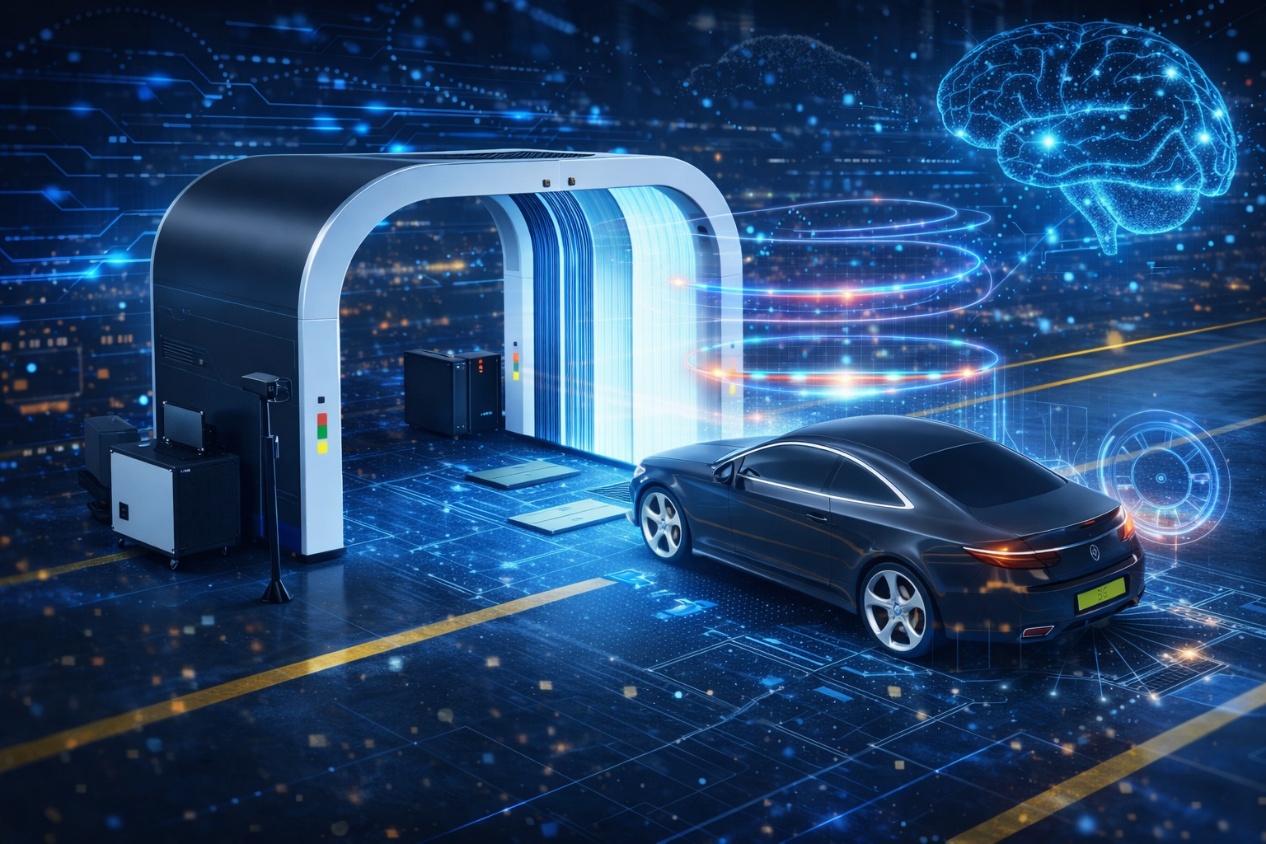
Instead of stopping a vehicle for a lengthy manual inspection, an Automated Vehicle Inspection system could scan the vehicle as it passes through a designated inspection area.
The concept is relatively simple.
The vehicle drives through.
Sensors and cameras capture its condition.
AI analyzes the collected data.
Potential abnormalities are identified.
Inspection results are stored for future reference.
This does not necessarily eliminate technicians. Instead, it can provide them with a more consistent and scalable way to monitor fleet condition.
What Could Automated Vehicle Inspection Look Like?
The technology behind an Automated Vehicle Inspection gateway could combine multiple inspection capabilities.
1.Automated Exterior Inspection
A vehicle body scanner could capture high-resolution images while the vehicle passes through the inspection zone.
AI-based image analysis could identify visible conditions such as scratches, dents, paint damage and missing or abnormal exterior components.
For a large Robotaxi fleet, creating a digital record of vehicle condition after repeated operating cycles could also help operators track changes over time.
2.Automated Tire Inspection
Tires are among the most frequently consumed components on any high-mileage vehicle.
For autonomous fleets, monitoring tread wear, uneven wear and other visible tire conditions could become an important part of routine fleet management.
Instead of relying solely on periodic manual checks, automated tire inspection could provide more frequent condition data as vehicles pass through the depot.
3.Underbody Inspection
The underside of a vehicle is one of the least visible areas during a conventional walk-around inspection.
Road debris, impacts, corrosion and fluid leakage may not always be immediately visible from the side of the vehicle.
An automated underbody scanning system could provide another layer of visibility, allowing operators to identify potential abnormalities without requiring technicians to physically inspect every vehicle underneath.
Together, these technologies point toward a broader concept: AI vehicle inspection as part of the depot itself.
Depot Automation Could Become the Next Layer of Robotaxi Infrastructure
The development of autonomous transportation is often described as a race to build better AI.
That is certainly important.
But commercial mobility is never just about the vehicle.
Airports need baggage systems. Logistics companies need warehouses. Electric vehicles need charging infrastructure. And autonomous fleets need efficient operational facilities.
Robotaxi infrastructure will likely evolve in the same way.
Charging can become automated.
Vehicle cleaning can become increasingly automated.
Fleet dispatch can be software-driven.
And Automated Vehicle Inspection could become another automated layer connecting these processes.
This does not mean every Robotaxi depot will immediately adopt fully automated inspection. The actual infrastructure model will depend on fleet size, operating conditions, regulations and business requirements.
But as autonomous fleets scale, the value of faster, repeatable and data-driven vehicle inspection is likely to become increasingly relevant.
The Future of Autonomy Is Bigger Than the Vehicle
Cybercab represents an important change in how we think about transportation: the vehicle itself is becoming increasingly autonomous.
But autonomy does not end when the vehicle arrives back at the depot.
The next question is what happens between rides.
How quickly can the vehicle be charged?
-
How efficiently can it be cleaned?
-
How accurately can its condition be monitored?
-
How quickly can potential problems be identified?
-
And how effectively can all of this information be connected to the vehicle's maintenance history?
These are not necessarily the most visible parts of the Robotaxi revolution.
But they could become critical to making autonomous fleets operationally scalable.
The public may continue to focus on the AI brain that allows a Cybercab to navigate a city.
From an industry perspective, however, there is another system worth watching:
the infrastructure that keeps that vehicle ready for its next ride.
The next stage of autonomous mobility may therefore involve more than autonomous driving.
It may also involve Automated Vehicle Inspection, intelligent fleet maintenance and increasingly automated depot operations.
The road to autonomous transportation may begin on the street--but its long-term scalability could depend just as much on what happens off the road.
Media Contact
New Tech Automotive Technology(Shanghai)Co., Ltd.
+86-17717670602
Source :New Tech Automotive Technology(Shanghai)Co., Ltd.
This article was originally published by IssueWire. Read the original article here.

Trump claims neither he nor Musk caused Ukraine Starlink outage
President Trump claimed on Friday that neither he nor SpaceX founder Elon Musk caused Ukraine’s Starlink outage earlier this week as the president clashed with Ukrainian President Volodymyr Zelensky over resumed strikes on Russian oil refineries. “I didn’t do that. No, we didn’t do that at all. In fact, I don’t even think it was...

18 reasons to get the new iPhone Duo with Smart Postpaid
A foldable design, a larger display when you need it, and the flexibility of the iPhone experience – all in one device. Apple’s much-anticipated iPhone Duo introduces a new way to experience iPhone, and Smart makes it easier for you to own it with Smart Postpaid Plans+ 1999 starting at P6,304 per month, with zero-interest

Musk settles election lottery lawsuits over $1 million voter giveaways
Tech mogul Elon Musk agreed to settle two lawsuits over his $1 million check handouts to battleground voters in the 2024 election, according to court filings published Thursday. The suits, filed in the Western District of Texas, accused the Tesla and SpaceX CEO of defrauding voters when his America PAC offered a $1 million giveaway...

AI safety group pushes for tighter export controls, limits on 'vastly superhuman AI'
A conservative AI safety group is calling for the U.S. to implement tighter restrictions on advanced chip sales to China and limit the development of “vastly superhuman AI” as part of a new framework for AI policy. Humans First, chaired by former Tea Party leader Amy Kremer, laid out what it described as an “America...

Warsh offers no fresh signals on interest rates
Federal Reserve Chair Kevin Warsh declined Friday to predict central bank officials’ future course on interest rates, less than two weeks before they meet to discuss monetary policy. “I don’t prejudge meetings. I don’t believe in saying now what I might do at the meetings that we have in the balance of this year,” Warsh...

'AI artists' perform improvised music at Jarasum Jazz Festival
Artificial intelligence (AI) models developed by a research team led by Korea Advanced Institute of Science and Technology (KAIST) professor Nam Ju-han made their debut at one of Korea’s leading jazz festivals, performing improvised jazz alongside human artists. According to the university Friday, the team showcased human-AI music collaboration technology that analyzes the flow of human performances in real time, allowing AI to take over performances or generate improvised accompaniment during the 23rd Jarasum Jazz Festival, held in Gapyeong County, Gyeonggi Province, from Oct. 9 to 11. A total of 12 human jazz artists participated in the event, collaborating with AI in 26 pieces across 12 performances. The technology is different from existing music AI services as it enables collaboration with human musicians in jazz, a genre characterized by improvisation. Jazz musicians often change the tempo or create new melodies based on how they feel in the moment. Because the same piece can be performed differently each time, musicians must listen to one another and adjust their playing accordi

Why do some Samsung employees cheer company's stock plunge?
Some Samsung Electronics employees have drawn criticism from online users after appearing to welcome a nearly 9 percent plunge in their company's share price on an anonymous workplace community. Posts written by Samsung Electronics employees on the company's board on Blind, an anonymous community for office workers, spread across online communities and social media Thursday. Blind requires users to verify their employment through their company email addresses, and displays the name of their employer alongside their usernames. According to the Korea Exchange, Samsung Electronics closed Thursday's regular trading at 210,000 won ($147), down 9.48 percent, or 22,000 won, from the previous session. One person believed to be a Samsung Electronics employee posted on Blind under the title, "Please let the stock plunge to 100,000 won." Another employee wrote a post titled, "Isn't a falling stock price actually better for Samsung Electronics employees?" The employee said, "From the Device Solutions (DS) division's perspective, a higher stock price only increases the risk associated with OPI2," ref

Michael Jordan's Steak House named Korea's best hotel restaurant
Michael Jordan’s Steak House, the only location of the U.S. restaurant brand outside the United States, has been named “Korea’s Best Hotel Restaurant 2026” at the World Culinary Awards. INSPIRE Entertainment Resort in Incheon, which houses the restaurant, said Friday that the steakhouse received the award at a ceremony held Wednesday in Jamaica. The awards recognize outstanding restaurants and culinary destinations through votes cast by industry professionals, experts and consumers. The event is a sister event of the World Travel Awards, described as the “Oscars of the travel industry.” The restaurant opened in Incheon in 2023 as the brand’s first and only location outside the U.S., bringing a selection of steaks that had proved popular in its home market. Cornerstone Restaurant Group oversees the brand in partnership with basketball legend Michael Jordan, with two U.S. locations in Chicago and Connecticut. The Incheon restaurant also received a Best of Award of Excellence in June from Wine Spectator, a U.S. wine publication, as part of its annual Restaurant Awards. “This

Chaevi wins all 4 government EV charging subsidy categories
Electric vehicle (EV) charging operator Chaevi has achieved a rare clean sweep in this year's government EV charging facility subsidy program, securing qualifications across all four categories in both network operation and hardware manufacturing. The company was selected as an operator and manufacturer of fast, medium-speed and slow charging facilities under a program overseen by the Ministry of Climate, Energy and Environment. The selection marks Chaevi’s ninth consecutive year as a designated charging facility operator and its first selection in newly introduced manufacturer categories, according to the company. The four categories cover operators of fast and medium-speed chargers, operators of slow chargers, manufacturers of fast and medium-speed chargers, and manufacturers of slow chargers, allowing Chaevi to participate in the government’s subsidy program through 2027. The government revised its evaluation system this year to assess operators and manufacturers separately, with manufacturers facing additional scrutiny of technological development, product quality and charging pe

Hyosung Heavy Industries doubles export capacity with Changwon factory
Power transmission equipment manufacturer Hyosung Heavy Industries opened a new factory in Changwon, South Gyeongsang Province, Friday, doubling its production capacity for extra-high-voltage circuit breakers rated at 420 kilovolts (kV) and above as it prepares for surging global demand for power infrastructure. The facility, covering about 18,996 square meters, will exclusively manufacture circuit breakers rated at 420 kV, 550 kV and 800 kV for export markets, strengthening the company's ability to fulfill large overseas orders. Hyosung Heavy Industries reorganized its existing circuit breaker operations to focus primarily on domestic models, while the new facility handles export products rated at 420 kV and above. The factory integrates component manufacturing, assembly, testing and shipping under one roof, creating a streamlined production system designed to improve efficiency and delivery times. Production capacity for insulation components, which are critical to circuit breaker performance, has also doubled, according to the company, which said it is the only domestic power equipmen

Samsung's Galaxy S26 Ultra, 2 other products named to TIME's Best Inventions of 2026
Samsung Electronics said Friday that three of its products have been named to TIME magazine’s list of The Best Inventions of 2026. The U.S. weekly news magazine announced the list Thursday (local time). It picked the Galaxy S26 Ultra smartphone in the Consumer Electronics category, the Bespoke AI Family Hub refrigerator in Household and the Odyssey G8 gaming monitor in Entertainment & Gaming. TIME compiles the list each year from nominations by its editors and correspondents around the world. It rates new products and ideas on originality, efficacy, ambition and impact. The magazine called the Galaxy S26 Ultra “a privacy-focused smartphone,” citing its Privacy Display. The feature effectively blocks people from viewing the screen from the side. Users can choose when it turns on or apply it only to certain content, such as pop-up notifications. TIME said this makes it more flexible than conventional privacy screen protectors. The phone is the top model in the Galaxy S26 series, which was released in March. It has a 200-megapixel wide-angle camera and artificial intelligence (AI) fea

AMCHAM chief receives honorary doctorate from Korea Aerospace University
American Chamber of Commerce in Korea (AMCHAM) Chairman James Kim received an honorary doctorate in business administration from Korea Aerospace University (KAU) on Thursday in recognition of his contributions to Korea-U.S. economic cooperation. The university recognized Kim for bringing businesses and policymakers from the two countries together to promote trade, investment and cooperation in advanced industries. It also cited his efforts to attract foreign investment to Korea and improve the business environment in the country, drawing on his experience leading global companies. A degree ceremony was held at Vision Hall in the university’s Aerospace Center following a commemorative tree-planting event. KAU President Hurr Hee-young delivered welcoming remarks, while Korean Air Executive Vice President Kenneth Chang offered congratulatory remarks. “It is a great honor to receive an honorary doctorate from a university that has been at the forefront of developing Korea’s aerospace and defense talent,” Kim said. Kim also praised KAU’s efforts to develop talent and strengthen ties



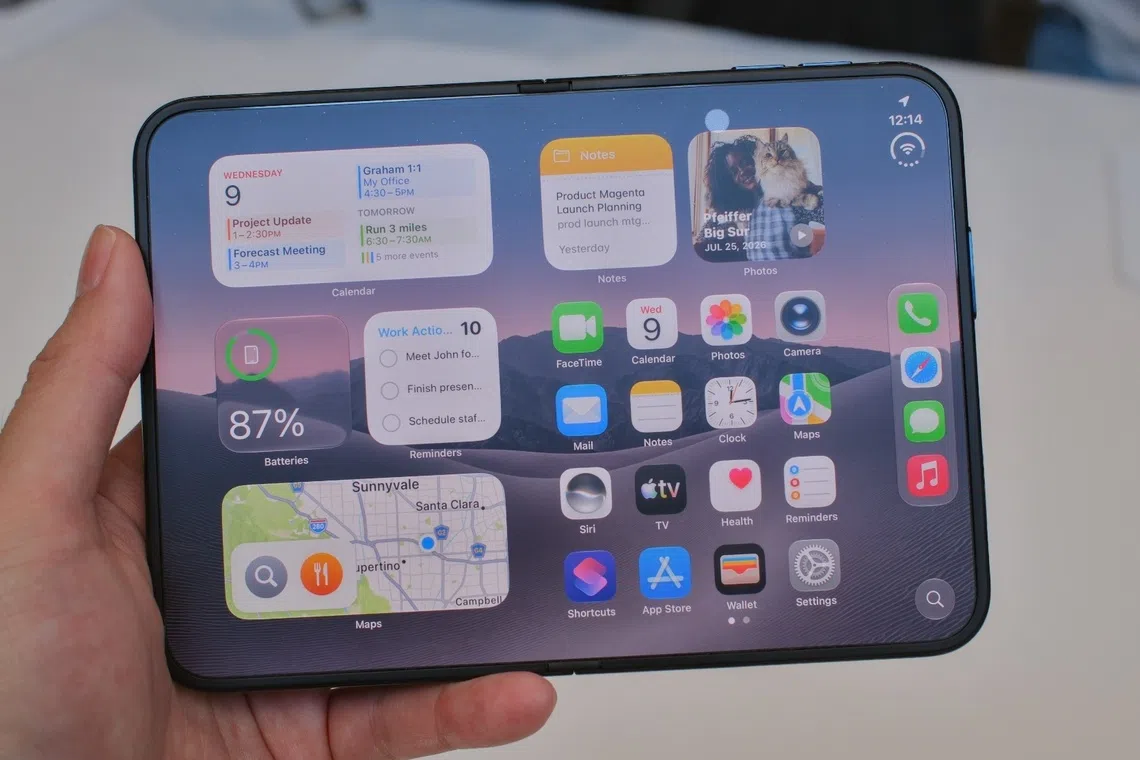


Where to preorder the iPhone Duo?

YOUR NEWS, OUR NETWORK.
Do you have Great News you want to tell the world?
Be it updates about your business or your community, you can make sure that it’s heard by submitting your story to our network reaching hundreds of news sites across 6 verticals.