
Evaluating High-Purity Quartz Glass Supplier in China Standards: Reach Certified Excellence at Southeast Quartz
Sep 4, 2026
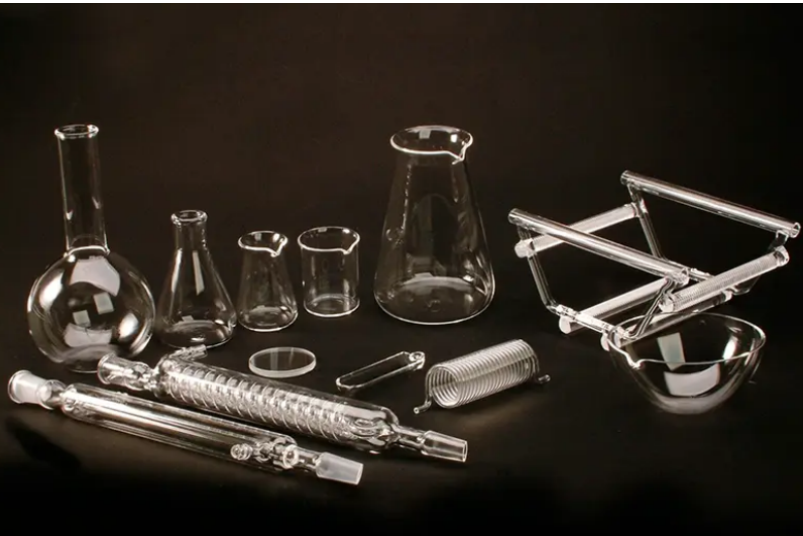
Lianyungang, Jiangsu Sep 4, 2026 (Issuewire.com) - In high-end manufacturing sectors such as silicon wafer processing, photovoltaic ingot pulling, precision optics, and advanced chemical analysis, raw material selection forms the definitive baseline for process stability and operational safety. Technical procurement engineers historically treated European REACH compliance as a standard regulatory formality necessary for cross-border international trade. However, technical audit teams, advanced testing laboratories, and cleanroom fabrication facilities now actively use REACH compliance documentation as a pre-intake material audit. This documentation allows them to evaluate trace heavy metal migration risks and impurity outgassing long before component integration occurs. Evaluating a high-purity quartz glass supplier in China requires looking far beyond standard factory self-certificates and examining the structural authority of third-party verification bodies. Lianyungang Southeast Quartz Products Co., Ltd. addresses these exacting operational requirements by combining raw material trace-element controls with batch-level compliance documentation. This comprehensive quality control framework ensures that every high-purity quartz glass component delivers consistent physical performance, structural integrity, and thermal stability under demanding high-temperature and high-vacuum processing conditions.
Evaluating Technical Quality Metrics for Quartz Glass Performance
Establishing a rigorous evaluation framework for high-purity quartz glass requires verifiable physical, thermal, and chemical performance metrics. Premium thermal process components must reliably maintain a silicon dioxide purity level of at least 99.99 percent, while trace alkali metals such as sodium and potassium and transition metals like iron are tightly controlled below strict parts-per-million thresholds. Excessive trace impurities significantly accelerate devitrification at elevated operating temperatures. Devitrification weakens structural integrity, alters thermal expansion traits, and leads to premature structural failure in diffusion furnaces, quartz boats, and reaction chambers.
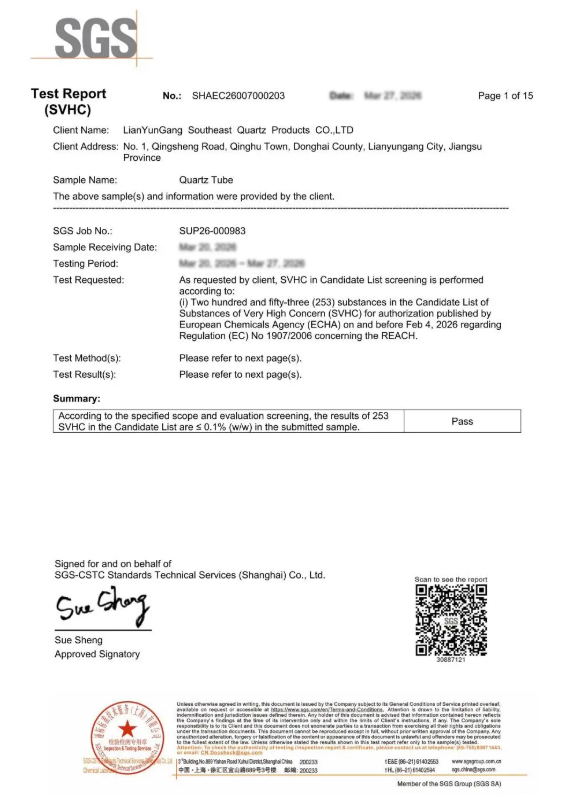
A dependable quartz glass supplier verifies internal structural integrity through multi-stage physical and chemical testing protocols before authorization of final shipment. Standard factory evaluations include high-sensitivity helium mass spectrometer leak detection to confirm gas tightness across high-vacuum environments. Manufactured components also undergo mechanical pressure resistance testing to assess structural load capacity, alongside extreme thermal shock resistance evaluations capable of enduring continuous exposure up to 1200°C. To satisfy strict semiconductor and high-precision laboratory standards, internal testing regimens are fully supplemented with accredited third-party verification, including detailed SGS testing reports for RoHS and REACH regulatory standards. These chemical analytical profiles verify that trace halogen levels, heavy metal concentrations, and restricted substance metrics remain strictly within international safety and exposure limits.
Embedding REACH Verification into Batch Traceability Systems
The designation REACH Certified Excellence reflects a strategic operational shift from periodic external compliance checks to full end-to-end supply chain verification. Rather than relying on a static, once-a-year factory compliance certificate, Southeast Quartz integrates chemical safety and material compliance data directly into the batch traceability system of each individual outgoing shipment. Every single production lot is systematically paired with raw material lot tracking from Donghai County quartz reserves, specific annealing furnace temperature logs, and ICP-MS level purity testing records.
This structured material verification system provides substantial technical and operational advantages for downstream manufacturing facilities across various demanding industries:
- Streamlined Incoming Material Audit Protocols
Detailed chemical analysis records and physical testing sheets arrive directly alongside each delivered product lot. This documentation allows client quality control departments to accept incoming quartz components straight into cleanroom inventory without conducting repetitive, expensive, or time-consuming chemical testing on site.
- Prevention of High-Temperature Impurity Outgassing
By enforcing ultra-low trace halogen and heavy metal thresholds, high-purity quartz glass components prevent volatile chemical outgassing during high-temperature thermal processing, epitaxy, or chemical vapor deposition. Controlling outgassing protects neighboring silicon wafers, delicate substrates, and chamber internal sensors from subtle chemical etching or unwanted metallic contamination.
- Complete Quality Management System Documentation
Comprehensive material testing packages integrate seamlessly into an enterprise Quality Management System audit file. This integration creates an unbroken, transparent chain of custody extending from initial raw quartz ore processing to final precision component fabrication.
Closed-Loop Compliance and Quality Verification Workflows
Lianyungang Southeast Quartz Products Co., Ltd. maintains rigorous quality control over its entire manufacturing workflow through a structured four-stage quality verification framework:
1. Raw Material Selection and Processing
Production begins with high-grade quartz ore sourced directly from the mineral-rich Donghai County region. The raw mineral batch undergoes specialized refining procedures to achieve ultra-low trace element concentrations, establishing predictable thermal expansion properties across every single glass melt.
2. Thermal Processing and Internal Stress Relief
Fused silica raw materials are shaped into specialized furnace tubes, heavy-duty crucibles, polished quartz plates, bell jars, or custom chemical instruments utilizing advanced plasma fusion and flame-working techniques. All fabricated components undergo long-duration controlled annealing cycles inside automated furnaces to eliminate internal mechanical stress, guaranteeing exceptional dimensional stability during rapid heating and cooling thermal cycles.
3. Precision Machining and Physical Quality Testing
Every completed component undergoes 100 percent dimensional inspection via precision optical measuring systems, followed by meticulous surface defect analysis, helium mass spectrometer leak detection, and high-pressure endurance evaluations.
4. Documentation Integration and Final Shipment
Every single outbound shipment includes a complete quality and compliance package: a comprehensive material chemical composition report, laser-verified dimensional measurement records, and individual batch test certificates for helium leak tightness, mechanical pressure resistance, and elemental purity.
Downstream technical teams can file these technical documentation packages directly into their internal QMS quality audit files. This process completely eliminates the operational need to organize independent third-party sample testing or delay installation schedules while waiting for external laboratory validation.
A Systematic Approach to Precision Quartz Vendor Selection
Selecting an appropriate quartz glass supplier involves far more than simply verifying basic REACH claims on a marketing brochure. The vital technical distinction lies in whether a vendor provides verifiable, batch-specific test reports that integrate seamlessly into internal quality audit workflows and regulatory compliance files. Through stringent raw material purification, comprehensive physical testing protocols, and complete batch documentation, Southeast Quartz provides transparent, verifiable component solutions capable of standing up to the most demanding thermal and chemical operational environments.
For complete product specifications, custom quartz fabrication capabilities, and verified material documentation packages, please visit the official website: https://www.dnquartz.com/
Media Contact
Lianyungang Southeast Quartz Products Co.,Ltd.
No. 1 Qingsheng Rd., Qinghu Industrial Park, Donghai County, Jiangsu, China/222300
Source :Lianyungang Southeast Quartz Products Co.,Ltd.
This article was originally published by IssueWire. Read the original article here.

North Korea linked to $6.3B Binance hack
A North Korea-based cybercrime group appears to be behind a $6.3 billion hack of the cryptocurrency exchange Binance, according to two blockchain intelligence firms. Both TRM Labs and Chainalysis tied the largest crypto hack on record to TraderTraitor, a North Korean hacking unit that has previously targeted the digital asset industry. Billions of dollars' worth...

Top Science Democrat probes cuts to research spending at National Science Foundation
A key Democrat is looking into a massive amount of money that was appropriated to the National Science Foundation (NSF) but reportedly not spent. In a letter first shared with The Hill, House Committee on Science, Space and Technology ranking member Zoe Lofgren (D-Calif.) accused the foundation of violating “Congress’ power of the purse and...

AI, fuelled by advanced chips, set to power semiconductor manufacturing: industry veteran
Artificial intelligence is no longer merely the driving force behind global semiconductor demand, but is also actively reinventing how chips are designed and built, industry leaders and scientists said at a major science forum in Shanghai on Friday. Chen Yunji, co-founder of AI chipmaker Cambricon Technologies, predicted that the integration between AI and chip design would eventually automate the chip design process entirely. “In the [next] 10 years, the most important development … is the RSI...

Backlash against AI data centers threatens GOP's grip on Ohio, Texas
The importance of AI data centers is growing this election cycle as the fight over the infrastructure's costs and environmental impacts may be threatening Republicans in battleground states like Texas and Ohio. Grassroots movements in rural communities, particularly where President Trump won by double-digit margins in each of his presidential bids, are threatening the rural...

Starlink drama puts spotlight on Musk's global stature
Elon Musk and his business's role in a recent dispute over Ukraine's access to Starlink and its military network is putting a spotlight on the tech mogul's outsized influence on the international stage. Following about 10 days of confusion and finger-pointing over what caused the slowdown of Starlink and its military-grade version — Starshield — in Ukraine, Musk acknowledged his company, SpaceX, was behind the restrictions on Starlink's...
Amid brutal sell-off, what comes next for Google, Amazon and other Big Tech titans?
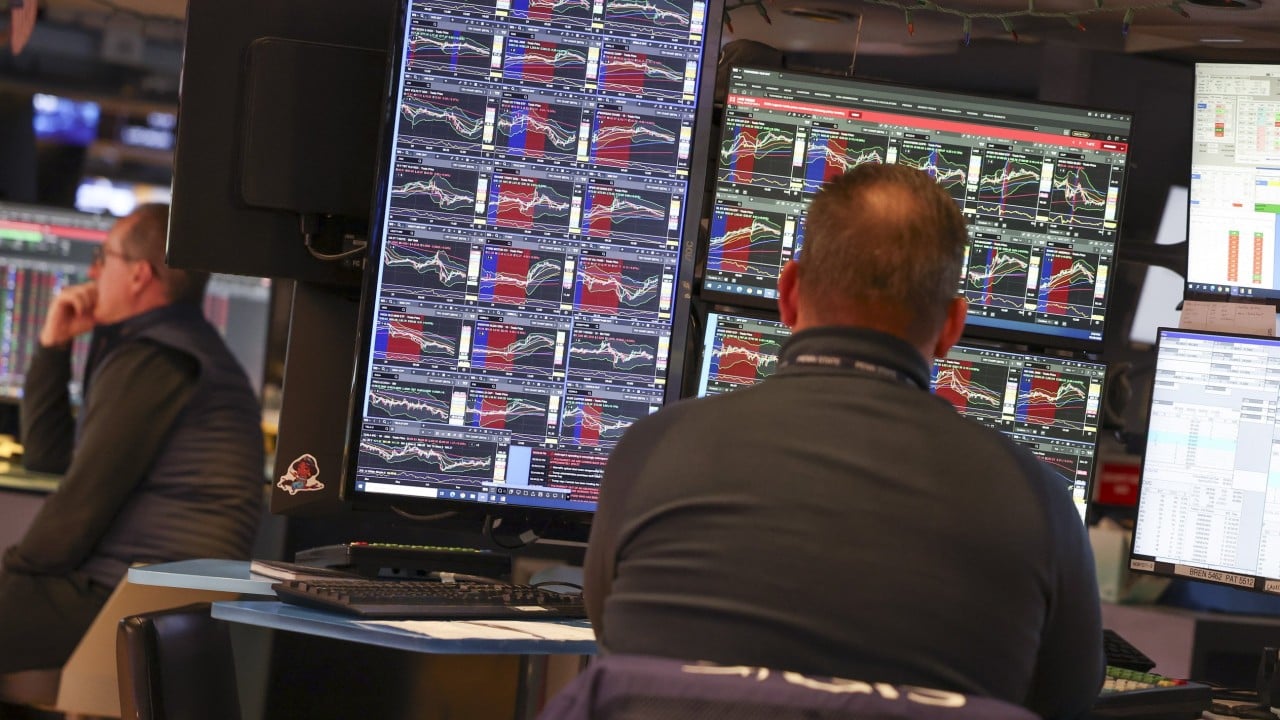
Soaring artificial intelligence revenues have failed to shield Intel, Amazon and Google’s parent company Alphabet from a brutal Wall Street sell-off, as their latest quarterly results deepened investor jitters over mounting capital spending and delayed returns. Intel plunged about 23 per cent in extended trading on Thursday, while Amazon shed 7.3 per cent. Alphabet tumbled 12.6 per cent during the regular session in its worst day on record, dragging the Nasdaq Composite down 1.4 per cent and...

Roblox hands Fave founder Joel Neoh the keys to SEA. His first job isn’t growth, it’s trust
Joel Neoh has spent two decades selling things to adults: group-buying deals at Groupon, cashback at Fave, DNA kits and supplements at Prenetics. His new job asks him to build a business on a platform where a large slice of the audience still needs a parent’s permission to buy anything. Roblox has appointed the Malaysian […] The post Roblox hands Fave founder Joel Neoh the keys to SEA. His first job isn’t growth, it’s trust appeared first on e27.

North Korea’s hiring scam just cost Binance US$6.3B. SEA’s engineers are on the shortlist
For years, Southeast Asia’s crypto regulators have asked exchanges the same set of questions. Where is your licence? Where is your local entity? Where are your cold wallets, and whose name is on them? On October 29, North Korea answered with a question of its own: whose laptop is this? Binance, the world’s largest crypto […] The post North Korea’s hiring scam just cost Binance US$6.3B. SEA’s engineers are on the shortlist appeared first on e27.

German chancellor urges global trade alliance as Germany deepens Indo-Pacific ties
German Chancellor Friedrich Merz called for a global political alliance to defend rules-based trade, urging Germany and Indo-Pacific economies to strengthen economic partnerships and diversify supply chains as geopolitical tensions and intensifying U.S.-China competition reshape the global economy. Speaking at the opening of the 19th Asia-Pacific Conference of German Business (APK) in Seoul on Friday, Merz proposed establishing a "global political alliance for rules-based trade" to defend and strengthen the international trading system and coordinate joint action when it comes under threat. “When supply chains become political pawns, when access to key technologies is imperiled or when efforts to secure raw materials become a projection of power rather than of fair partnership, this jeopardizes growth, prosperity and, ultimately, the security,” he said. “Countries that decouple lose security, innovative strength, prosperity and scope for action. We do not wish to withdraw but rather to expand our freedom of action.” Turning to bilateral ties, the chancellor said Germany and Korea

Goldman Sachs eyes Tmap Mobility acquisition by year-end
Goldman Sachs is seeking to acquire a controlling stake in Tmap Mobility, operator of Korea’s leading navigation app, from SK Square by the end of this year, seeing an investment opportunity in its lower valuation and vast trove of mobility data as autonomous driving advances, industry sources said Friday. For SK Square, SK Group’s investment arm and the largest shareholder of SK hynix, the sale is part of a broader strategy to focus on artificial intelligence (AI) and semiconductors. The global investment bank is looking to invest between 600 billion won ($450 million) and 800 billion won to secure a 60 to 70 percent stake in Tmap Mobility. It is in talks to buy shares from SK Square, the largest shareholder with a 63.23 percent stake, as well as other financial investors, including Affirma Capital and EastBridge Partners, which each hold 9.83 percent, and KB Kookmin Bank, which owns 6.39 percent. Tmap Mobility traces its roots to a navigation service launched by SK Telecom in 2002. The telecom operator spun off its mobility business into a separate company in December 2020, and Tm

Hanwha Systems wins SAR microsatellite constellation project
Hanwha Systems has won a contract to develop synthetic aperture radar (SAR) satellites for Korea's microsatellite constellation aimed at enhancing national security and disaster response capabilities, data showed Friday. The defense solutions arm of Hanwha Group was selected for the SAR satellite development project commissioned by the state-run Agency for Defense Development (ADD), according to the Public Procurement Service. The microsatellite development project is a joint initiative involving the defense ministry, the Korea AeroSpace Administration (KASA) and the Korea Coast Guard to strengthen surveillance of security threats and natural disasters on the Korean Peninsula and in surrounding waters. SAR satellites can capture images of land and sea regardless of weather conditions or time of day. Operating a constellation of small satellites allows for more frequent monitoring of specific areas and faster intelligence gathering. Hanwha Systems has previously supplied SAR sensors and data links for Korea's military reconnaissance satellites.

LIG D&A faces growing hurdles in global arms export amid bribery scandal
LIG Defense & Aerospace's (LIG D&A) overseas expansion plans could be in jeopardy, as an ongoing bribery scandal threatens to disrupt its defense development and production pipeline through a potential two-year government bidding ban. The Seoul Administrative Court will hold a hearing on Thursday to review the company's request to suspend the enforcement of a two-year restriction imposed by the Defense Acquisition Program Administration (DAPA). Last week, the defense authority imposed the penalty on allegations that the firm’s executives offered bribes worth hundreds of millions of won to a DAPA employee during the bidding process for a weapons development project. LIG D&A denied the allegations and has taken legal steps for a temporary suspension of the penalty, which was originally scheduled to take effect on Thursday. The suspension will remain in place until Nov. 20. The potential disruption carries significant implications for the company's business structure. Its government and public institution clients accounted for 64.5 percent, or 2.78 trillion won ($2.07 billion), of LIG D&A


[WEEKENDER] Unknown at home, big abroad







YOUR NEWS, OUR NETWORK.
Do you have Great News you want to tell the world?
Be it updates about your business or your community, you can make sure that it’s heard by submitting your story to our network reaching hundreds of news sites across 6 verticals.