
Digital RX Lens Lab Outsourcing Guide | CONVOX
Sep 17, 2026
Zhenjiang, Jiangsu Sep 16, 2026 (Issuewire.com) - Cost, Quality, Turnaround and Production Capacity for B2B Optical Buyers
For optical laboratories, retail chains and distributors, outsourcing prescription lens production can be a practical way to extend RX capability without immediately expanding every stage of in-house surfacing, polishing, coating and quality-control infrastructure. It is not automatically the right choice for every business; the value depends on order mix, internal capacity, prescription complexity and service expectations.
A suitable outsourcing partner should therefore be evaluated on more than price. Buyers need to understand the supplier's workflow, design capability, material range, coating options, quality verification, turnaround time and ability to support repeat orders with consistent specifications.
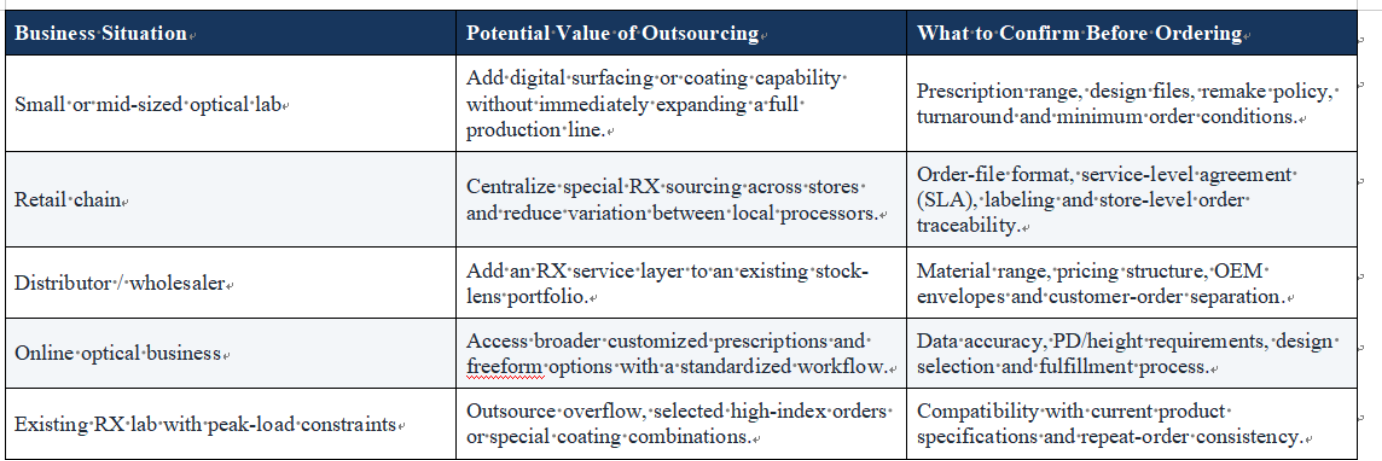
- When Does RX Outsourcing Make Business Sense?
RX outsourcing is most useful when it solves a specific operational constraint rather than simply replacing an existing lab process. The table below summarizes common B2B situations.
(pic)
- Cost Structure: In-House Expansion vs. Outsourced RX Production
Maintaining or expanding an RX laboratory can involve generators, polishers, coating systems, calibration, software, engineering staff, utilities, semi-finished blank inventory and process losses. Outsourcing can reduce the need for additional capital investment and convert part of these fixed manufacturing costs into variable production costs tied to actual orders.
The financial benefit depends on the buyer's own volume and utilization rate. A high-volume laboratory may justify substantial in-house investment, while a smaller laboratory or distributor may benefit from using an external RX supplier for selected products, overflow orders or complex prescriptions.
- Material flexibility: access to commonly used resin indices including CR-39, 1.56, 1.59 PC, 1.60/1.61 MR-8, 1.67, 1.71 and 1.74, subject to the selected design and coating specification.
- Lower inventory burden: reduce the need to hold every semi-finished base curve and high-index option locally.
- Technology access: use digital surfacing and coating infrastructure without purchasing every machine or software module internally.
- Capacity flexibility: use external production for overflow, special materials or selected customized orders when local capacity is constrained.
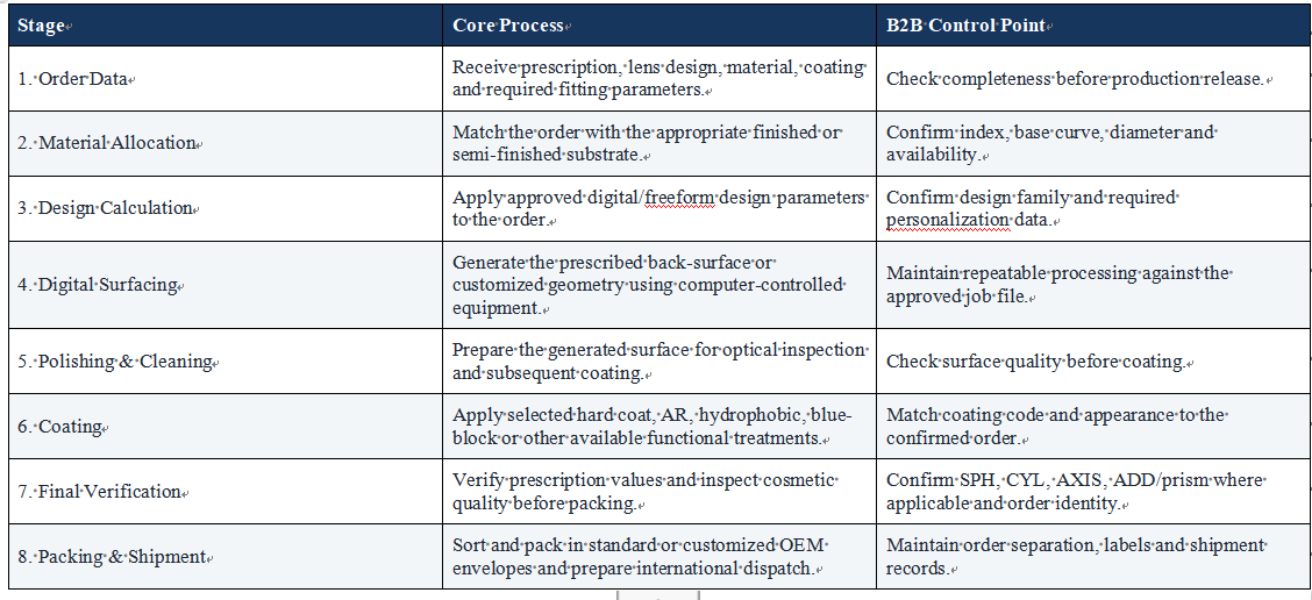
- RX Order Outsourcing Workflow
A reliable outsourcing relationship depends on a clear order path. The production target should be repeatability and traceability from submitted order data through final inspection and shipment. (pic)
- Digital Freeform Design and Customized RX Capability
Digital surfacing allows the laboratory to manufacture prescription surfaces that are calculated for the selected lens design rather than relying only on fixed molded geometry. Depending on the design and available personalization data, this can support customized single vision and freeform progressive products with more controlled power distribution and usable visual zones.
For B2B buyers, the important question is not whether a supplier uses the word "freeform," but whether the design, input parameters, production file, surfacing process and final prescription verification are managed as one controlled workflow. Consistency across repeat orders is especially important for distributors and chains building a long-term RX program.
- Quality, Coating and Turnaround
RX outsourcing should be evaluated as a combined manufacturing system. Digital design alone is not sufficient if material control, surfacing, polishing, coating or final verification are inconsistent. CONVOX combines prescription processing with broader resin-lens manufacturing, vacuum coating capability and internal quality-control procedures.
Standard RX orders can typically be processed within 48-72 hours depending on prescription complexity, lens design, material availability and coating requirements. This is a production target rather than a universal guarantee; complex jobs or special treatments may require additional time.
CONVOX manufacturing and DESMAN design overview: advanced RX production, German-inspired optical design and a 48-72 hour standard workflow depending on prescription complexity and coating requirements.
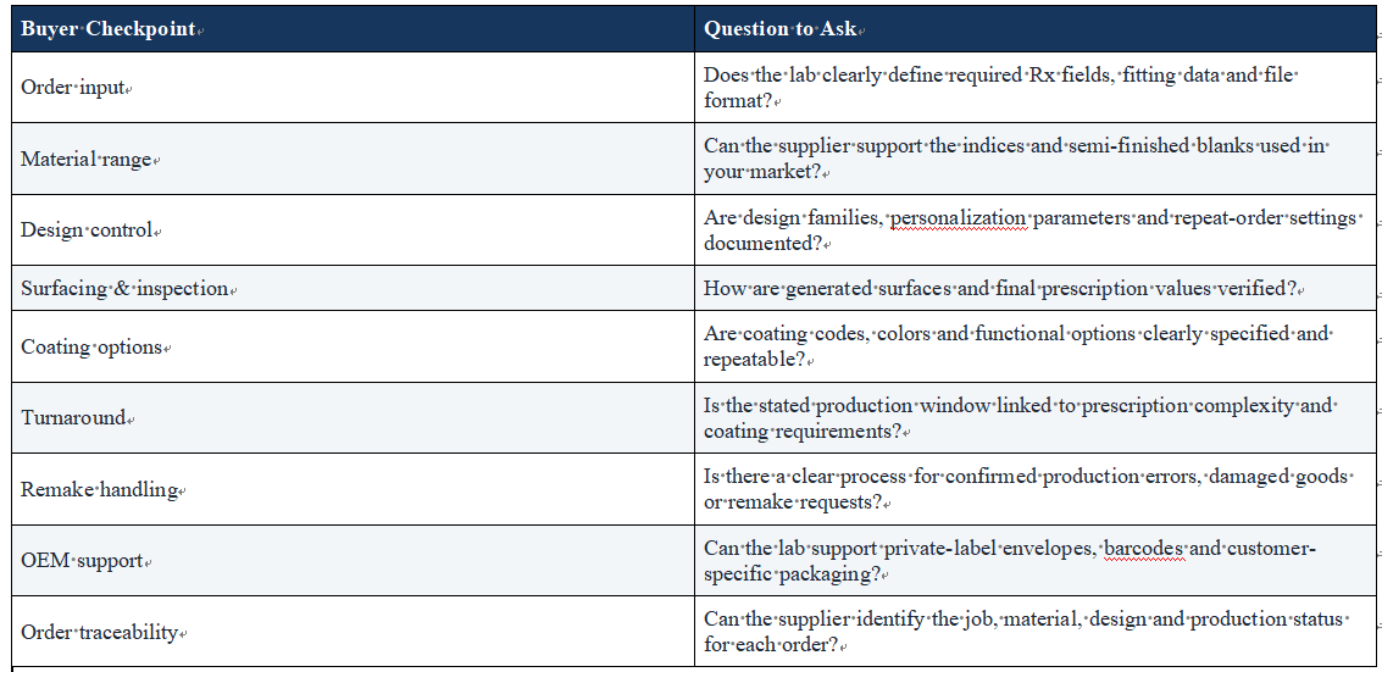
- What Buyers Should Check Before Choosing an RX Outsourcing Partner
(pic)
- Manufacturing Scale and Supply Support
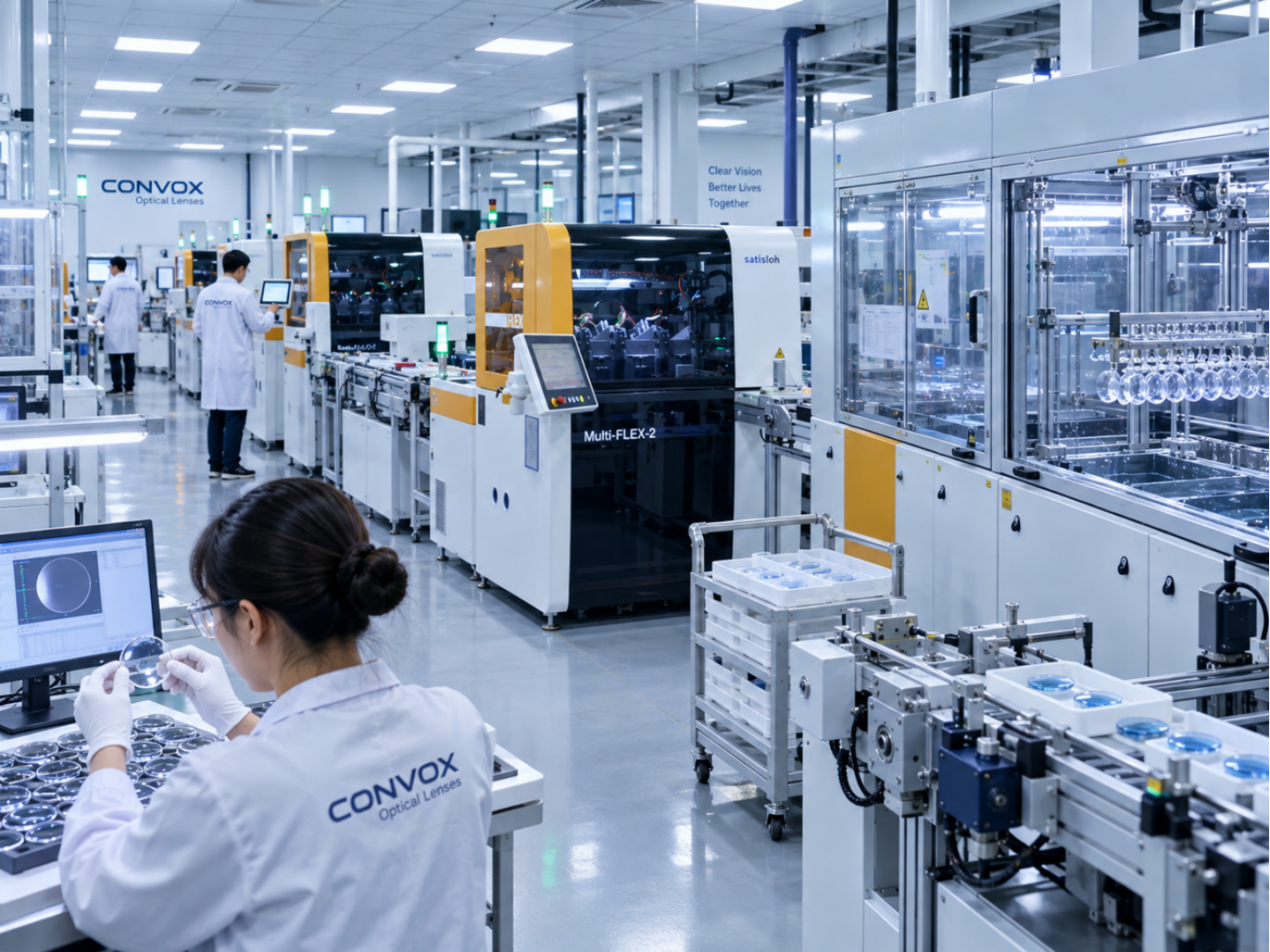
An RX lab also depends on the upstream supply of suitable blanks, coatings and packaging. CONVOX operates a broader resin-lens manufacturing platform with stock and semi-finished products alongside its prescription-processing department. For overseas buyers, this can simplify replenishment and reduce the number of suppliers required for stock and RX programs.
Large-scale manufacturing capacity should not be interpreted as RX output alone. The relevant B2B measure is whether the supplier can maintain the required RX service level while supporting material availability, repeatable specifications and international shipment preparation.
Illustrative view of CONVOX RX automation and manufacturing support, based on current workshop and equipment references.
- FAQ: RX Lens Outsourcing
Q1: Does outsourcing always cost less than running an in-house RX lab?
Not necessarily. The economics depend on order volume, equipment utilization, labor, material inventory and the range of products your business needs. Outsourcing is often most useful for businesses that want to avoid additional investment, manage overflow or access products that are not economical to manufacture internally.
Q2: What RX orders can be suitable for outsourcing to CONVOX?
The RX department supports digital prescription processing including customized single vision and freeform progressive production, with multiple resin indices and selected coating or functional options according to the confirmed product specification.
Q3: What is the normal production time?
Standard RX orders can generally be processed within 48-72 hours, depending on prescription complexity, design, material availability and coating requirements. Shipping transit time is separate from production time.
Q4: How should a distributor protect consistency across repeat orders?
Use fixed product codes, design names, material and coating specifications, and provide complete order data each time. For recurring programs, buyer and supplier should agree on a stable product matrix and remake/exception workflow.
Q5: Can private-label packaging be supported?
Yes. OEM packaging can be discussed for eligible programs, including customized lens envelopes, brand layouts and barcode requirements based on the agreed project specification.
Build a More Flexible RX Supply Chain
Request CONVOX RX product information, sample options, B2B pricing or an OEM packaging discussion for your market.
Website: www.convox-optical.com | Email: [email protected]
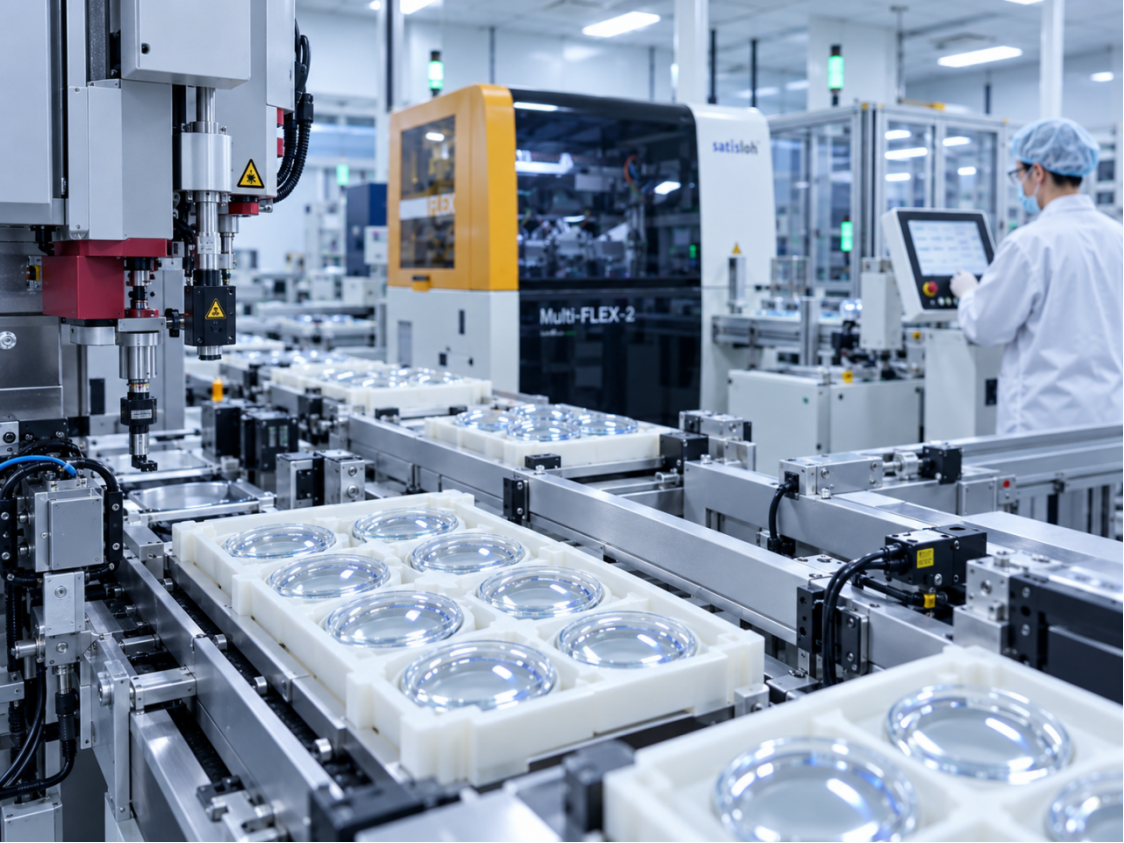
Source :JIANGSU CONVOX OPTICAL CO.,LTD.
This article was originally published by IssueWire. Read the original article here.

FTC's costly crackdown on conglomerates generates little return
The Fair Trade Commission’s (FTC) increasingly aggressive crackdown on major conglomerates is generating a costly cycle with little tangible return, as the watchdog has been forced to refund billions of won in fines overturned by courts. The watchdog has returned nearly 290 billion won ($216.7 million) to companies since 2022 after administrative court rulings overturned its sanctions. The figures raise questions about whether the regulator’s tougher enforcement produces lasting results or simply creates more legal and financial burdens for both businesses and taxpayers. The latest figures offer little reassurance. For the first nine months combined this year, the FTC returned 23 billion won in fines and associated payments, with 99.7 percent of the amount attributable to sanctions overturned in whole or in part through administrative litigation, according to data submitted to Rep. Choi Eun-seok of the main opposition People Power Party. But the regulator is moving in the opposite direction. Since President Lee Jae Myung took office last year, the government has pushed to strengthen

The AI promise was automation. The reality? Managing digital workers
When artificial intelligence agents first arrived, they came with a tantalising promise: autonomous “digital workers” that would finally free humans from corporate drudgery. As businesses across Asia are discovering, however, the reality is quite the opposite – more work, new friction and a whole new layer of management. When Xiao Mengjie, an AI product marketing manager at a Big Tech firm in Shanghai, recently assigned two AI agents what she described as a simple task, she expected efficiency....
[Reporter's Notebook] FTC's costly crackdown on conglomerates generates little return
The Fair Trade Commission’s (FTC) increasingly aggressive crackdown on major conglomerates is generating a costly cycle with little tangible return, as the watchdog has been forced to refund billions of won in fines overturned by courts. The watchdog has returned nearly 290 billion won ($216.7 million) to companies since 2022 after administrative court rulings overturned its sanctions. The figures raise questions about whether the regulator’s tougher enforcement produces lasting results or simply creates more legal and financial burdens for both businesses and taxpayers. The latest figures offer little reassurance. For the first nine months combined this year, the FTC returned 23 billion won in fines and associated payments, with 99.7 percent of the amount attributable to sanctions overturned in whole or in part through administrative litigation, according to data submitted to Rep. Choi Eun-seok of the main opposition People Power Party. But the regulator is moving in the opposite direction. Since President Lee Jae Myung took office last year, the government has pushed to strengthen

Street Fighter: a fighting game movie that fans must see
MANILA, Philippines – For nearly four decades since it started out as a small arcade game and eventually turned into the fighting game franchise powerhouse it is today, Capcom’s Street Fighter series is as universally recognizable as every iconic property and brand known in popular culture. The series has undergone several evolutionary leaps since it

Apple’s new HomePod mini 2 speakers feature Sound Glow and will eventually support Siri AI
It’s been six years since the first HomePod mini, so now we are getting a much-needed update to keep it fresh.

Meta wants to put more AI technology on our faces
At Meta Connect 2026, Meta unveiled its latest AI glasses, shared how they’re bringing the Muse personal AI agent to glasses, and introduced the all-new Meta VR Glasses.

Casetify gives Hello Kitty a very Y2K makeover with its latest collection
Leopard prints, hot pink and sticker-covered cases bring early-2000s visuals to iPhones and other accessories.

Only 17% of Philippine businesses have a roadmap to scale AI
Only 17% of businesses in the Philippines have a roadmap for scaling artificial intelligence (AI), highlighting a gap between growing adoption of the technology and companies’ ability to integrate it more deeply into their operations. The finding comes from Unlocking the Philippines’ AI Potential 2026, a report commissioned by Amazon Web Services (AWS) and conducted

Securing equipment emerges as new variable for Korea's chip expansion plans
Securing equipment for manufacturing advanced memory chips is emerging as a new variable in Korea's plans to expand semiconductor production capacity through large-scale industrial clusters, after ASML, the dominant supplier of advanced chipmaking equipment, warned that its current production plans may not be sufficient to meet demand in 2027 and 2028. During its earnings call Wednesday, ASML CEO Christophe Fouquet said the company's plans to increase its production capacity for advanced chipmaking equipment by 30 percent in 2027 and another 30 percent in 2028 would likely not be enough to meet customer demand. “Last quarter, we talked about 30 percent more capacity next year, and also the aspiration to have another 30 percent increase in 2028,” Fouquet said. “But to be honest, it's becoming very clear that 30 percent in 2027, 30 percent in 2028 will not allow us to meet our customer demand.” According to the company, the planned capacity increases cover both low-numerical-aperture extreme ultraviolet (low-NA EUV) lithography equipment and deep ultraviolet (DUV) immersion system

Musinsa teams up with Japan's ZOZOTOWN for 1st Korean pop-up
Fashion platform Musinsa has teamed up with ZOZOTOWN, one of Japan's leading online fashion retailers, to open a pop-up store in Seongsu-dong, Seoul, a popular destination for young consumers. Musinsa opened the doors to ZOZOTOWN in Musinsa, the Japanese platform’s first official pop-up store in Korea, to the media on Friday. The pop-up will run through Oct. 31, while an accompanying online promotion will continue until Nov. 16. Launched in 2004, ZOZOTOWN features more than 11,000 brands and serving over 13 million customers annually. Fifteen Japanese fashion brands available on the platform, including Snidel and Grancy, are participating in the event. The pop-up’s concept, ZOZO is Coming to Town, draws inspiration from Korean streets. Crosswalks, road markings and oversized three-dimensional typography have been incorporated into the space to create the impression of an intersection where Korean and Japanese fashion meet. The pop-up follows the signing of a memorandum of understanding between the two platforms in December 2024 to establish a strategic partnership. In November last y

China’s proposed AI tech export bans may create short-term costs, long-term gains: analysts
China’s proposed export bans and controls of artificial intelligence technologies aim to tighten Beijing’s grip in the strategically vital sector, casting a cloud over the commercial prospects of domestic model developers in the global AI race, analysts say. The new measures come as concerns mount globally over the risks of advanced AI systems, following a string of recent cyberattacks, while also underscoring AI’s growing national security importance for both Beijing and Washington. Zhang Yi,...
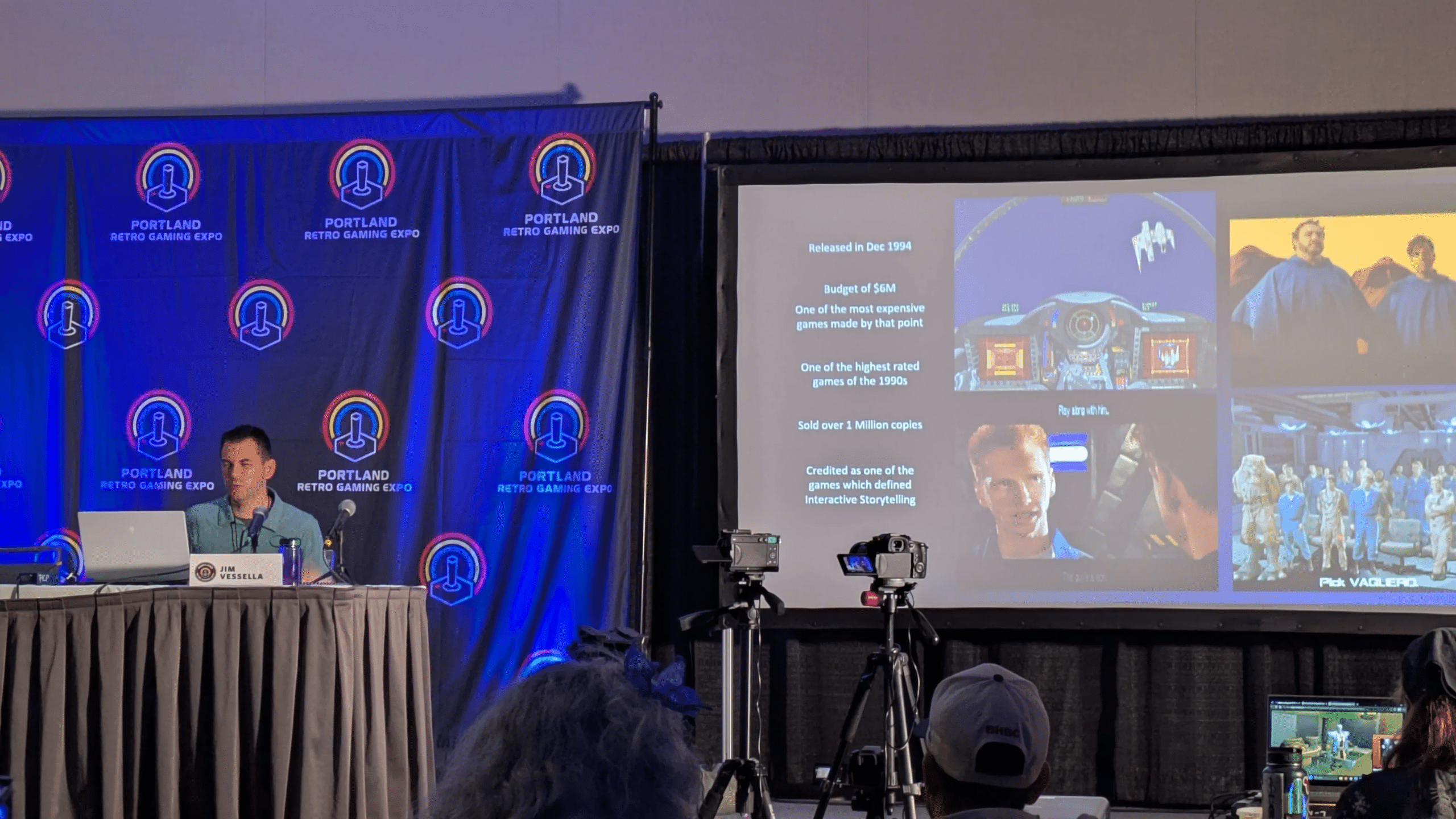
EA producer confirms the return of Wing Commander
MANILA, Philippines – A panel at the Portland Retro Gaming Expo on game preservation revealed that the master tapes containing high quality source video for Wing Commander III were located. The contents of these tapes will now undergo restoration and preparation is at work for a new release of the game, tentatively called Wing Commander






YOUR NEWS, OUR NETWORK.
Do you have Great News you want to tell the world?
Be it updates about your business or your community, you can make sure that it’s heard by submitting your story to our network reaching hundreds of news sites across 6 verticals.