
Custom Multi-Function Gym Equipment: Why Ljfitness is the Trusted OEM Partner for Fitness Brands
Sep 27, 2026
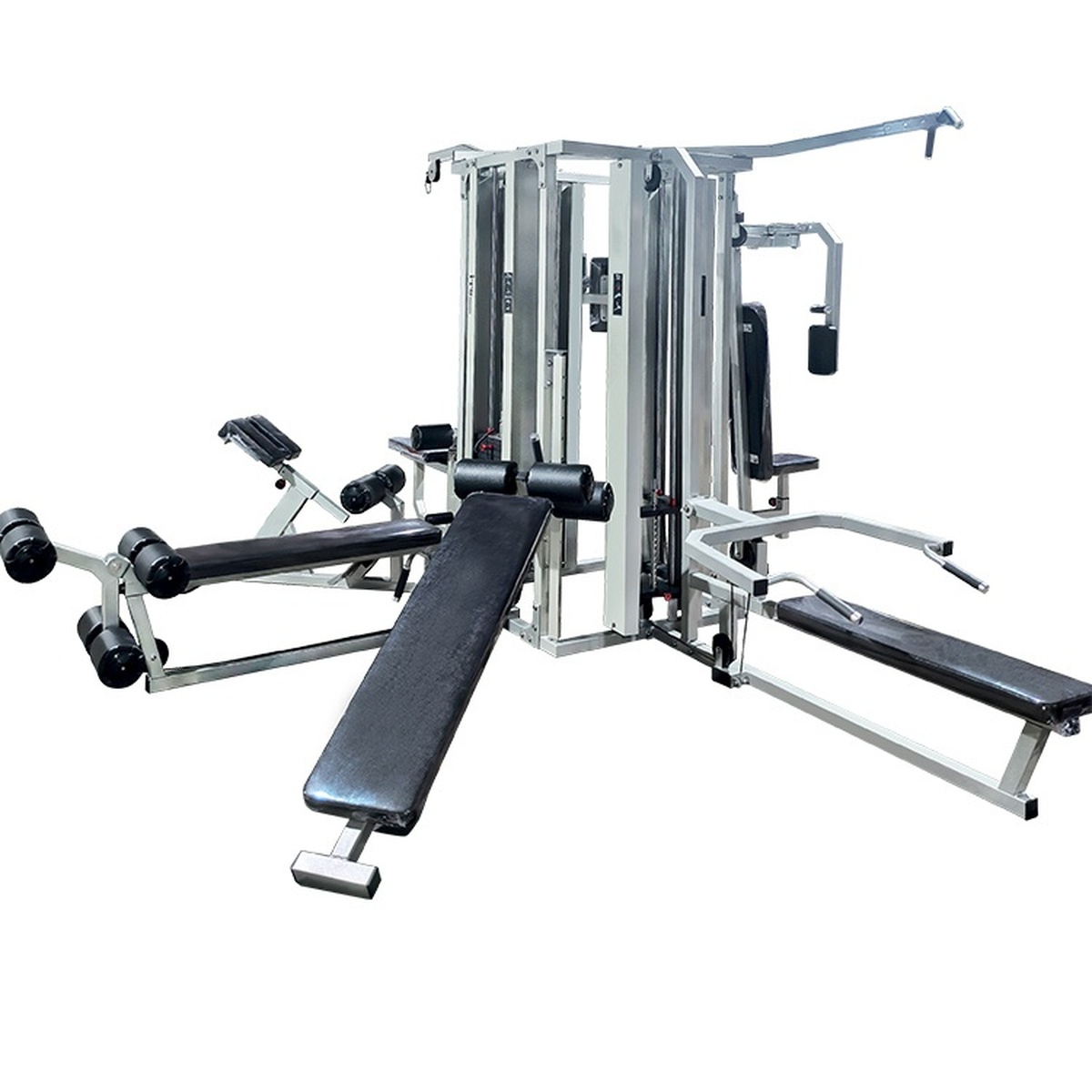
Foshan, Guangdong Sep 27, 2026 (Issuewire.com) - Maximizing square-footage efficiency without compromising biomechanical trajectory is a core operational priority in modern training facility design. Consolidating multi-station exercise modalities onto a unified, heavy-gauge steel chassis maximizes facility square-footage efficiency while leaving broad clearance for functional movement zones. Engineering custom multi-function gym equipment allows commercial fitness brands to deliver versatile resistance curves while integrating proprietary brand aesthetics. Situated in Foshan, Guangdong--the premier precision hardware and fitness equipment manufacturing hub in South China--Foshan Laijian Fitness Equipment Co., Ltd. (Ljfitness) provides direct OEM/ODM engineering capabilities backed by two decades of fabrication expertise. The company manufactures commercial-grade strength platforms built to meet international biomechanical motion profiles, dynamic fatigue ratings, and long-term structural duty cycles.
Sourcing commercial multi-function strength platforms requires rigorous validation across chassis rigidity, transmission mechanics, and international safety compliance. Built on end-to-end fabrication control and automated tube-milling systems, Ljfitness delivers custom commercial machinery through five foundational manufacturing benchmarks:
Modular Multi-Station Configuration and Footprint Optimization: Flexible 4-station to 8-station platforms and combo units matching varied facility layouts.
Heavy-Gauge Structural Steel and Aviation-Grade Cable Transmission: Heavy rectangular and flat oval tubing, robotic welding, and 1000 kg breaking-strength cables.
Ergonomic High-Density Upholstery and Bespoke Brand Customization: Flame-retardant microfiber leather, cold-cure molded foam, and custom electrostatic powder coating.
International Compliance and Quality Standards: Certified ISO 9001, ISO 14001, and CE safety standards backed by 100 percent factory pre-assembly testing.
Facility Layout Planning and Global Logistics Execution: Full-scale 2D/3D CAD space planning, real-time video factory audits, and reinforced packaging for worldwide delivery.
Modular Multi-Station Configuration and Footprint Optimization
Efficient facility zoning hinges on multi-station equipment configurations that integrate diverse training modalities into a consolidated spatial envelope. Ljfitness manufactures scalable multi-jungle architectures configurable from 4-station up to 8-station multi-tower platforms (such as the LJ-5904N and LJ-5907 series). These integrated structures support simultaneous high-load operation across independent cable columns, accommodating high-traffic movements--including lat pulldowns, seated low rows, triceps extensions, and dual adjustable cable crossovers--via dedicated selectorized weight stacks.
For compact training studios and hospitality fitness spaces, Ljfitness integrates cable mechanics with guided barbell movement through combo units like the LJ-5909B functional trainer and Smith machine platform. This engineering consolidates a dual adjustable pulley system and a vertical linear-bearing Smith assembly onto a single unified footprint. The shared-frame architecture enables comprehensive compound barbell lifts alongside isolated kinetic cable trajectories. In select all-in-one and combo rack configurations, this structural integration merges rigid linear guide rod systems with free-motion cable assemblies onto a shared footprint, allowing equipment brands to specify targeted station modules matching diverse facility layouts.
Heavy-Gauge Structural Steel and Aviation-Grade Cable Transmission
Continuous commercial training environments subject multi-station fitness frames to heavy mechanical loads and constant cyclical cable tension. Ljfitness constructs main machine frameworks using heavy carbon steel rectangular and large-radius flat oval tubing. Frame tube walls measure between 2.5 mm and 3.0 mm in thickness to provide exceptional rigidity. Solid steel base plates and robotic continuous welding maintain structural stability during intensive multi-user workouts.
Smooth resistance delivery depends on high-grade mechanical cable and pulley engineering. Ljfitness equips each multi-gym with aviation-grade self-lubricating steel wire ropes featuring multi-strand core construction. Coated with wear-resistant polyurethane protective jackets, these cables deliver a tensile breaking strength exceeding 1000 kilograms. Precision chrome-plated solid guide rods and deep-groove sealed bearing aluminum pulleys support smooth, silent weight stack movement along anatomical resistance curves.
Ergonomic High-Density Upholstery and Bespoke Brand Customization
Commercial gym machinery must combine long-lasting upholstery resilience with distinctive visual aesthetics that reflect client brand positioning. Ljfitness utilizes high-density cold-cure molded polyurethane foam cores for all seat pads, backrests, and leg support rollers. Cushions are upholstered in flame-retardant, sweat-resistant microfiber leather that withstands repetitive friction during high-volume commercial workouts. Ergonomic contours support proper spinal alignment and isolate targeted muscle groups during training.
Private label brand partners benefit from standardized OEM customization workflows that align equipment builds with private brand identity. Ljfitness provides dual-color upholstery stitching and bespoke branding applications to showcase proprietary emblems. Exterior finishing integrates shot blasting and dual-layer electrostatic powder lines matching custom RAL palettes.
International Compliance and Quality Standards
International commercial buyers require transparent quality management and accredited third-party compliance documentation for commercial fitness installations. Ljfitness maintains certified management operations under ISO 9001 quality, ISO 14001 environmental, and ISO 45001 occupational health standards. Multi-station gym systems comply with European CE safety directives for commercial mechanical fitness equipment. Product lines carry formal test reports from accredited CMA and CNAS third-party inspection laboratories.
Factory production follows a structured multi-stage quality control protocol across incoming, in-process, and final assembly stages. Incoming steel tubing undergoes dimensional wall-thickness verification, material composition analysis, and weld seam ultrasonic inspection. During fabrication, technicians verify automated laser cutting tolerances, shot blast surface roughness, and electrostatic powder adhesion. Prior to final packaging, factory engineers conduct 100 percent full pre-assembly testing to verify smooth cable tracking and magnetic weight stack engagement.
Facility Layout Planning and Global Logistics Execution
Commercial gym projects require detailed spatial coordination to ensure smooth member movement and optimal equipment spacing. Ljfitness supports commercial gym clients with complimentary 2D CAD architectural layouts and 3D realistic rendering services. Engineering teams map out strength zones, cardio sections, and functional turf spaces based on precise client floor plans. This technical planning ensures multi-station machines fit building structural dimensions and safety clearances.
To facilitate transparent international procurement, Ljfitness provides real-time live video factory audits for overseas fitness brand buyers. International purchasing teams review workshop fabrication lines, inspect pre-assembled equipment, and verify packaging standards before container loading. Machines are protected with bubble wrap cushioning, EPE pearl cotton, reinforced edge guards, and heavy export-grade plywood crates. The mnufacturer manages full-container-load shipments to over 100 countries across Europe, North America, Southeast Asia, and the Middle East.
Commercial Sourcing Strategy and Full Portfolio Value
Direct factory collaboration with Ljfitness provides fitness equipment brands and gym chains with distinct commercial procurement advantages. Sourcing directly from South China bypasses intermediary trading markups and establishes direct technical communication with factory production teams. Beyond multi-function gym units, Ljfitness offers an extensive catalog of over 400 equipment specifications. The portfolio spans selectorized strength lines, heavy plate-loaded series, commercial treadmills, stair climbers, and free weight accessories.
This complete equipment matrix enables procurement directors to source complete turnkey gym packages from a single qualified manufacturing partner. Consolidated container shipping streamlines international logistics and standardizes upholstery materials across different equipment categories. Long-term factory supply stability and dedicated engineering support ensure reliable spare parts availability for international commercial fitness facilities.
Technical Consultation and Factory Documentation
Commercial fitness brand owners, gym chain developers, and international equipment distributors are invited to contact Ljfitness for project planning. Access complete product catalogs, custom OEM specifications, 2D/3D layout drawings, and direct factory quotation schedules by visiting the official international portal: https://en.lj-fitness.com/.
Media Contact
Foshan Laijian Fitness Equipment Co., Ltd.
86-1331 8317 078
No. 41, Xiaxi Industrial Zone, Nanshui Road, Nanhai District, Foshan City, Guangdong Province, China
Source :Foshan Laijian Fitness Equipment Co., Ltd.
This article was originally published by IssueWire. Read the original article here.

POSCO completes upstream process of 2nd lithium plant in Argentina
POSCO Holdings has completed the upstream process of its second brine lithium plant at the Hombre Muerto Salt Flat in Argentina, laying the groundwork for an annual production capacity of 50,000 tons of lithium hydroxide, eight years after acquiring mining rights to the site. POSCO Holdings held a completion ceremony for the upstream process on Tuesday (local time) near the salt flat, located at an altitude of 4,000 meters above sea level. The ceremony was attended by POSCO Group Chairman Chang In-hwa, POSCO Argentina President Park Hyun, Argentine presidential chief of staff Karina Milei and Korean Ambassador to Argentina Lee Chong-hwa, among others. "Since I became head of the new business division in 2014, I have personally visited sites to find salt flats suitable for lithium development. It is deeply moving to have overcome numerous challenges in the extreme environment at 4,000 meters above sea level and reach today's completion," Chang said. "We will continue to proactively secure competitive resources, turn them into production and profitability and stably supply the critical mi

LG Electronics' Q3 profit rises on home appliances, auto parts
LG Electronics reported solid earnings growth in the third quarter, driven largely by strong performance in its home appliance and vehicle component businesses, the company said Wednesday in a regulatory filing. The electronics maker posted an operating profit of 781.8 billion won ($583 million) for the July-September period, up 13.5 percent from a year earlier. Sales rose 8.9 percent to 23.82 trillion won. The company attributed the growth to robust sales of its core businesses and continued expansion of business-to-business (B2B) operations. Its home appliance and vehicle solutions businesses maintained solid profitability, while its TV business also improved profitability from a year earlier. For the first nine months, LG Electronics’ sales reached a record 71.38 trillion won, up 9.2 percent from a year earlier. Operating profit also hit a record 4.03 trillion won, up 55.9 percent. Despite unfavorable external business conditions, including conflicts in the Middle East, the company said it continued to grow sales by maintaining its strong market positions in its core businesses and

S. Korea's Nuri space rocket lifts off from Naro Space Center
South Korea launched its homegrown Nuri rocket Wednesday on its fifth flight to place 15 satellites into orbit, including five that will form part of the country's first domestically launched microsatellite constellation. The 200-ton Nuri blasted off from the Naro Space Center in Goheung, about 400 kilometers southwest of Seoul, at 12:25 p.m. The payload consists of five New-space Earth Observation Satellite Constellation for National Safety (NEONSAT) microsatellites and 10 CubeSats. Nuri's first and second stages will separate about 123 and 268 seconds after liftoff, respectively, with satellite deployment beginning between 810 and 960 seconds at an altitude of around 575 kilometers. The five NEONSATs, Nos. 2 through 6, will be deployed at intervals of 35 to 40 seconds, with Nuri's upper stage rotating by about 45 degrees between each separation to prevent collisions. The 10 CubeSats will then be deployed two at a time at 10-second intervals. After releasing all 15 satellites, Nuri will perform a collision-avoidance maneuver and vent its remaining fuel, completing its flight about 20 min

KT&G launches new Indonesia plant, completes 5-country production network
KT&G has begun full-scale operations at a new cigarette plant in Indonesia, completing a five-country global production network spanning Korea, Indonesia, Russia, Kazakhstan and Turkey. KT&G said Wednesday that it held an opening ceremony for the plant in Pasuruan, East Java, on Monday Indonesia is one of the world's major tobacco markets and a key export hub in the Asia-Pacific region. KT&G entered the market in 2011 by acquiring a local company. It has since introduced Esse and Juara, its leading brands in Indonesia. The company ranks fourth in the country's cigarette market. KT&G built the plant to meet growing demand. It signed an agreement with Indonesia's Ministry of Investment and the Investment Coordinating Board in September 2023, began construction in April 2024 and started trial operations in the first half of 2026. Once all nine production lines are installed, the plant will have an annual capacity of up to 21 billion cigarettes. Combined with the existing plant's 14 billion-cigarette capacity, KT&G's total capacity in Indonesia will reach 35 billion cigarettes a year, making

KCCI, audit authority collaborate to resume construction of 4,000 public housing units
The audit authority has cleared a key hurdle for six stalled public housing projects totaling nearly 4,000 units after the Korea Chamber of Commerce and Industry (KCCI) sought a preliminary consultation on behalf of builders struggling with soaring construction costs. The KCCI said on Tuesday that the Board of Audit and Inspection (BAI) determined that project costs for the six sites, covering 3,936 housing units, can be recalculated to reflect current market conditions. The case marks the KCCI’s first use of the consultation program since it was opened to private organizations in May. “Companies have faced difficulties for a long time, but this was not an issue they could easily make a decision on,” Lee Jong-myung, head of the KCCI's industry innovation division, said. “The BAI's decision to open its doors to the private sector has added another channel for resolving corporate difficulties, and its first result will benefit the public through housing supply.” The six projects are part of a public-private housing program, with public agencies providing the land while private bu

Private sector's role increased in 5th Nuri launch
Private companies played a significantly greater role in the successful fifth launch of Korea’s Nuri rocket on Wednesday, signaling that the country’s efforts to keep pace with the global shift toward a private sector-led “New Space” era are gaining momentum. The Nuri rocket completed its fifth launch and 20-minute-long flight successfully after lifting off at the Naro Space Center in Goheung, Jeonnam-Gwangju Special Metropolitan City, at 12:25 p.m. The most notable change in the latest launch was not the rocket itself, but the growing presence of private-sector personnel at the launch site. Hanwha Aerospace has overseen the manufacturing of the Nuri rocket as its system integrator since the fourth launch on Nov. 27 last year, but this time, its role expanded to the consoles at the launch control center. Hanwha Aerospace deployed 42 staffers for the fifth launch. They participated in operations at 20 of the 22 consoles responsible for launch vehicle systems, and at 18 of them, Hanwha employees directly operated the controls instead of specialists from the Korea Aerospace Researc
![[EXPLAINER] How AI emerged as new threat in Korea's bank hacking crisis](https://newsimg.koreatimes.co.kr/2026/10/07/77d98bb7-f23e-430d-be94-38ae9821547a.jpg)
[EXPLAINER] How AI emerged as new threat in Korea's bank hacking crisis
Hackers once had to manually test security defenses, identify vulnerabilities and work out how to exploit them. Now, artificial intelligence (AI) can do much of that work, requiring little human input. That possibility is at the center of Korea's latest security crisis in the financial sector, as investigators have found traces of an AI-powered autonomous penetration-testing tool in a series of recent cyberattacks on the country's major banks. Since last week, Shinhan Bank, KB Kookmin Bank, Hana Bank, Yegaram Savings Bank and BNK Busan Bank have all reported data breaches, while Woori Bank and NH NongHyup Bank have detected signs of hacking attempts, though no data leaks were confirmed. Shinhan Bank reported that about 25,000 customers were affected, with personal information including names, phone numbers, annual income and loan limits exposed. KB Kookmin reported 119 affected customers, while Hana Bank said personal information belonging to 89 customers was exposed. The hacking spree has drawn particular concern after investigators reportedly found traces of an AI-powered tool known as

SK Energy, HD Hyundai Oilbank face fines over alleged fuel price fixing
SK Energy and HD Hyundai Oilbank may face sanctions from the Fair Trade Commission (FTC) over allegations that they colluded on gasoline, diesel and kerosene prices, with combined fines potentially reaching 4.63 trillion won ($3.45 billion). The antitrust regulator said Wednesday that it sent a review report to the two companies, formally launching deliberations over the alleged price-fixing case. The FTC said the alleged collusion lasted from February 2022, shortly before Russia's invasion of Ukraine, through March this year, shortly after the outbreak of the war in Iran. The case covers petroleum products that are essential to household and economic activity. Korea's oil refining industry is highly concentrated, with SK Energy, HD Hyundai Oilbank, GS Caltex and S-Oil accounting for about 98 percent of the domestic market. According to the FTC, SK Energy and HD Hyundai Oilbank exchanged information on the prices of gasoline, diesel and kerosene, including provisional prices, final prices and sales policies. The regulator also determined that the two companies colluded on prices followin

Beef tallow remains hurdle to Charrr's global expansion
Countries’ regulations on imported foods containing beef tallow pose a hurdle for Samyang Foods as the Korean instant noodle giant seeks to expand exports of its latest black bean sauce instant noodles, Charrr. The company has established Buldak as a massively popular product around the globe without using beef tallow, selling 10 billion units and generating cumulative sales of 7 trillion won ($5.2 billion) as of June. Unlike the spicy, brothless instant noodle brand, however, Charrr uses beef tallow as a key ingredient to give its sauce a rich, beefy flavor. Charrr is not Samyang’s first instant noodle product using beef tallow. The company launched Samyang 1963 in November last year with the ambitious goal of reviving the “forgotten” taste of its first instant noodle product, Samyang Ramen, which was introduced in 1963 and used beef tallow. Samyang Ramen, introduced by the late company founder Chun Joong-yoon to help feed a population suffering from widespread poverty at the time, remains a cornerstone of the company’s identity. Its use of beef tallow has now become part of

Bank data breach victims step up calls for compensation
A growing number of customers affected by a string of recent personal data breaches at major commercial banks and other financial firms appear to be turning to class action lawsuits in pursuit of compensation, according to industry officials, Wednesday. The banks have pledged to fully compensate customers whose losses, including those from voice phishing scams, are found to have directly resulted from the leaks. But proving that a loss was caused by a specific data breach can be difficult in practice, and the banks have yet to set out clear standards for determining which claims would qualify, prompting some victims to resort to legal action. Seven financial firms have reported information leaks so far, including three of the country’s largest commercial lenders — Shinhan Bank, KB Kookmin Bank and Hana Bank. Shinhan reported the largest breach, affecting around 25,000 people, followed by 119 at KB Kookmin and 89 at Hana Bank. The exposed data includes customers’ names, contact details, resident registration numbers, annual income and loan limits. The combination of personal and fin
![[COVER STORY] Nuri rocket successfully completes 5th flight](https://newsimg.koreatimes.co.kr/2026/10/07/6a8cafff-abc8-4ebb-86ed-8bb7b1eb07d3.jpg)
[COVER STORY] Nuri rocket successfully completes 5th flight
Korea’s domestically-developed Nuri rocket successfully carried out its mission in its fifth launch Wednesday, sequentially deploying 14 out of the 15 satellites it carried into their target orbit. The key objective of the fifth launch was to safely deploy the five microsatellite constellations, and its success has demonstrated Korea's increased multisatellite launch capabilities, taking another step toward privately-led commercial launch services. The rocket lifted off from the launchpad at the Naro Space Center in Goheung, Jeonnam-Gwangju Special Metropolitan City, at 12:25 p.m. and completed its roughly 20-minute flight at around 12:45 p.m. The rocket separated its first stage about two minutes after liftoff, followed by the second stage about four and a half minutes into the flight. At around 12:40 p.m., it reached an altitude of 570 kilometers and completed the sequential deployment of five New-space Earth Observation Satellite Constellation for National Safety (NEONSAT) microsatellites (satellites No. 2 to 6), its primary payload, along with nine of the 10 CubeSats it carried. In

AMD to establish AI research center in Korea this year, hire hundreds
U.S. chip giant AMD announced Wednesday that it plans to establish an artificial intelligence (AI) research center in Korea by the end of this year and hire hundreds of researchers as part of broader AI cooperation between the company and Korea. The announcement came during a meeting between AMD CEO Lisa Su and Second Vice Minister of Science and ICT Ryu Je-myung in Seoul. AMD also plans to help develop graduate-level AI and AI transformation talent and collaborate with Korea on a reference model for heterogeneous AI computing. The model would combine AMD’s central processing units (CPUs) and graphics processing units (GPUs) with domestically developed neural processing units (NPUs). The meeting, arranged by the Ministry of Science and ICT, served as an interim review of AI cooperation agreed upon by the ministry and AMD during President Lee Jae Myung’s attendance at the San Francisco AI Summit in July. AMD also outlined plans to work with Korea’s private sector to create new business opportunities. At a subsequent roundtable with 13 Korean companies involved in AI infrastructure, c



YOUR NEWS, OUR NETWORK.
Do you have Great News you want to tell the world?
Be it updates about your business or your community, you can make sure that it’s heard by submitting your story to our network reaching hundreds of news sites across 6 verticals.