
Custom Diamond Saw Blade for Granite Factory: Meeting Specific Industrial Requirements
Sep 26, 2026
Quanzhou, Fujian Sep 25, 2026 (Issuewire.com) - Commercial granite cutting operations require precise synchronization between blade matrix metallurgy, spindle horsepower, and rock quartz concentration. Generic diamond tooling often suffers from accelerated segment wear on abrasive stones or segment glazing and blade fluttering on extra-hard quartzites, causing wavy cuts and excessive downtime. To address premature segment wear and maintain flat, high-speed sawing across diverse granite varieties, Fujian Wanlong Times Technology Co., Ltd. (WANLONG / Wanlong Group) manufactures high-performance custom diamond saw blade for granite tooling calibrated to specific mineral hardness and machinery parameters. Operating since 1993, WANLONG combines empirical rock laboratory testing, advanced powder metallurgy, and laser-welded alloy cores to deliver high-yield cutting solutions for global stone processing facilities.
Operating modern industrial facilities spanning 64 acres with 40,000 square meters of workshop capacity, WANLONG structures tooling customization around six core engineering criteria:
Dimensional Machinery Kinematics: Matching blade diameters from 105 mm to 2000 mm with specific spindle horsepower, flange mountings, and peripheral linear cutting speeds.
Engineered Segment Metallurgy: Formulating cobalt-based, iron-based, and bronze bond matrices calibrated to exact rock quartz content and Mohs hardness scales.
Alloy Core and Sintering Integrity: Utilizing 65Mn and 75Cr1 quenched steel cores with high-temperature hot isostatic pressing and high-strength laser welding interfaces.
Operational Cutting Environments: Designing water coolant distribution channels, noise-dampening sandwich silent cores, and specialized gullet profiles for wet processing.
Empirical Performance Testing: Verifying diamond retention strength, dynamic rotational balancing, and test cutting performance on reference granite varieties.
Standardized Technical Documentation: Supplying certified inspection certificates, material declarations, and international compliance documentation under European EN 13236 safety standards
Matching Blade Dimensions with Industrial Machinery Kinematics
Selecting the correct circular blade configuration requires precise alignment between machinery specifications, mounting interfaces, and daily production goals. WANLONG manufactures diamond saw blades spanning from 105 mm to 2000 mm in diameter to support diverse stone processing equipment. For manual saws, bridge cutting machines, and CNC saws, blades from 105 mm to 600 mm execute precision edge sizing and miter beveling. For multi-blade block cutters and primary sawing machinery, large-diameter blades up to 2000 mm slice heavy quarry blocks into dimensional slabs. Engineers calculate exact outer diameters, center bore dimensions, and pinhole patterns to match specific machine spindle designs.
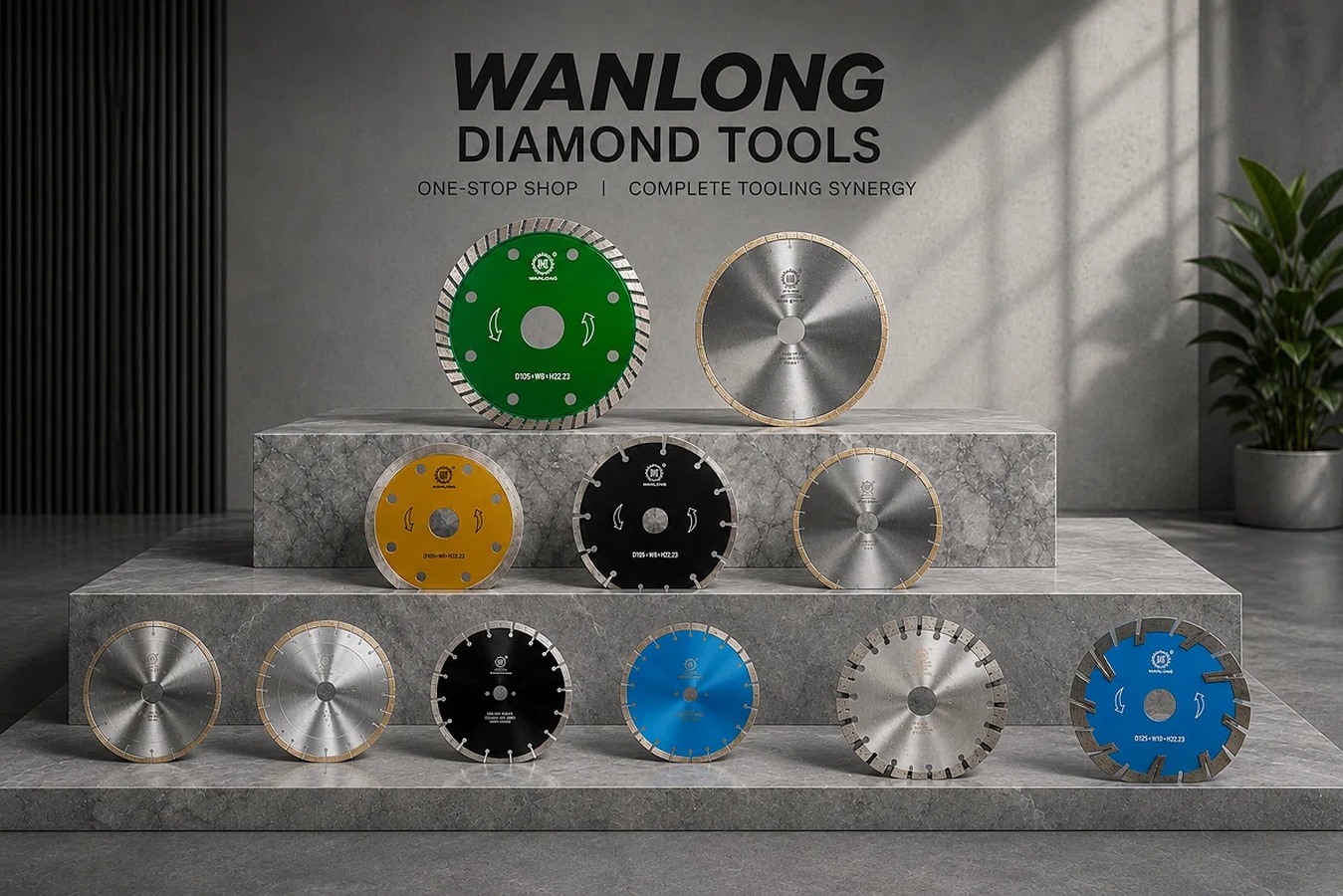
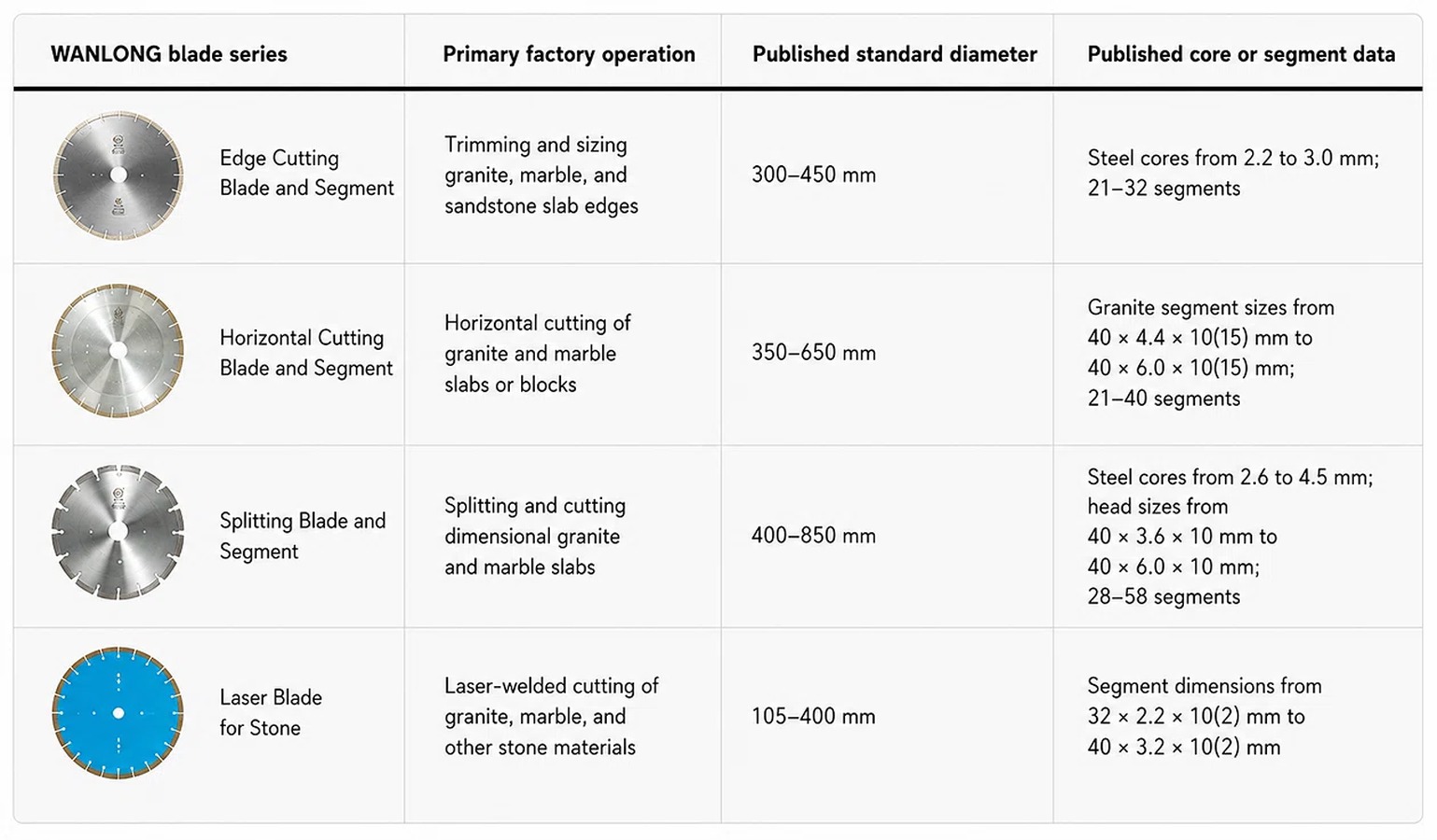
In industrial practice, selecting a custom blade requires determining the exact cutting station before finalizing core thickness and segment geometry. As illustrated in the representative tooling overview below, WANLONG structures primary workshop applications around dedicated, high-demand series:
Edge Cutting Blade and Segment (300-450 mm): Calibrated for precise slab trimming and edge sizing across granite, marble, and sandstone, utilizing stabilized 2.2 to 3.0 mm steel cores with 21-32 segment arrays to ensure chip-free borders.
Horizontal Cutting Blade and Segment (350-650 mm): Engineered for multi-directional block trimming and slab dividing, pairing reinforced segment profiles with flexible pitch layouts to balance cutting friction under continuous lateral feed.
Splitting Blade and Segment (400-850 mm): Built for high-load dimensional slab separation, featuring heavier core gauges (up to 4.5 mm) and high-density segment arrays to prevent blade deviation during deep single-pass cuts.
Laser Blade for Stone (105-400 mm): Utilizing direct beam-fused segment bonds for demanding dry or wet cutting, delivering exceptional thermal durability across compact fabrication hand tools and bridge cutters.
Beyond standard published diameters and segment dimensions, the engineering team formulates bespoke blade geometries, proprietary matrix bonds, and non-standard bore patterns tailored to unique machine dynamics.
Spindle power and rotational speed dictate the linear velocity of diamond cutting segments across the stone face. High-power block cutters operating at 132 kW require heavy-gauge steel cores with reinforced segment bases to handle intense rotational torque. Bridge saws running at variable speeds require optimized segment spacing to ensure smooth blade entry and uniform stone removal. Engineers align segment kerf thickness with steel core thickness to prevent side friction against kerf walls during deep multi-pass sawing. This kinematic alignment maintains stable blade trajectory and extends overall cutting life.
Segment Matrix and Diamond Formulation for Variable Granite Hardness
Granite mineral composition varies substantially across global quarries, ranging from medium-hard regional stones to extra-hard quartzites. WANLONG operates a specialized stone testing laboratory that evaluates mineral density, calcite content, and abrasive quartz percentages on client rock samples. Using empirical hardness data, metallurgists synthesize custom metal matrices that synchronize bond erosion rates with synthetic diamond crystal wear. For hard, high-quartz granites, cobalt-rich and bronze matrices expose sharp diamond cutting points continuously to prevent segment glazing. For highly abrasive, softer granites, tungsten carbide and refractory additives reinforce the metal matrix against rapid slurry erosion.
Synthetic diamond grain selection determines the micro-fracturing characteristics and impact resistance of cutting segments. WANLONG selects high-grade octahedron diamond crystals featuring exceptional thermal stability and elevated Thermal Toughness Index (TTI) ratings. Diamond crystals receive chemical active alloy coatings, such as titanium-silicon or nickel-chromium, to establish strong metallurgical bonds during sintering. Automated cold-press molding systems distribute metal powders and coated diamond grits with tight weight tolerances of plus or minus 0.1 grams per segment. Subsequent Hot Isostatic Pressing (HIP) consolidates segments to full density, eliminating internal porosity and ensuring consistent cutting speed.
Steel Core Dynamics, Welding Integrity, and Precision Manufacturing
The structural steel core provides the mechanical foundation that keeps the circular blade running true under heavy industrial cutting loads. WANLONG utilizes premium 65Mn and 75Cr1 alloy spring steel plates that undergo precise heat treatment and quenching processes. Experienced technicians perform disciplined mechanical rolling and tension leveling to establish uniform radial and tangential tension throughout the core. This balanced tension profile eliminates blade fluttering and side deflection during high-speed rotation. Dynamic balance testing and laser surface inspection confirm radial and axial runout within tight tolerances of 0.05 mm.
Segment attachment integrity is critical for industrial workshop safety and consistent cutting performance. WANLONG utilizes automated high-frequency silver brazing and high-penetration fiber laser welding systems to bond segments securely to the steel core. For high-intensity fabrication lines and demanding stone materials, fully laser-welded blades eliminate segment loss under continuous thermal stress, providing maximum operational safety. Every welded segment undergoes rigorous torque testing and mechanical pull-off verification compliant with EN 13236 safety standards. This high-strength joint structure withstands intense thermal shocks and heavy dynamic impacts during continuous granite processing.
Tailored Engineering for Specific Industrial Processing Conditions
Industrial stone processing facilities often operate under unique workshop constraints, environmental regulations, and production targets. WANLONG customizes blade core architectures to satisfy specialized operational requirements across global processing plants. For urban fabrication shops subject to strict noise restrictions, sandwich silent cores incorporating copper sound-dampening layers reduce operational noise by 10 to 15 decibels. Specialized keyhole, wide-U, and fishhook gullet designs accelerate coolant water flow and flush abrasive stone sludge rapidly from deep cutting kerfs. These optimized water channels preserve thermal balance and maintain sharp diamond cutting points during long production shifts.
Tooling customization also adapts segment geometry to specific material behavior and cutting kinematics. For instance, horizontal cutting blades and slab-splitting tools require optimized segment widths and clearance angles tailored to hard granite rather than softer stones to minimize lateral friction and maintain strict slab verticality. Both silent and standard solid steel cores can be integrated across these operational blade types.
For multi-blade block cutting operations, WANLONG provides synchronized multi-blade sets manufactured with matched thickness tolerances. Engineers calculate progressive blade diameter steps and uniform segment kerfs across sets of up to 26 blades mounted on a single spindle. This synchronized multi-blade configuration distributes cutting loads evenly, producing flat dimensional slabs with minimal surface thickness variation. Stone fabricators benefit from reduced grinding requirements on downstream automated polishing lines, accelerating overall workshop throughput.
Quality Verification, Empirical Testing, and Scalable Mass Production
WANLONG enforces rigorous quality governance across all manufacturing stages under the SGS ISO 9001:2015 quality management system. Before initiating large-scale batch manufacturing, the enterprise produces pilot test blades for empirical verification on reference stone varieties. Laboratory technicians analyze actual square meter output, cutting speed in meters per minute, and segment wear rates per square meter. Based on empirical test cutting feedback, metallurgists fine-tune diamond concentration and binder hardness to achieve optimal tooling economy. Once validated, automated production lines replicate exact metallurgical formulas across multi-ton production batches with complete repeatability.
All finished diamond saw blades receive detailed quality inspection certificates and standardized Declarations of Conformity (DoC). Compliance protocols under European EN 13236 standards validate tool safety and operational limits for international trade. Operating 40,000 square meters of heavy production facilities, WANLONG maintains scalable manufacturing capacity to fulfill large wholesale container orders reliably. Protective wooden crating and anti-corrosion packaging preserve blade integrity during international maritime transportation to global stone processing hubs.
Commercial Advantages and Strategic Value of Custom Tooling Solutions
Investing in customized diamond saw blades delivers decisive operational and economic advantages to high-volume granite processing enterprises. Direct factory collaboration eliminates distributor markups, providing favorable procurement pricing for industrial-scale tooling programs. Matched diamond segment formulas accelerate cutting speeds, reduce electrical power consumption, and lower tooling cost per square meter of processed stone. Precision-tensioned steel cores produce smooth, uniform slab surfaces that minimize raw material waste and reduce downstream surface finishing labor. These operational gains enable stone processing plants to expand production capacity, shorten order turnaround times, and strengthen market competitiveness.
To submit stone samples for laboratory analysis or download technical blade catalogs, visit the official portal at https://www.wanlongtimes.com/ . Direct engineering consultations and wholesale container quotations are available through the official international portal.
Media Contact
Wanlong Times Technology Co., Ltd.
0086 595 2249 8030
13# Zhitai Road Quanzhou Economic Technology Development Zone, Quanzhou, China
Source :Wanlong Times Technology Co., Ltd.
This article was originally published by IssueWire. Read the original article here.

Corporations' excess funds hit record high in Q2 on robust chip exports
Excess funds held by South Korean businesses hit an all-time high in the second quarter as strong semiconductor exports boosted corporate earnings, central bank data showed Wednesday. Net financial funds -- the value of financial assets minus financial liabilities -- held by non-financial corporations totaled 67.1 trillion won ($50.1 billion) at the end of June, sharply up from 20.8 trillion won three months earlier, according to the data from the Bank of Korea (BOK). It marked the highest quarterly figure since the BOK began compiling the data in 2009. Households' net financial funds fell to 60.7 trillion won in the second quarter from 79.2 trillion won in the first quarter, partly due to a fall in incomes and more purchases of homes. Financial assets held by the country's households and nonprofit organizations totaled 6,930.2 trillion won at the end of June, up 513 trillion won from three months earlier. Their debts rose by 28.2 trillion won from three months earlier to 2,495.8 trillion won over the cited period. The ratio of financial assets to liabilities owned by households stood at 2

POSCO completes upstream process of 2nd lithium plant in Argentina
POSCO Holdings has completed the upstream process of its second brine lithium plant at the Hombre Muerto Salt Flat in Argentina, laying the groundwork for an annual production capacity of 50,000 tons of lithium hydroxide, eight years after acquiring mining rights to the site. POSCO Holdings held a completion ceremony for the upstream process on Tuesday (local time) near the salt flat, located at an altitude of 4,000 meters above sea level. The ceremony was attended by POSCO Group Chairman Chang In-hwa, POSCO Argentina President Park Hyun, Argentine presidential chief of staff Karina Milei and Korean Ambassador to Argentina Lee Chong-hwa, among others. "Since I became head of the new business division in 2014, I have personally visited sites to find salt flats suitable for lithium development. It is deeply moving to have overcome numerous challenges in the extreme environment at 4,000 meters above sea level and reach today's completion," Chang said. "We will continue to proactively secure competitive resources, turn them into production and profitability and stably supply the critical mi

LG Electronics' Q3 profit rises on home appliances, auto parts
LG Electronics reported solid earnings growth in the third quarter, driven largely by strong performance in its home appliance and vehicle component businesses, the company said Wednesday in a regulatory filing. The electronics maker posted an operating profit of 781.8 billion won ($583 million) for the July-September period, up 13.5 percent from a year earlier. Sales rose 8.9 percent to 23.82 trillion won. The company attributed the growth to robust sales of its core businesses and continued expansion of business-to-business (B2B) operations. Its home appliance and vehicle solutions businesses maintained solid profitability, while its TV business also improved profitability from a year earlier. For the first nine months, LG Electronics’ sales reached a record 71.38 trillion won, up 9.2 percent from a year earlier. Operating profit also hit a record 4.03 trillion won, up 55.9 percent. Despite unfavorable external business conditions, including conflicts in the Middle East, the company said it continued to grow sales by maintaining its strong market positions in its core businesses and

S. Korea's Nuri space rocket lifts off from Naro Space Center
South Korea launched its homegrown Nuri rocket Wednesday on its fifth flight to place 15 satellites into orbit, including five that will form part of the country's first domestically launched microsatellite constellation. The 200-ton Nuri blasted off from the Naro Space Center in Goheung, about 400 kilometers southwest of Seoul, at 12:25 p.m. The payload consists of five New-space Earth Observation Satellite Constellation for National Safety (NEONSAT) microsatellites and 10 CubeSats. Nuri's first and second stages will separate about 123 and 268 seconds after liftoff, respectively, with satellite deployment beginning between 810 and 960 seconds at an altitude of around 575 kilometers. The five NEONSATs, Nos. 2 through 6, will be deployed at intervals of 35 to 40 seconds, with Nuri's upper stage rotating by about 45 degrees between each separation to prevent collisions. The 10 CubeSats will then be deployed two at a time at 10-second intervals. After releasing all 15 satellites, Nuri will perform a collision-avoidance maneuver and vent its remaining fuel, completing its flight about 20 min

KT&G launches new Indonesia plant, completes 5-country production network
KT&G has begun full-scale operations at a new cigarette plant in Indonesia, completing a five-country global production network spanning Korea, Indonesia, Russia, Kazakhstan and Turkey. KT&G said Wednesday that it held an opening ceremony for the plant in Pasuruan, East Java, on Monday Indonesia is one of the world's major tobacco markets and a key export hub in the Asia-Pacific region. KT&G entered the market in 2011 by acquiring a local company. It has since introduced Esse and Juara, its leading brands in Indonesia. The company ranks fourth in the country's cigarette market. KT&G built the plant to meet growing demand. It signed an agreement with Indonesia's Ministry of Investment and the Investment Coordinating Board in September 2023, began construction in April 2024 and started trial operations in the first half of 2026. Once all nine production lines are installed, the plant will have an annual capacity of up to 21 billion cigarettes. Combined with the existing plant's 14 billion-cigarette capacity, KT&G's total capacity in Indonesia will reach 35 billion cigarettes a year, making

KCCI, audit authority collaborate to resume construction of 4,000 public housing units
The audit authority has cleared a key hurdle for six stalled public housing projects totaling nearly 4,000 units after the Korea Chamber of Commerce and Industry (KCCI) sought a preliminary consultation on behalf of builders struggling with soaring construction costs. The KCCI said on Tuesday that the Board of Audit and Inspection (BAI) determined that project costs for the six sites, covering 3,936 housing units, can be recalculated to reflect current market conditions. The case marks the KCCI’s first use of the consultation program since it was opened to private organizations in May. “Companies have faced difficulties for a long time, but this was not an issue they could easily make a decision on,” Lee Jong-myung, head of the KCCI's industry innovation division, said. “The BAI's decision to open its doors to the private sector has added another channel for resolving corporate difficulties, and its first result will benefit the public through housing supply.” The six projects are part of a public-private housing program, with public agencies providing the land while private bu

Private sector's role increased in 5th Nuri launch
Private companies played a significantly greater role in the successful fifth launch of Korea’s Nuri rocket on Wednesday, signaling that the country’s efforts to keep pace with the global shift toward a private sector-led “New Space” era are gaining momentum. The Nuri rocket completed its fifth launch and 20-minute-long flight successfully after lifting off at the Naro Space Center in Goheung, Jeonnam-Gwangju Special Metropolitan City, at 12:25 p.m. The most notable change in the latest launch was not the rocket itself, but the growing presence of private-sector personnel at the launch site. Hanwha Aerospace has overseen the manufacturing of the Nuri rocket as its system integrator since the fourth launch on Nov. 27 last year, but this time, its role expanded to the consoles at the launch control center. Hanwha Aerospace deployed 42 staffers for the fifth launch. They participated in operations at 20 of the 22 consoles responsible for launch vehicle systems, and at 18 of them, Hanwha employees directly operated the controls instead of specialists from the Korea Aerospace Researc
![[EXPLAINER] How AI emerged as new threat in Korea's bank hacking crisis](https://newsimg.koreatimes.co.kr/2026/10/07/77d98bb7-f23e-430d-be94-38ae9821547a.jpg)
[EXPLAINER] How AI emerged as new threat in Korea's bank hacking crisis
Hackers once had to manually test security defenses, identify vulnerabilities and work out how to exploit them. Now, artificial intelligence (AI) can do much of that work, requiring little human input. That possibility is at the center of Korea's latest security crisis in the financial sector, as investigators have found traces of an AI-powered autonomous penetration-testing tool in a series of recent cyberattacks on the country's major banks. Since last week, Shinhan Bank, KB Kookmin Bank, Hana Bank, Yegaram Savings Bank and BNK Busan Bank have all reported data breaches, while Woori Bank and NH NongHyup Bank have detected signs of hacking attempts, though no data leaks were confirmed. Shinhan Bank reported that about 25,000 customers were affected, with personal information including names, phone numbers, annual income and loan limits exposed. KB Kookmin reported 119 affected customers, while Hana Bank said personal information belonging to 89 customers was exposed. The hacking spree has drawn particular concern after investigators reportedly found traces of an AI-powered tool known as

SK Energy, HD Hyundai Oilbank face fines over alleged fuel price fixing
SK Energy and HD Hyundai Oilbank may face sanctions from the Fair Trade Commission (FTC) over allegations that they colluded on gasoline, diesel and kerosene prices, with combined fines potentially reaching 4.63 trillion won ($3.45 billion). The antitrust regulator said Wednesday that it sent a review report to the two companies, formally launching deliberations over the alleged price-fixing case. The FTC said the alleged collusion lasted from February 2022, shortly before Russia's invasion of Ukraine, through March this year, shortly after the outbreak of the war in Iran. The case covers petroleum products that are essential to household and economic activity. Korea's oil refining industry is highly concentrated, with SK Energy, HD Hyundai Oilbank, GS Caltex and S-Oil accounting for about 98 percent of the domestic market. According to the FTC, SK Energy and HD Hyundai Oilbank exchanged information on the prices of gasoline, diesel and kerosene, including provisional prices, final prices and sales policies. The regulator also determined that the two companies colluded on prices followin

Beef tallow remains hurdle to Charrr's global expansion
Countries’ regulations on imported foods containing beef tallow pose a hurdle for Samyang Foods as the Korean instant noodle giant seeks to expand exports of its latest black bean sauce instant noodles, Charrr. The company has established Buldak as a massively popular product around the globe without using beef tallow, selling 10 billion units and generating cumulative sales of 7 trillion won ($5.2 billion) as of June. Unlike the spicy, brothless instant noodle brand, however, Charrr uses beef tallow as a key ingredient to give its sauce a rich, beefy flavor. Charrr is not Samyang’s first instant noodle product using beef tallow. The company launched Samyang 1963 in November last year with the ambitious goal of reviving the “forgotten” taste of its first instant noodle product, Samyang Ramen, which was introduced in 1963 and used beef tallow. Samyang Ramen, introduced by the late company founder Chun Joong-yoon to help feed a population suffering from widespread poverty at the time, remains a cornerstone of the company’s identity. Its use of beef tallow has now become part of

Bank data breach victims step up calls for compensation
A growing number of customers affected by a string of recent personal data breaches at major commercial banks and other financial firms appear to be turning to class action lawsuits in pursuit of compensation, according to industry officials, Wednesday. The banks have pledged to fully compensate customers whose losses, including those from voice phishing scams, are found to have directly resulted from the leaks. But proving that a loss was caused by a specific data breach can be difficult in practice, and the banks have yet to set out clear standards for determining which claims would qualify, prompting some victims to resort to legal action. Seven financial firms have reported information leaks so far, including three of the country’s largest commercial lenders — Shinhan Bank, KB Kookmin Bank and Hana Bank. Shinhan reported the largest breach, affecting around 25,000 people, followed by 119 at KB Kookmin and 89 at Hana Bank. The exposed data includes customers’ names, contact details, resident registration numbers, annual income and loan limits. The combination of personal and fin
![[COVER STORY] Nuri rocket successfully completes 5th flight](https://newsimg.koreatimes.co.kr/2026/10/07/6a8cafff-abc8-4ebb-86ed-8bb7b1eb07d3.jpg)
[COVER STORY] Nuri rocket successfully completes 5th flight
Korea’s domestically-developed Nuri rocket successfully carried out its mission in its fifth launch Wednesday, sequentially deploying 14 out of the 15 satellites it carried into their target orbit. The key objective of the fifth launch was to safely deploy the five microsatellite constellations, and its success has demonstrated Korea's increased multisatellite launch capabilities, taking another step toward privately-led commercial launch services. The rocket lifted off from the launchpad at the Naro Space Center in Goheung, Jeonnam-Gwangju Special Metropolitan City, at 12:25 p.m. and completed its roughly 20-minute flight at around 12:45 p.m. The rocket separated its first stage about two minutes after liftoff, followed by the second stage about four and a half minutes into the flight. At around 12:40 p.m., it reached an altitude of 570 kilometers and completed the sequential deployment of five New-space Earth Observation Satellite Constellation for National Safety (NEONSAT) microsatellites (satellites No. 2 to 6), its primary payload, along with nine of the 10 CubeSats it carried. In

Cantwell unveils new AI framework



YOUR NEWS, OUR NETWORK.
Do you have Great News you want to tell the world?
Be it updates about your business or your community, you can make sure that it’s heard by submitting your story to our network reaching hundreds of news sites across 6 verticals.