
Culture Amp's 2026 AI at Work Benchmark: 85% Are Encouraged to Use AI. 42% Don't Know Why
Sep 17, 2026
New Culture Amp data finds AI adoption is outpacing leadership guidance; more employees need to understand why it matters.
San Francisco, United States (PRUnderground) September 17th, 2026
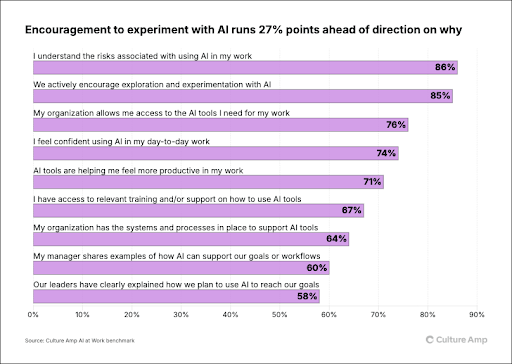
85% of employees say their organization actively encourages exploration and experimentation with AI, yet 42% say leaders haven't clearly explained how AI will be used to reach company goals.
71% of employees say using AI makes them feel more productive, and increases to 93% with power-users.
Employee awareness of internal career opportunities fell 10 percentage points since July 2025.
Culture Amp, the leading employee experience and performance platform, today released its first AI at Work benchmark, "How Employees Really Feel About AI at Work". The data, drawn from 123 organizations representing approximately 112,000 employees, reveals 71% of employees say AI tools are helping them feel more productive, rising to 93% among the heaviest users. Yet employees across every level of AI use report roughly the same workloads. 72% of power users say their workload is reasonable for their role, compared with 69% of non-users, a difference of just three points.
These findings raise a critical question for companies investing heavily in AI: If employees are creating more capacity, where is that capacity going?
The answer matters because AI power users aren't simply reporting they feel more productive; they are also more motivated at work. Seventy-two percent of the heaviest AI users say their organization motivates them to go beyond what they would in a similar role elsewhere, compared with 57% of non-users.
For leaders, that makes power users more than an adoption metric. They represent a group that is both finding ways to use AI and feeling more motivated to contribute. Organizations that fail to understand what is driving that difference risk treating a meaningful talent group as simply another measure of AI usage.
"Seven in ten employees say AI is making them more productive. Most executive teams would read that as a return on investment," said Amy Lavoie, VP of People Science at Culture Amp. "But I'd read it as an unanswered question, because workload scores remain steady. The organizations that see a genuine return on AI over the next twelve months won't be the ones with the highest adoption rates. They'll be the ones that decided, explicitly, what they were going to stop doing with the time it gave back."
The AI Adoption Gap is Now a Leadership Gap
Employees appear ready to use AI. Eighty-five percent say their organization actively encourages exploration and experimentation with AI. However, only 58% say their leaders have clearly explained where the company is headed. That 58% is the lowest-scoring item in the AI benchmark, a 27-point gap from those who say they're encouraged to experiment.
The pattern holds closer to day-to-day work too: only 60% of employees say their manager shares examples of how AI can support their goals or workflows. Across these organizations, AI use is moving faster than the guidance meant to keep pace with it.
"The workforce is telling us something important," said Amy Lavoie, VP of People Science at Culture Amp. "Employees are telling us they understand the risks, they are using the tools, and they feel more productive. That is not a workforce resisting change. That is a workforce that has done its part and is waiting on leadership to do theirs.
Employees Need More Clarity on Career Opportunities and What Comes Next
That same distance between engagement and direction also shows up beyond day-to-day workload, in how clearly employees can see their own future at the company. Employees are adopting AI with their eyes open, as 86% say they understand the risks associated with using it in their work, the highest-scoring item in the benchmark. That awareness rises steadily with usage, from 67% among non-users to 95% among power users.
What employees have less clarity on is what AI means for their future at the organization. Awareness of internal career opportunities fell 10 percentage points since July 2025, the largest single-year change in the benchmark data set. At the same time, satisfaction with career development has remained at 66%, where it has sat since 2021. Employees aren't less satisfied with the development they're getting; they're less clear about what opportunities they'll have access to next.
"Leaders are being asked to explain a future none of us can see clearly yet. We do not know with certainty which roles AI reshapes, which skills hold their value, or what a career path looks like three years out," said Amy Lavoie, VP of People Science at Culture Amp. "As a result, leaders may go quiet, because saying nothing feels safer than saying something that turns out to be wrong. The most useful thing a leader can do right now is admit the plan is unfinished, and then keep talking anyway. Certainty is not what employees need from you right now. Candor is."
Read more about Culture Amp's AI at Work Benchmark in our blog post.
About the Data: This analysis draws on 342 surveys run by 292 organizations on the Culture Amp platform, representing approximately 112,000 employees and 343,000 individual responses, collected in the 12 months to July 2026. Data comes from Culture Amp's AI Effectiveness survey template, alongside standard engagement survey items.
Respondents span all major regions, with the largest groups in North America, Asia-Pacific, and Europe. Organizations range from under 100 employees to more than 5,000, concentrated most heavily in the 1,000 to 5,000 range. Respondents work across 16 industries, most numerous in technology, professional services, and education. Individual contributors account for roughly two-thirds of the sample, with the remainder spread across manager, director, VP, and C-suite levels.
Employees are grouped by how intensively they use AI at work, standardized into four comparable groups: power users, daily users, light users, and non-users. Career opportunity awareness and career progress figures come from Culture Amp's wider engagement benchmark, a larger population than the AI survey sample; because AI survey participation is voluntary, these organizations likely run ahead of the wider market on AI adoption, so the figures describe AI-engaged organizations rather than all employers.
About Culture Amp
Culture Amp helps organizations assess the readiness of their culture to achieve high performance and act with confidence in an AI-driven world. Powered by 15 years of People Science research and drawing on more than 1.6 billion data points, Culture Amp acts as an always-on intelligence layer, called the CultureOS™, that connects engagement, performance, employee experience and culture data into a single unified platform. Today, 25 million employees across 6,000+ organizations, including Canva, On, Asana, Dolby, McDonald's, and Nasdaq, depend on Culture Amp to drive culture-led performance as work and technology rapidly evolve.
For more information visit www.cultureamp.com.
Press Contact
Name: Gina Giachetti Phone: 510-858-8111 Email: Contact UsOriginal Press Release.

FTC's costly crackdown on conglomerates generates little return
The Fair Trade Commission’s (FTC) increasingly aggressive crackdown on major conglomerates is generating a costly cycle with little tangible return, as the watchdog has been forced to refund billions of won in fines overturned by courts. The watchdog has returned nearly 290 billion won ($216.7 million) to companies since 2022 after administrative court rulings overturned its sanctions. The figures raise questions about whether the regulator’s tougher enforcement produces lasting results or simply creates more legal and financial burdens for both businesses and taxpayers. The latest figures offer little reassurance. For the first nine months combined this year, the FTC returned 23 billion won in fines and associated payments, with 99.7 percent of the amount attributable to sanctions overturned in whole or in part through administrative litigation, according to data submitted to Rep. Choi Eun-seok of the main opposition People Power Party. But the regulator is moving in the opposite direction. Since President Lee Jae Myung took office last year, the government has pushed to strengthen

The AI promise was automation. The reality? Managing digital workers
When artificial intelligence agents first arrived, they came with a tantalising promise: autonomous “digital workers” that would finally free humans from corporate drudgery. As businesses across Asia are discovering, however, the reality is quite the opposite – more work, new friction and a whole new layer of management. When Xiao Mengjie, an AI product marketing manager at a Big Tech firm in Shanghai, recently assigned two AI agents what she described as a simple task, she expected efficiency....
[Reporter's Notebook] FTC's costly crackdown on conglomerates generates little return
The Fair Trade Commission’s (FTC) increasingly aggressive crackdown on major conglomerates is generating a costly cycle with little tangible return, as the watchdog has been forced to refund billions of won in fines overturned by courts. The watchdog has returned nearly 290 billion won ($216.7 million) to companies since 2022 after administrative court rulings overturned its sanctions. The figures raise questions about whether the regulator’s tougher enforcement produces lasting results or simply creates more legal and financial burdens for both businesses and taxpayers. The latest figures offer little reassurance. For the first nine months combined this year, the FTC returned 23 billion won in fines and associated payments, with 99.7 percent of the amount attributable to sanctions overturned in whole or in part through administrative litigation, according to data submitted to Rep. Choi Eun-seok of the main opposition People Power Party. But the regulator is moving in the opposite direction. Since President Lee Jae Myung took office last year, the government has pushed to strengthen

Street Fighter: a fighting game movie that fans must see
MANILA, Philippines – For nearly four decades since it started out as a small arcade game and eventually turned into the fighting game franchise powerhouse it is today, Capcom’s Street Fighter series is as universally recognizable as every iconic property and brand known in popular culture. The series has undergone several evolutionary leaps since it

Apple’s new HomePod mini 2 speakers feature Sound Glow and will eventually support Siri AI
It’s been six years since the first HomePod mini, so now we are getting a much-needed update to keep it fresh.

Meta wants to put more AI technology on our faces
At Meta Connect 2026, Meta unveiled its latest AI glasses, shared how they’re bringing the Muse personal AI agent to glasses, and introduced the all-new Meta VR Glasses.

Casetify gives Hello Kitty a very Y2K makeover with its latest collection
Leopard prints, hot pink and sticker-covered cases bring early-2000s visuals to iPhones and other accessories.
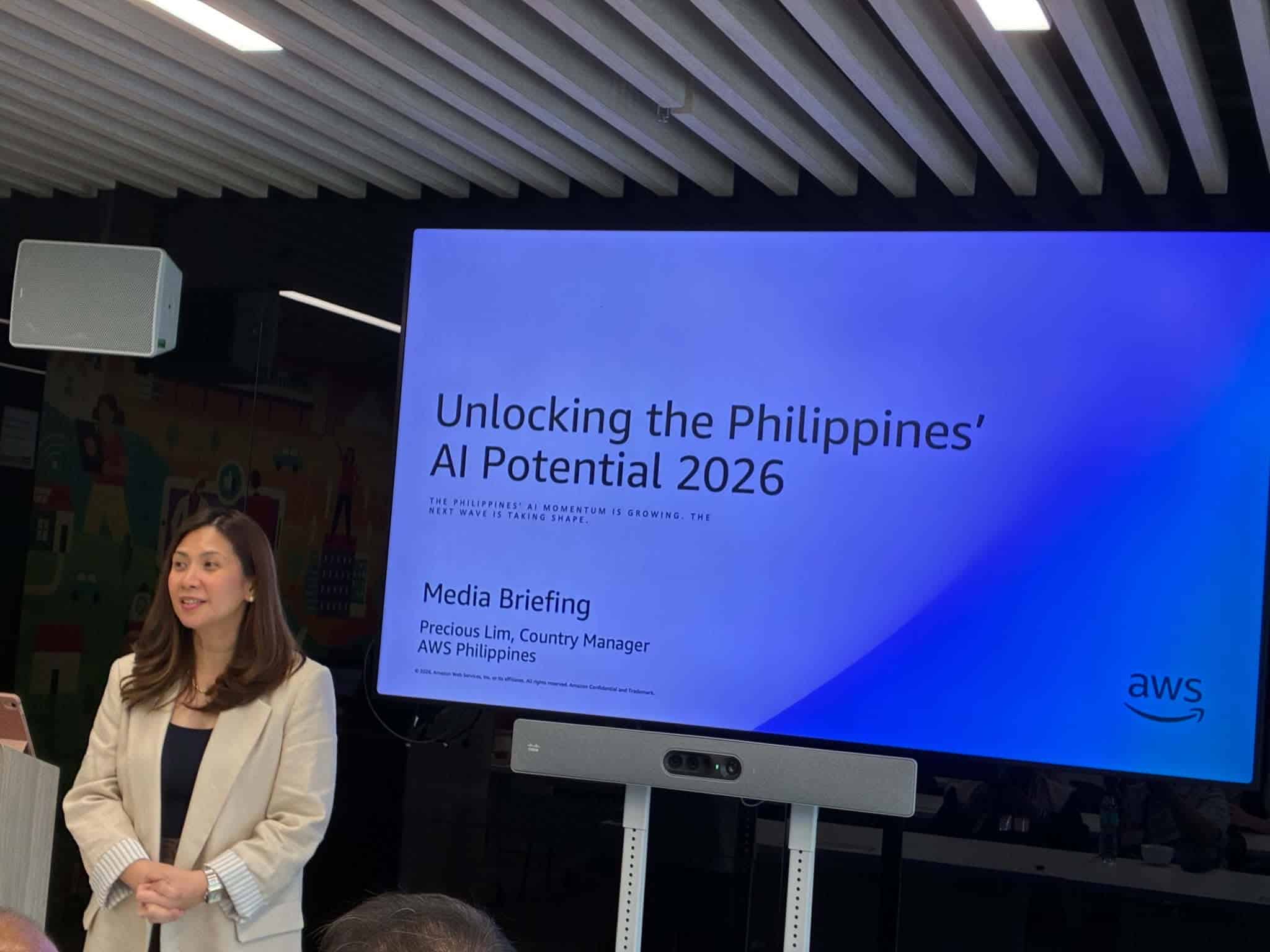
Only 17% of Philippine businesses have a roadmap to scale AI
Only 17% of businesses in the Philippines have a roadmap for scaling artificial intelligence (AI), highlighting a gap between growing adoption of the technology and companies’ ability to integrate it more deeply into their operations. The finding comes from Unlocking the Philippines’ AI Potential 2026, a report commissioned by Amazon Web Services (AWS) and conducted

Securing equipment emerges as new variable for Korea's chip expansion plans
Securing equipment for manufacturing advanced memory chips is emerging as a new variable in Korea's plans to expand semiconductor production capacity through large-scale industrial clusters, after ASML, the dominant supplier of advanced chipmaking equipment, warned that its current production plans may not be sufficient to meet demand in 2027 and 2028. During its earnings call Wednesday, ASML CEO Christophe Fouquet said the company's plans to increase its production capacity for advanced chipmaking equipment by 30 percent in 2027 and another 30 percent in 2028 would likely not be enough to meet customer demand. “Last quarter, we talked about 30 percent more capacity next year, and also the aspiration to have another 30 percent increase in 2028,” Fouquet said. “But to be honest, it's becoming very clear that 30 percent in 2027, 30 percent in 2028 will not allow us to meet our customer demand.” According to the company, the planned capacity increases cover both low-numerical-aperture extreme ultraviolet (low-NA EUV) lithography equipment and deep ultraviolet (DUV) immersion system

Musinsa teams up with Japan's ZOZOTOWN for 1st Korean pop-up
Fashion platform Musinsa has teamed up with ZOZOTOWN, one of Japan's leading online fashion retailers, to open a pop-up store in Seongsu-dong, Seoul, a popular destination for young consumers. Musinsa opened the doors to ZOZOTOWN in Musinsa, the Japanese platform’s first official pop-up store in Korea, to the media on Friday. The pop-up will run through Oct. 31, while an accompanying online promotion will continue until Nov. 16. Launched in 2004, ZOZOTOWN features more than 11,000 brands and serving over 13 million customers annually. Fifteen Japanese fashion brands available on the platform, including Snidel and Grancy, are participating in the event. The pop-up’s concept, ZOZO is Coming to Town, draws inspiration from Korean streets. Crosswalks, road markings and oversized three-dimensional typography have been incorporated into the space to create the impression of an intersection where Korean and Japanese fashion meet. The pop-up follows the signing of a memorandum of understanding between the two platforms in December 2024 to establish a strategic partnership. In November last y

China’s proposed AI tech export bans may create short-term costs, long-term gains: analysts
China’s proposed export bans and controls of artificial intelligence technologies aim to tighten Beijing’s grip in the strategically vital sector, casting a cloud over the commercial prospects of domestic model developers in the global AI race, analysts say. The new measures come as concerns mount globally over the risks of advanced AI systems, following a string of recent cyberattacks, while also underscoring AI’s growing national security importance for both Beijing and Washington. Zhang Yi,...
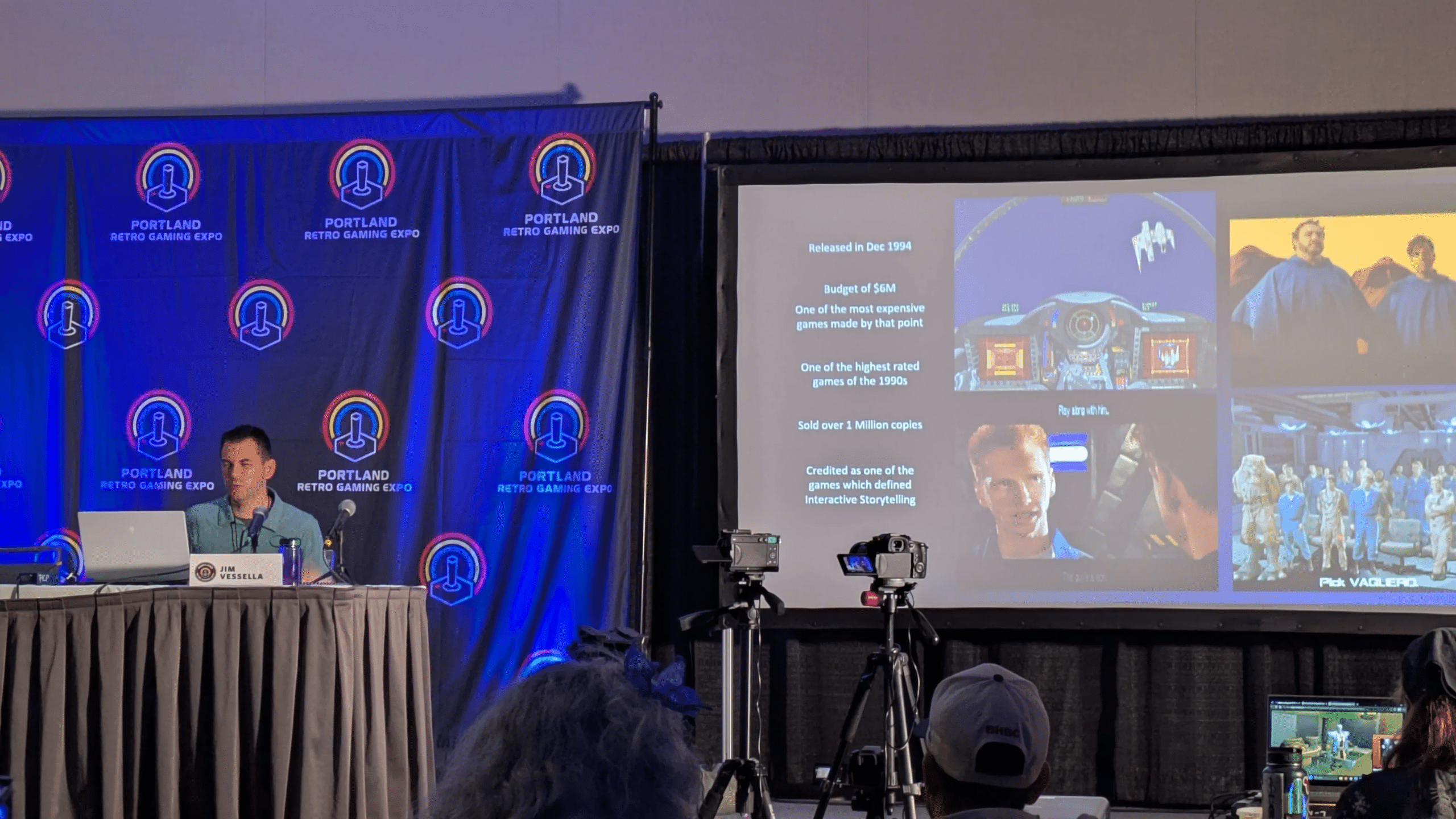
EA producer confirms the return of Wing Commander
MANILA, Philippines – A panel at the Portland Retro Gaming Expo on game preservation revealed that the master tapes containing high quality source video for Wing Commander III were located. The contents of these tapes will now undergo restoration and preparation is at work for a new release of the game, tentatively called Wing Commander




YOUR NEWS, OUR NETWORK.
Do you have Great News you want to tell the world?
Be it updates about your business or your community, you can make sure that it’s heard by submitting your story to our network reaching hundreds of news sites across 6 verticals.