
Cambridge Casual Marks Important Anniversary With the Launch of Hermosa, Its Signature Teak Collection
Nov 10, 2026
Launching November 12, Hermosa marks a new design direction in Indonesian teak craftsmanship.
Carrollton, United States, November 10, 2026 -- Outdoor teak furniture brand Cambridge Casual is excited to celebrate the release of its signature teak collection, Hermosa. The release coincides with the brand’s 12th anniversary, marking a long record of craftsmanship.
This milestone signature collection points to where Cambridge Casual is headed while delivering the traditional shapes, familiar accents and rustic warmth teak furniture is known for. Hermosa connects decades of experience with a more personal design direction.
The brand launched in 2014, with a production history dating back to 1988, when a factory began making teak outdoor furniture. For years, the factory created teak pieces for other companies. When Cambridge Casual was created, the creative minds behind the pieces could finally bring their experience to their own collections, building a catalog of craftsmanship that people have come to rely on.
“Hermosa represents a shift in our design direction, moving towards a more contemporary aesthetic while maintaining the warmth of teak and traditional craftsmanship,” said Aurene, brand manager at Cambridge Casual. “It’s about finding a balance between the two, bringing in a more modern feel without losing the comfort and character of what we’ve always been known for.”
Hermosa is a collection that carries that foundation forward. As the first collection conceived fully in Cambridge Casual’s own design voice, it represents where the brand is going next.
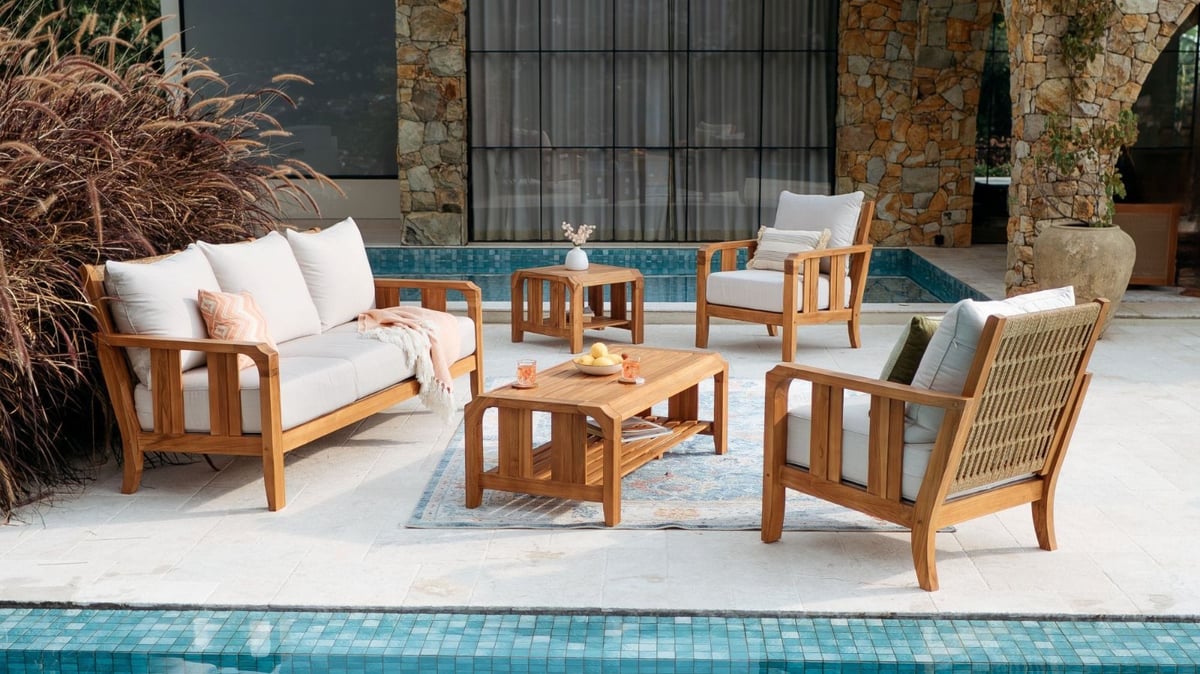
Built from solid Indonesian teak, Hermosa combines deep-seating sofas, lounge chairs, coffee tables and side tables for outdoor living. The collection’s defining detail is a curved teak arm, marking a move away from ornate design to a restrained, traditional line that fits any outdoor aesthetic. Cambridge Casual controls every stage: sourcing its own timber, manufacturing in its own facilities and selling directly to customers. By using SVLK-verified teak from responsibly managed forests, the brand prices its furniture against what it costs to make, not what the market will bear, combining skilled craftsmanship with rigorous quality standards to deliver lasting quality and value.
Rather than leaving curves behind completely with this new collection, Cambridge Casual has combined the decorative detailing of its heritage pieces with the spare lines of a fully modern collection. Hermosa has one curve with a clear purpose. The result is an expression of the traditional craftsmanship that Cambridge Casual was built upon, designed to sit comfortably among contemporary outdoor design.
Cambridge Casual’s hand-crafted teak furniture collections aren’t limited to residential dwellings, however. Other brands and businesses interested in its products can obtain more competitive pricing, dedicated support and tailored solutions with direct-ship fulfillment by joining the company’s trade and hospitality program, Cambridge Hospitality.
The Hermosa collection launches on November 12, kicking off a 12-day anniversary event that runs through the company’s founding anniversary on November 17th. During the event, every Hermosa seating product orders across the full collection also receive a complimentary anniversary gift with tiered purchases.
Shoppers are invited to check out Cambridge Casual’s website, cambridge-casual.com, to browse the new collection.
For more information about Cambridge Casual, its Hermosa collection or its upcoming 12th anniversary event, please contact Anna Kate Womack, publicist at Otter PR, via email at [email protected].
About Cambridge Casual
Cambridge Casual makes solid Indonesian teak outdoor furniture, drawing on a heritage that began in Indonesia in 1988. Its vertically integrated organization oversees each stage from design and sourcing through production, distribution and customer experience. With a manufacturing network spanning four locations, Cambridge Casual serves homes throughout North America with furniture grounded in material, joinery and direct value from the maker.
Contact Info:
Name: Anna Kate Womack
Email: Send Email
Organization: Cambridge Casual
Website: https://cambridge-casual.com/
Release ID: 89209119
In the event of any inaccuracies, problems, or queries arising from the content shared in this press release, we encourage you to notify us immediately at [email protected] (it is important to note that this email is the authorized channel for such matters, sending multiple emails to multiple addresses does not necessarily help expedite your request). Our diligent team will be readily available to respond and take swift action within 8 hours to rectify any identified issues or assist with removal requests. Ensuring the provision of high-quality and precise information is paramount to us.

TV businesses of Samsung, LG face mounting pressure from rising LCD panel prices
Samsung Electronics and LG Electronics are expected to face growing pressure on their TV businesses, as rising prices of Chinese-made LCD panels drive up production costs, particularly for low- and mid-range TVs. According to market tracker Omdia, the cash cost of a 65-inch LCD TV open cell is projected to rise from $112 in 2025 to $116.80 this year and $124.55 in 2027, as higher component and material prices increase manufacturing costs. An open cell refers to an LCD panel before the backlight and other components are assembled into a complete display module. Omdia noted that three Chinese panel makers — CSOT, HKC and BOE — sent official letters to their clients outlining plans to raise prices for some panels starting in September or the fourth quarter. According to another market tracker, TrendForce, LCD panel prices have remained flat, with 55-inch and 65-inch panels holding steady at $123 and $173, respectively, in October and November. However, Omdia expects LCD TV panel makers to successfully raise prices in December as “rising costs approach a tipping point.” LG Electronic

IWF Korea mentors North Jeolla startups on global expansion
The International Women's Forum Korea (IWF Korea) held one-on-one mentoring sessions for local startups in North Jeolla Province on Saturday to help them evaluate their business strategies and prepare for overseas expansion. IWF Korea said Tuesday that it hosted the "Local Startup Value-Up: Local to Global" mentoring program in Jeonju, North Jeolla Province. The program was organized as part of the 2026 J-Startup Festa and held in conjunction with the 11th Startup Jeonbuk Entrepreneurship Expo in Jeonju's Hanok Village. It was jointly sponsored by the Ministry of SMEs and Startups, North Jeolla Province and the city of Jeonju, with the Jeonbuk Center for Creative Economy and Innovation, the Jeonbuk Business Agency, investment firm Krypton and IWF Korea participating in its organization. The initiative aimed to help local startups leverage regional assets and brands, strengthen their competitiveness as they grow and expand into overseas markets. “Startups based in regional communities can pursue growth with global markets in mind from the very beginning," said Kim Ji-won, organizing co

Samsung supports 1,000 startups, helping attract $1.6 bil. in investment
Samsung Electronics said Tuesday it has supported 1,000 startups, helping attract a cumulative 2.2 trillion won ($1.6 billion) in investment. Notably, the Korean tech giant selects promising entrepreneurs and startups for its C-Lab initiative, choosing 30 companies this year, the company said. Of the selected startups, 15 are currently conducting technology verification projects with Samsung Electronics, with the company seeking to identify further opportunities for business collaborations. Twelve of the startups are based outside the Seoul metropolitan area, Samsung said. Samsung has operated regional C-Lab hubs in the central city of Daegu and the southwestern city of Gwangju since 2023 to foster regional economic development. At an event held Tuesday at its R&D center in southern Seoul, representatives from six startups took the stage to share their growth stories and examples of business collaboration. One of the startups was Config Intelligence, a two-year-old startup, is developing data technologies to train and deploy artificial intelligence (AI) systems for robots. The company has a

Hanwha Aerospace secures Korea's 1st approval for vessel-use hydrogen fuel cell
Hanwha Aerospace said Tuesday it has become the first company in Korea to win type approval for a marine hydrogen fuel cell from the Korean Register, the country’s ship classification society. The company said this is only the fifth time worldwide that a classification society has granted type approval to a hydrogen fuel cell for ships. Classification societies are independent bodies that set and enforce technical standards for how ships are built and operated. Type approval certifies that a product meets international maritime standards and the society’s own rules. Without it, a hydrogen fuel cell cannot be installed on ships or on offshore structures such as drilling vessels. To receive approval, the manufacturer must prove both performance and safety in harsh sea conditions. Hanwha Aerospace said its system passed marine environment tests for conditions such as vibration and tilting. It also passed the Korean Register’s review of its manufacturing process and quality control system. Hydrogen fuel cells make electricity from a reaction between hydrogen and oxygen, and their only

Lotte Chilsung, Thailand's CP Group sign MOU for beverage partnership
Lotte Chilsung Beverage said Tuesday it has partnered with Thailand's Charoen Pokphand (CP) Group to expand sales of its beverage and bottled water products in the Southeast Asian country. Under a memorandum of understanding (MOU) signed with CP Group's retail unit, CP AXTRA, Lotte Chilsung will expand its export product portfolio in Thailand and supply customized products exclusively through CP AXTRA's retail network, the company said in a press release. "This agreement is significant as it lays the groundwork for long-term cooperation with CP AXTRA, which operates a nationwide retail network in Thailand," a company official said. Lotte Wellfood also joined the agreement, with plans to jointly develop products tailored to local consumer preferences with CP AXTRA and expand its presence in the Thai market. CP Group has business interests spanning food production, distribution and telecommunications.

POSCO International completes $700 mil. LNG terminal expansion in Gwangyang
POSCO International, the energy and trading arm of POSCO Group, completed its second liquefied natural gas (LNG) terminal in Gwangyang, cementing its position as Korea's top private natural gas operator and reinforcing domestic supply lines. The company held a completion ceremony Tuesday at the Gwangyang LNG terminal, attended by about 100 people, including government officials, business representatives and executives from POSCO Group. The project cost 949.2 billion won ($700 million) and took 47 months to complete, adding two storage tanks, each with a capacity of 200,000 cubic meters, along with supporting facilities. The development also includes a berth capable of accommodating LNG carriers with capacities of up to 270,000 cubic meters and a separate bunkering berth for vessels of up to 20,000 cubic meters. With the completion of the second terminal, the combined storage capacity of POSCO International's first and second terminals has increased from 930,000 kiloliters to 1.33 million kiloliters, the largest capacity operated by a single private company in Korea. The company said the f

Ceragem earns 9 CES Innovation Awards for AI-powered health care products
Health care equipment maker Ceragem has won nine CES 2027 Innovation Awards for eight products on Tuesday, marking its fourth consecutive year of recognition and bringing its cumulative total to 30 awards. The company has previously won three awards in 2024, six in 2025 and 12 in 2026. This year’s awards include products designed to meet the health care needs of different age groups, from infants and young children to older adults. The eight award-winning products are: Ceragem artificial intelligence (AI) Wellness Home, Therapier AI Multi Boosting Capsule, Youridm AI Muscle Longevity System, AI Sleep Recovery Pillow, AI Pet Wellness Suite, AI Neuro Focus Office Chair, Senior Wellness Sofa with AI Adaptive Care and AI Sensor Pod & Smart Crib. Ceragem AI Wellness Home, which won an award in the AI category, uses physical AI to analyze users' biometric data and daily routines, assess their health status and automatically adjust connected home environments and health care devices to their needs. The platform brings together connected devices, health data and services to deliver personalize

LS Eco Energy makes push for world's 1st mass production of samarium
LS Eco Energy, a subsidiary of LS Cable & System, said Tuesday it will begin trial production of samarium metal in December, with the goal of becoming the world's first company to mass-produce the key material for permanent magnets using non-Chinese raw materials. The move is part of the company's efforts to establish a supply chain independent of China ahead of new U.S. restrictions on rare earth materials used in defense applications. According to the company, LS Eco Energy is investing 11.6 billion won ($8 million) to build a samarium metal production facility at its subsidiary LSCV in Ho Chi Minh City, Vietnam. The company plans to begin trial production in December before moving to full-scale mass production. The facility's annual output of 240 tons of samarium metal would be sufficient to produce approximately 700 to 1,000 tons of samarium-cobalt (SmCo) permanent magnets. Samarium is a key material for SmCo permanent magnets, which retain their magnetic strength at high temperatures. SmCo magnets are used in aerospace and defense applications, including fighter jets and missiles. St

Boston Dynamics' Atlas robot pulls off 360-degree spinning jump on wheels instead of feet
Boston Dynamics' humanoid robot Atlas has successfully performed a challenging aerial maneuver, jumping into the air, spinning 360 degrees and landing like a figure skater — all while equipped with wheels instead of feet. The robotics company, a subsidiary of Hyundai Motor Group, released a video Monday showing a wheeled version of Atlas performing a series of demanding movements designed to test the limits of its motors and whole-body control technology. The 2-minute, 50-second video shows Atlas rapidly moving sideways while changing direction on its wheels, executing a full 360-degree spinning jump, balancing on one wheel with the other leg raised and lifting itself off the floor before accelerating forward. The robot successfully completed the 360-degree spinning jump on its first attempt. The achievement followed efforts by the development team to narrow the gap between computer simulations and real-world hardware through a process known as "sim-to-real" transfer. Engineers also used reinforcement learning, a machine-learning technique in which robots improve their performance throu

Seoul Metro union threatens Nov. 25 general strike over wage, hiring disputes
The largest of three labor unions at Seoul Metro threatened Tuesday to launch a general strike on Nov. 25 unless its demands, including additional staff recruitment and wage increases, are met. Union 1 of Seoul Metro, which operates subway Lines 1-8 and parts of Line 9, issued the warning at a news conference following a meeting of senior union members. The union initially sought a 5.2 percent wage increase but lowered its demand to 3.5 percent in negotiations with management. It also calls for scrapping a plan to cut 2,212 jobs and hiring an additional 1,313 workers this year to address staff shortages. Other demands include state funding for public services and a requirement that all field work be performed by two-person teams. The union said 7,782, or 84.6 percent, of its 9,201 members recently participated in a vote, with 6,715, or 86.3 percent of those who voted, backing the strike plan. Unions 2 and 3 also approved the strike plan, with 80.8 percent and 94.9 percent of their respective members voting in favor. Union 1 said it and Union 2 plan to launch a "work-to-rule" campaign on N

F&F Q3 net income down 34.6% to $49.3 mil.
F&F on Tuesday reported its third-quarter net income of 65.9 billion won ($49.3 million), down 34.6 percent from a year earlier. Operating income for the July-September period was 108.4 billion won, down 15.3 percent from a year ago, the fashion and beauty retailer said in a regulatory filing. Sales also backtracked 4.7 percent to 452.1 billion won. The earnings fell behind market expectations. The average estimate of net profit by analysts stood at 96.7 billion won, according to a survey by Yonhap Infomax, the financial data firm of Yonhap News Agency.

LG Energy Solution secures CES Innovation Award for battery diagnostic software
LG Energy Solution has won a CES 2027 Innovation Award for software that can assess the condition and remaining performance of used batteries, marking the second consecutive year the company has been recognized for a software-based solution. The company said Tuesday that its Re.Pulse solution, which assesses the health and remaining performance of used batteries, was named an honoree in the awards' Vehicle Tech and Advanced Mobility category. The system sends specific electrical pulses through a battery, measures changes in voltage and analyzes the data using its proprietary AI model to quickly assess the battery's condition. The company said the assessment will allow operators to determine whether a used battery is best suited for reuse, remanufacturing or recycling, helping get the most value out of each battery. "This CES Innovation Award recognizes the strength of our battery diagnostic technology and software capabilities," a company official said. "We will continue to advance our diagnostic and management technologies to unlock greater value from used batteries and help build a sus







YOUR NEWS, OUR NETWORK.
Do you have Great News you want to tell the world?
Be it updates about your business or your community, you can make sure that it’s heard by submitting your story to our network reaching hundreds of news sites across 6 verticals.