
台北信义区办公室怎么租?专属办公室、共享办公与传统租赁比较
Sep 30, 2026
台北, September 30, 2026 -- 想在台北信义区设立办公室,先别急着只比较每月租金。对正在起步或快速成长的团队来说,入驻时间、使用人数、设备需求,以及未来能否调整空间,同样影响整体成本。

常见的选择有传统办公室、即租即用的专属办公室,以及共享办公空间。三者没有一种适合所有企业;关键是选择符合团队现阶段工作方式的方案。
先想清楚:你的团队每天如何使用办公室?
开始找空间前,可以先回答五个问题:
- 有多少人需要固定座位? 是一个人、两三人的团队,还是持续扩编的部门?
- 多久需要开始使用? 是否有时间规划装修、家具及网络?
- 需要多少私密性? 是否经常进行内部讨论、客户通话或处理机密资料?
- 预计使用多久? 是短期项目、测试台北市场,还是长期办公据点?
- 除了桌位,还需要什么? 例如会议空间、商务地址或行政支持。
把这些需求列出来,再比较方案,会比只看坪数或单一报价更有效。
三种办公方式,差别在哪里?
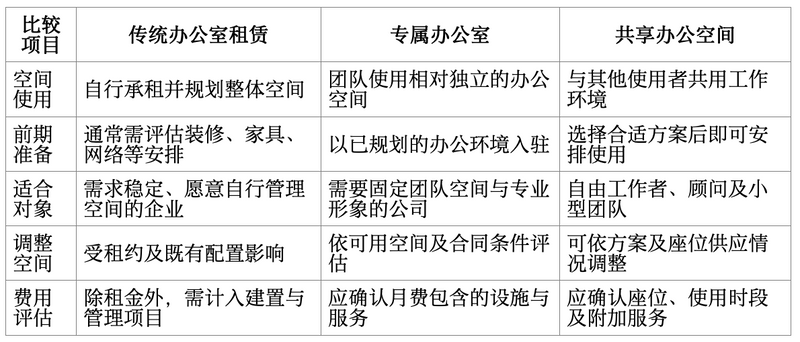
以上是选择方向,实际租期、设备、费用及使用范围,仍应以各场地的正式方案与合同为准。
1. 传统办公室:适合需求明确且稳定的企业
传统租赁让企业自行规划格局、品牌展示及日常管理。如果团队规模稳定、需要高度定制化,并有时间处理装修与设备配置,这可能是合适的选择。
比较成本时,除了租金,也应盘点装修、家具、网络、清洁、维护及相关管理安排。不同房源及合同条件差异很大,最好用预计使用期间的总成本比较,而非只看月租。
2. 专属办公室:适合希望快速入驻的团队
若团队需要固定工作位置、相对独立的讨论环境,却不想从装修与设备建置开始,专属办公室值得纳入比较。
竞空间 JIN SPACE 的专属办公室面向个人工作室、小型团队及企业项目办公室。实际可使用的空间、服务内容及报价,应依团队人数与需求向服务人员确认。
3. 共享办公空间:适合需要弹性办公空间的人
自由工作者、顾问或刚成立的小型团队,不一定需要一间独立办公室。共享办公空间可提供工作环境,也增加与其他专业人士交流的机会。
竞空间 JIN SPACE 的共享办公空间适合自由工作者、创业者、顾问与移动工作者。选择前,建议确认座位形式、可使用时段、会议室使用及其他服务是否另计。
如果只需要台北商务地址呢?
有些企业采用远程办公,暂时不需要每天使用实体座位。这时可以另外评估虚拟办公室,而不必直接承租一间办公室。竞空间虚拟办公室,提供商务地址及相关邮件、行政支持服务。
商务地址不等于任何公司都能直接用来登记。是否符合公司登记需求,需依所选方案、经营项目及相关规定个别确认;邮件服务及地址使用范围也应以合同内容为准。
在信义区选址,还要看交通与见客需求
办公室是团队工作的地方,也是客户、合作伙伴接触企业的场所。若需要定期见客,除了地址本身,还应考虑捷运站步行距离、附近的会议空间,以及来访者是否容易找到。
竞空间 JIN SPACE 位于台北市信义区信义路四段415号2楼之一。依官网交通信息,从捷运台北101/世贸站 1 号出口步行约 4 分钟。若正在比较信义区办公空间,实地参观能更清楚判断动线、座位配置与工作氛围是否符合需求。
参观前,建议带着这份核对清单
- 报价包含哪些座位、设备及服务?哪些项目另计?
- 可使用的时段、会议空间及访客规范是什么?
- 合同期间、付款方式、押金及提前终止条件为何?
- 团队增加或缩减人数时,可以如何调整?
- 若需商务地址或公司登记,方案的使用范围与审核条件为何?
适合的办公室,是能支持目前工作,也容得下下一阶段变化的空间。如果你正在信义区寻找办公据点,可以先整理团队人数、预计开始日期、需要的服务与使用期间,确认合适的选择。
Contact Info:
Name: JIN SPACE
Email: Send Email
Organization: JIN SPACE
Website: https://jin-space.com.tw/#solutions
Release ID: 89204774
Should any errors, concerns, or inconsistencies arise from the content provided in this press release that require attention or if a press release needs to be taken down, we kindly request that you immediately contact us at [email protected] (it is important to note that this email is the authorized channel for such matters, sending multiple emails to multiple addresses does not necessarily help expedite your request). Our efficient team will be at your disposal for timely assistance within 8 hours – taking necessary measures to rectify identified issues or providing guidance on the removal process. We prioritize delivering accurate and reliable information.

KCCI, audit authority collaborate to resume construction of 4,000 public housing units
The audit authority has cleared a key hurdle for six stalled public housing projects totaling nearly 4,000 units after the Korea Chamber of Commerce and Industry (KCCI) sought a preliminary consultation on behalf of builders struggling with soaring construction costs. The KCCI said on Tuesday that the Board of Audit and Inspection (BAI) determined that project costs for the six sites, covering 3,936 housing units, can be recalculated to reflect current market conditions. The case marks the KCCI’s first use of the consultation program since it was opened to private organizations in May. “Companies have faced difficulties for a long time, but this was not an issue they could easily make a decision on,” Lee Jong-myung, head of the KCCI's industry innovation division, said. “The BAI's decision to open its doors to the private sector has added another channel for resolving corporate difficulties, and its first result will benefit the public through housing supply.” The six projects are part of a public-private housing program, with public agencies providing the land while private bu

Private sector's role increased in 5th Nuri launch
Private companies played a significantly greater role in the successful fifth launch of Korea’s Nuri rocket on Wednesday, signaling that the country’s efforts to keep pace with the global shift toward a private sector-led “New Space” era are gaining momentum. The Nuri rocket completed its fifth launch and 20-minute-long flight successfully after lifting off at the Naro Space Center in Goheung, Jeonnam-Gwangju Special Metropolitan City, at 12:25 p.m. The most notable change in the latest launch was not the rocket itself, but the growing presence of private-sector personnel at the launch site. Hanwha Aerospace has overseen the manufacturing of the Nuri rocket as its system integrator since the fourth launch on Nov. 27 last year, but this time, its role expanded to the consoles at the launch control center. Hanwha Aerospace deployed 42 staffers for the fifth launch. They participated in operations at 20 of the 22 consoles responsible for launch vehicle systems, and at 18 of them, Hanwha employees directly operated the controls instead of specialists from the Korea Aerospace Researc
![[EXPLAINER] How AI emerged as new threat in Korea's bank hacking crisis](https://newsimg.koreatimes.co.kr/2026/10/07/77d98bb7-f23e-430d-be94-38ae9821547a.jpg)
[EXPLAINER] How AI emerged as new threat in Korea's bank hacking crisis
Hackers once had to manually test security defenses, identify vulnerabilities and work out how to exploit them. Now, artificial intelligence (AI) can do much of that work, requiring little human input. That possibility is at the center of Korea's latest security crisis in the financial sector, as investigators have found traces of an AI-powered autonomous penetration-testing tool in a series of recent cyberattacks on the country's major banks. Since last week, Shinhan Bank, KB Kookmin Bank, Hana Bank, Yegaram Savings Bank and BNK Busan Bank have all reported data breaches, while Woori Bank and NH NongHyup Bank have detected signs of hacking attempts, though no data leaks were confirmed. Shinhan Bank reported that about 25,000 customers were affected, with personal information including names, phone numbers, annual income and loan limits exposed. KB Kookmin reported 119 affected customers, while Hana Bank said personal information belonging to 89 customers was exposed. The hacking spree has drawn particular concern after investigators reportedly found traces of an AI-powered tool known as

SK Energy, HD Hyundai Oilbank face fines over alleged fuel price fixing
SK Energy and HD Hyundai Oilbank may face sanctions from the Fair Trade Commission (FTC) over allegations that they colluded on gasoline, diesel and kerosene prices, with combined fines potentially reaching 4.63 trillion won ($3.45 billion). The antitrust regulator said Wednesday that it sent a review report to the two companies, formally launching deliberations over the alleged price-fixing case. The FTC said the alleged collusion lasted from February 2022, shortly before Russia's invasion of Ukraine, through March this year, shortly after the outbreak of the war in Iran. The case covers petroleum products that are essential to household and economic activity. Korea's oil refining industry is highly concentrated, with SK Energy, HD Hyundai Oilbank, GS Caltex and S-Oil accounting for about 98 percent of the domestic market. According to the FTC, SK Energy and HD Hyundai Oilbank exchanged information on the prices of gasoline, diesel and kerosene, including provisional prices, final prices and sales policies. The regulator also determined that the two companies colluded on prices followin

Beef tallow remains hurdle to Charrr's global expansion
Countries’ regulations on imported foods containing beef tallow pose a hurdle for Samyang Foods as the Korean instant noodle giant seeks to expand exports of its latest black bean sauce instant noodles, Charrr. The company has established Buldak as a massively popular product around the globe without using beef tallow, selling 10 billion units and generating cumulative sales of 7 trillion won ($5.2 billion) as of June. Unlike the spicy, brothless instant noodle brand, however, Charrr uses beef tallow as a key ingredient to give its sauce a rich, beefy flavor. Charrr is not Samyang’s first instant noodle product using beef tallow. The company launched Samyang 1963 in November last year with the ambitious goal of reviving the “forgotten” taste of its first instant noodle product, Samyang Ramen, which was introduced in 1963 and used beef tallow. Samyang Ramen, introduced by the late company founder Chun Joong-yoon to help feed a population suffering from widespread poverty at the time, remains a cornerstone of the company’s identity. Its use of beef tallow has now become part of

Bank data breach victims step up calls for compensation
A growing number of customers affected by a string of recent personal data breaches at major commercial banks and other financial firms appear to be turning to class action lawsuits in pursuit of compensation, according to industry officials, Wednesday. The banks have pledged to fully compensate customers whose losses, including those from voice phishing scams, are found to have directly resulted from the leaks. But proving that a loss was caused by a specific data breach can be difficult in practice, and the banks have yet to set out clear standards for determining which claims would qualify, prompting some victims to resort to legal action. Seven financial firms have reported information leaks so far, including three of the country’s largest commercial lenders — Shinhan Bank, KB Kookmin Bank and Hana Bank. Shinhan reported the largest breach, affecting around 25,000 people, followed by 119 at KB Kookmin and 89 at Hana Bank. The exposed data includes customers’ names, contact details, resident registration numbers, annual income and loan limits. The combination of personal and fin
![[COVER STORY] Nuri rocket successfully completes 5th flight](https://newsimg.koreatimes.co.kr/2026/10/07/6a8cafff-abc8-4ebb-86ed-8bb7b1eb07d3.jpg)
[COVER STORY] Nuri rocket successfully completes 5th flight
Korea’s home-developed Nuri rocket successfully carried out its mission in its fifth launch Wednesday, sequentially deploying 14 out of 15 satellites it carried into their target orbit. The key objective of the fifth launch was to safely deploy the five microsatellite constellations, and the success has demonstrated Korea's increased multi-satellite launch capabilities, taking another step toward privately led commercial launch services. The rocket lifted off from the launchpad at the Naro Space Center in Goheung, Jeonnam-Gwangju Special Metropolitan City, at 12:25 p.m. and completed its roughly 20-minute flight at around 12:45 p.m. The rocket separated its first stage about two minutes after liftoff, followed by the second stage about four and a half minutes into the flight. At around 12:40 p.m., it reached an altitude of 570 kilometers and completed the sequential deployment of five New-space Earth Observation Satellite Constellation for National Safety (NEONSAT) microsatellites (satellites No. 2 to 6), its primary payload, along with nine of the 10 CubeSats it carried. Initially, th

Nuri rocket deploys 14 satellites, 1 CubeSat fails to release
The Nuri rocket successfully lifted off on its fifth launch and deployed 14 of the 15 satellites it carried into their target orbit Wednesday. The rocket lifted off from the second launch pad at the Naro Space Center in Goheung, Jeonnam-Gwangju Special Metropolitan City, at 12:25 p.m. and completed its roughly 20-minute flight at around 12:45 p.m. The rocket separated its first stage about two minutes after liftoff, followed by the second stage about four and a half minutes into the flight. At around 12:40 p.m., it reached an altitude of 570 kilometers and completed the sequential deployment of five NEONSAT swarm microsatellites (satellite No. 2 to 6), its primary payload, along with nine of the 10 CubeSats it carried. Initially, the Nuri sent signals indicating that all of the CubeSats had been successfully deployed. However, subsequent checks found that PERSAT02, developed by Quaternion, had failed to separate from the rocket. The flight ended at around 12:45 p.m. after the third stage completed its autopilot sequence. "The Nuri rocket successfully completed its planned fifth launch mis

Southeast Asia’s foodtech winners are the least glamorous ones
Southeast Asia’s foodtech story was supposed to be about disruption: lab-grown shrimp on every plate, groceries at your door in 15 minutes, ghost kitchens replacing the corner restaurant. The reality has been humbler, and arguably more interesting. The 2022 correction thinned the herd, the eFishery scandal and TaniHub’s collapse left scars, and many of the […] The post Southeast Asia’s foodtech winners are the least glamorous ones appeared first on e27.

When the carer has dementia too: Japan turns to physical AI to rescue eldercare
Some Japanese words resist translation. Take rōrō kaigo (老老介護). The character rō means “elderly”, and repeating it describes an elderly person caring for another elderly person, such as an 80-year-old husband looking after his equally frail wife on his own. That is the reality the word captures. Then there is the darker ninnin kaigo (認認介護). […] The post When the carer has dementia too: Japan turns to physical AI to rescue eldercare appeared first on e27.

Southeast Asian tech leaders are learning to trust AI agents, but not with production
AI coding agents have moved quickly from novelty to daily tool inside Southeast Asian engineering teams. Across Singapore, Bangkok, Jakarta and Ho Chi Minh City, developers are no longer just asking AI to complete a line of code or explain an error message. They are using agents to plan tasks, refactor repositories, generate tests and […] The post Southeast Asian tech leaders are learning to trust AI agents, but not with production appeared first on e27.
Nuri rocket successfully deploy 15 satellites
The Nuri rocket successfully lifted off in its fifth launch and deployed 15 satellites into their target orbit, Wednesday. The rocket lifted off from the second launch pad at the Naro Space Center in Goheung, Jeonnam-Gwangju Special Metropolitan City, at 12:25 p.m. and completed its roughly 20-minute flight at around 12:45 p.m. The rocket separated its first stage about two minutes after liftoff, followed by the second stage about four and a half minutes into the flight. At around 12:40 p.m., it reached an altitude of 570 kilometers and completed the sequential deployment of five NEONSAT swarm microsatellites, its primary payload, and 10 CubeSats. The flight ended at around 12:45 p.m. after the third stage completed its autopilot sequence. "The Nuri rocket has been confirmed to have reached its target orbit in accordance with the planned flight sequence, and all five NEONSAT swarm microsatellites were separated in the planned order,” Korea AeroSpace Administration (KASA) Administrator Oh Tae-seog said. “Based on the satellite deployment process and flight status confirmed so far, the


YOUR NEWS, OUR NETWORK.
Do you have Great News you want to tell the world?
Be it updates about your business or your community, you can make sure that it’s heard by submitting your story to our network reaching hundreds of news sites across 6 verticals.